Reliable and timely sea state information is critical to any operation, and advancements in radar-based measurements paired with AI are setting a new industry standard for performance.
The emergence of deterministic wave and vessel motion prediction is enabling real-time tracking of individual waves and providing unprecedented situational awareness. This transformation mirrors a broader trend—AI is not just optimizing processes; it’s redefining what’s possible for sea state monitoring.
SITUATIONAL INSIGHTS FOR OPERATIONAL SAFETY
Radar-based technologies have long provided valuable data into a breadth of variables; ocean wave spectra, significant wave height, wave periods, and near-surface current vectors.
Examples of these solutions include Wavex® and RangeFinder, both developed by Miros. These sensors leverage imaging radar, doppler radar, and frequency-modulated continuous wave (FMCW) technology to enhance ocean monitoring capabilities.
The drive for efficiency and safety of offshore operations has shifted the industry’s focus toward deterministic prediction of ocean waves and vessel motion. Unlike statistical prediction, which forecasts general sea state trends over minutes to hours, deterministic prediction provides real-time tracking of specific waves and their impact within seconds to minutes. This offers offshore personnel critical advance warnings about approaching waves and motion patterns, improving operational safety and efficiency.
Wave radars, like the DNV-certified Wavex, serve as a strong foundation for deterministic prediction at any vessel speed, capturing wave patterns and currents within the radar’s range. Radar images are processed using electromagnetic backscatter techniques, including tilt modulation, hydrodynamic modulation, and shadowing. The data can be digitized using specialized hardware or accessed directly from digital radars, eliminating additional processing steps. This ability to track real-time ocean dynamics enables better decision-making, mitigating risks associated with extreme weather conditions.
OVERCOMING TRADITIONAL CHALLENGES
Historically, deterministic prediction has been considered immature due to various limitations, including: Challenges in multi- modal sea states; Non-linear wave effects; Strict radar installation requirements; and limited correlation between sea surface data and vessel motion.
Miros has addressed these challenges by integrating multiple radar sources with advanced algorithms and AI. This new prediction technology, named PredictifAI®, automatically adapts to varying sea conditions, reliably handling complex wave patterns and nonlinear ocean behaviors. The AI-driven model is continuously refined by learning from diverse wave and motion conditions.
The solution provides a real-time, in-operation prediction of the wave field your vessel will encounter, and the associated wave-induced vessel motion up to a couple of minutes in advance. This innovation not only improves prediction accuracy but also paves the way for enhanced maritime automation.
FEATURES & FUNCTIONALITY
The combination of AI with X-band radar measurement of incoming waves and local, alpha-factor-approved, downward wave measurements reliably verifies the accuracy of the prediction, achieving highest prediction quality.
The algorithms dynamically adjust based on incoming data, ensuring accurate predictions of ocean surface height, air gaps, and vessel movement (heave, surge, sway, yaw, roll, and pitch). The GUI presents critical data in an intuitive format, including operational limits and uncertainty zones, allowing offshore personnel to make informed decisions. The flexibility of the solution allows it to be tailored to different maritime environments, ensuring adaptability across a wide range of sea conditions.
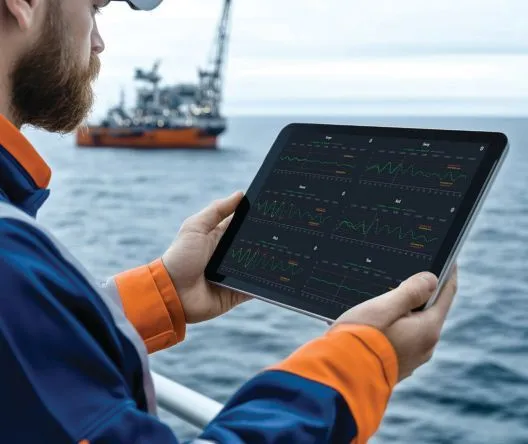
This capability allows operators to anticipate waves and vessel motion exceeding operating limits ahead of time, enabling better timing of critical operations such as crane lifts and heavy lifting. It can enhance safety and operability in high-risk activities like anchor-handling and ensure safer crew transfers during gangway operations, such as walk-to-work scenarios. Additionally, precise wave and motion predictions optimizes instrument deployment, including remotely operated vehicles (ROVs), and assistance with dynamic positioning (DP) operations.
VALIDATED RESULTS
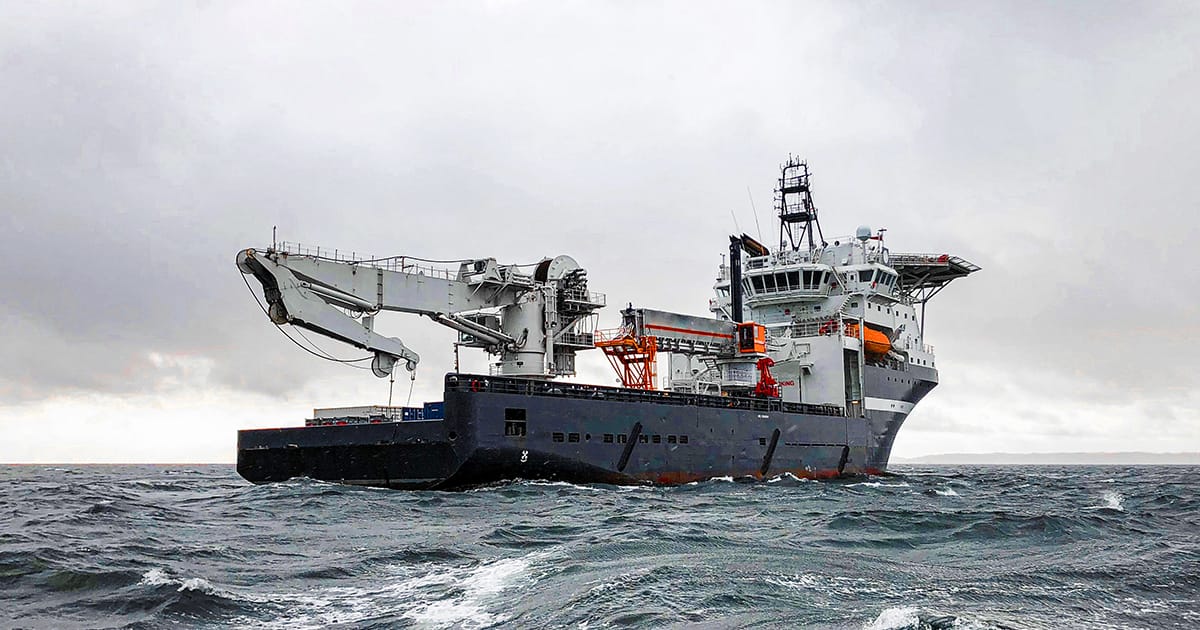
Data acquisition during the extensive development and testing phase was comprehensive, leveraging PredictifAI technology installed on DeepOcean’s Edda Freya, a construction vessel operating in the harsh North Sea. For Miros, it is always fundamental to validate the effectiveness of new technology under real-world conditions.
Key findings include:
- Strong correlation (0.85–0.95) between predicted and measured wave parameters
- Low root-mean-square (RMS) deviation, ensuring reliable predictions
- Stable accuracy for prediction times between 20 to 60 seconds, gradually decreasing up to 2 minutes
For different applications, the tool can be customized with specific radar models, sensor configurations, and operational thresholds. Likewise, it can be deployed in fixed locations for ocean surface height prediction without motion tracking. Furthermore, ongoing advancements in AI and machine learning allow for continuous improvements, making radar-based predictive technology a cornerstone for future offshore monitoring.
INSTANT REAL-TIME VERIFICATION
By seamlessly integrating AI with multiple radar sources, Miros has pioneered a system that dynamically adapts to ever-changing ocean conditions, enabling offshore personnel to make proactive, data-driven decisions.
The key to this advancement lies in PredictifAI, which applies AI with caution and purpose, combining measurement with prediction to ensure instant real-time verification of AI-supported prediction. This careful approach enhances the reliability and trustworthiness of predictive insights, making them immediately actionable in operational environments.
Successfully deployed on Edda Freya, this cutting-edge technology has undergone rigorous operational validation, incorporating valuable user feedback to constantly refine its capabilities. More than just an advancement, this marks the dawn of a new era in ocean monitoring—where AI-enhanced radar systems redefine how the maritime industry navigates risk and optimizes performance.
This feature appeared in ON&T Magazine’s 2025 May Edition, Oceanography & Remote Monitoring, to read more access the magazine here.