Panels targeted additive manufacturing to remedy steel shortages, integrating uncrewed systems to force multiply surveillance and deterrence efforts, and the adoption of AI and Machine Learning tools, alongside a range of other trending topics.
US NAVPLAN
The 2024 update to the US Naval Navigation Plan (NAVPLAN), which includes the overarching goal of achieving 80% surge readiness by 2027, was a cornerstone of the week’s agenda, with several speakers citing flashpoints in contested waters, such as tensions in the South China Sea, as fuel in a global maritime arms race.
However. NAVPLAN deliverables face a series of challenges: stalled production schedules, skilled labor shortages, supply chain constraints, and bureaucratic approval processes threaten progress. Now, military leaders are looking to industry partners for innovative ways to improve time-consuming vessel inspections and maintenance and streamline novel approaches to training and manning.
AI, MACHINE LEARNING, & AUTONOMY
While US governmental agencies have invested in the adoption of AI and ML, the private industrial base has significantly outpaced the public sector—a point of palatable frustration among audiences at SAS.
In a panel uniting technologists and acquisition program leaders, points were made to illuminate how AI could open new doors to ensure the availability and reliability of military assets. Services embracing AI, like those provided by Geko Robotics, can automate vessel repair and maintenance plans and optimize forecasting, thus reducing lead times, manpower, and assessment duration. With a steady rise in field-proven AI and ML applications comes trust, was the consensus.
INDUSTRY COLLABORATION
An update on the AUKUS Trilateral agreement—an ambitious, generational commitment between the US, the UK, and Australia to fortify undersea capabilities and deepen allied interoperability—touched on the status of Pillar I (Australia’s acquisition of nuclear power submarines) and Pillar II (removing cooperative barriers by uplifting innovation and manufacturing efforts between the democracies).
On the expo floor, HII set an example for AUKUS’ ability to remove barriers by presenting an additional five Australian companies with certificates upon the completion of their participation in HII-led supplier initiatives. The receipt of their individual Newport News Shipbuilding (NNS) identification numbers signifies that, upon full certification through the AUSSQ process, these companies are qualified to participate in the NNS supply chain in support of nuclear-powered submarine construction.
FORCE MULTIPLICATION
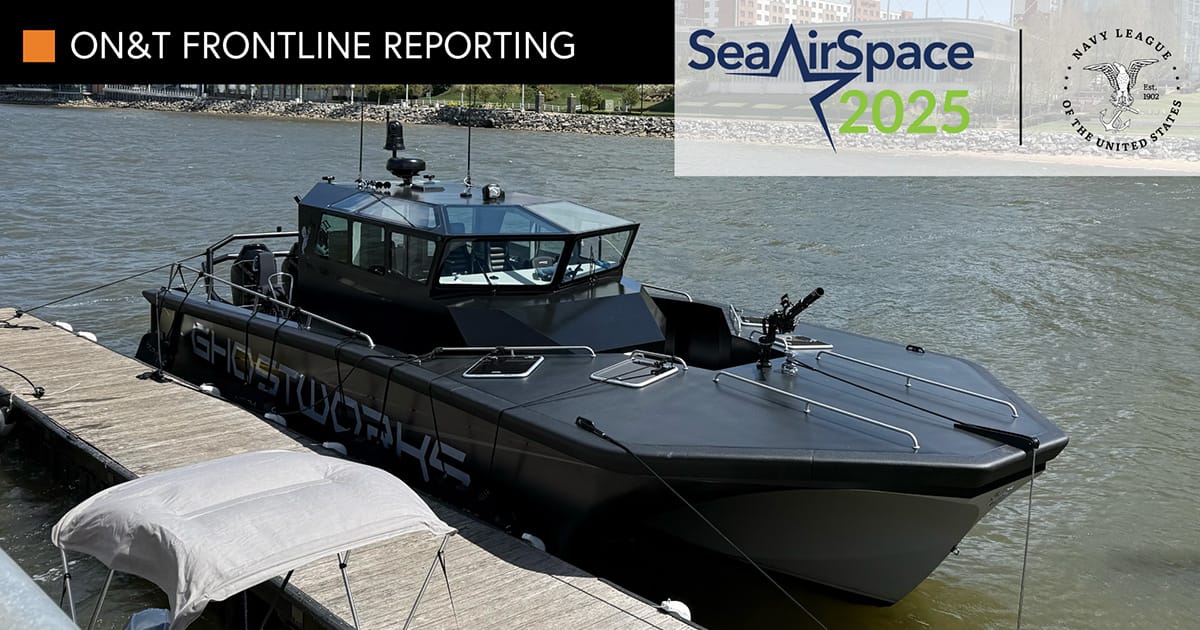
The age of unmanned systems integrations is here. Military decision-makers are looking to uncrewed systems to fill asset gaps, force multiply a war fighter’s efforts and decrease risk. With proof of concept achieved in real-world scenarios, including several exercises in the Red Sea, operators are turning to uncrewed systems to improve military domain awareness, enhance presence in contested waters, and champion innovative ways for replenishing forces with essential supplies, whether at sea or on shore.
As is customary, there were several new product launches and partnership announcements made at SAS, including the introduction of Anduril’s Copperhead AUVs, capable of not only search and res- cue, critical infrastructure inspection, and environmental monitoring but also the delivery of underwater firepower on demand to disable or destroy maritime threats.
While government officials expressed an interest in acquiring both uncrewed platforms and mission-as-a-service offerings, some US military decision-makers voice a preference for the latter by way of avoiding the additional maintenance and launch costs associated with operating a swarm of USVs/AUVs. This puts turnkey service operators like Kraken Robotics, Terradepth, and Saildrone at first-mover advantage.
ON THE WATER
The cold and blustering winds of National Harbor set the scene for real-world demos of uncrewed assets in less than hospitable conditions.
In collaboration with Red Cat Holdings, Ocean Power Technologies (OPT) displayed how an ecosystem of marine robotic systems—in this case, the pairing of an uncrewed aerial vehicle (UAV) with an uncrewed surface vehicle (USV)—can bring a new dimension to multidomain surveillance.
Saronic Technologies put their largest autonomous surface vessel (ASV), the 24’ Corsair, to the test. With a range of up to 1,000 nautical miles, a 1,000+ lb. payload capacity, and a top speed of 35+ knots, this ASV responds to the call for higher endurance mission capabilities. Also on display was Saronic Technologies’ Spyglass, a 6’ ASV built for remote domain awareness and tactical deployments in shallow waters.
Additional demonstrations, including those by Maritime Robotics, Ocean Aero, and Textron Systems, underlined the emerging utility of uncrewed platforms for a widening range of at-sea tasks.
Above all, Sea-Air-Space reaffirmed that advancing the ability of today’s naval war fighter demands an ongoing and successful dialogue between industry and government to action innovative, develop novel technologies, re-frame training methods, and ultimately bridge critical gaps in securing international peace and prosperity.
This spotlight appeared in ON&T Magazine’s 2025 May Edition, Oceanography & Remote Monitoring, to read more access the magazine here.