EvoLogics, a company with 25 years of experience in underwater acoustics, positioning, and robotics, is advancing through the shift toward networked robotic missions with a connected ecosystem of autonomous systems—the Sonobot 5 USV, the Quadroin AUV, and the Diver Communication System. Together, they are creating a scalable multi-domain network that unites surface, subsea, and human operations into one collaborative environment.
ACOUSTIC NETWORKING
Every element of this ecosystem is linked by EvoLogics’ acoustic communication technology, which serves as the operational backbone for underwater positioning, data transfers, and command exchange.
At the surface, a stationary USBL Buoy and/or a mobile Sonobot 5 USV with USBL act as acoustic gateways, maintaining a data link with submerged AUVs. The gateway is connected with the operator station over WiFi or long-range radio, and relays periodic GNSS fixes, status updates and commands between the surface and the underwater assets.
This acoustic network also extends to divers, equipped with EvoLogics’ Diver Communication System. By integrating into the same acoustic network as the robotic platforms, divers can receive mission data, updates on detected objects, and navigation guidance directly through their underwater display units. In real-time, supervisors can then redirect a diver team to inspect features discovered by autonomous vehicles, turning what was once a sequential workflow into an interactive operation.
BIONIC DESIGN MEETS AUTONOMY
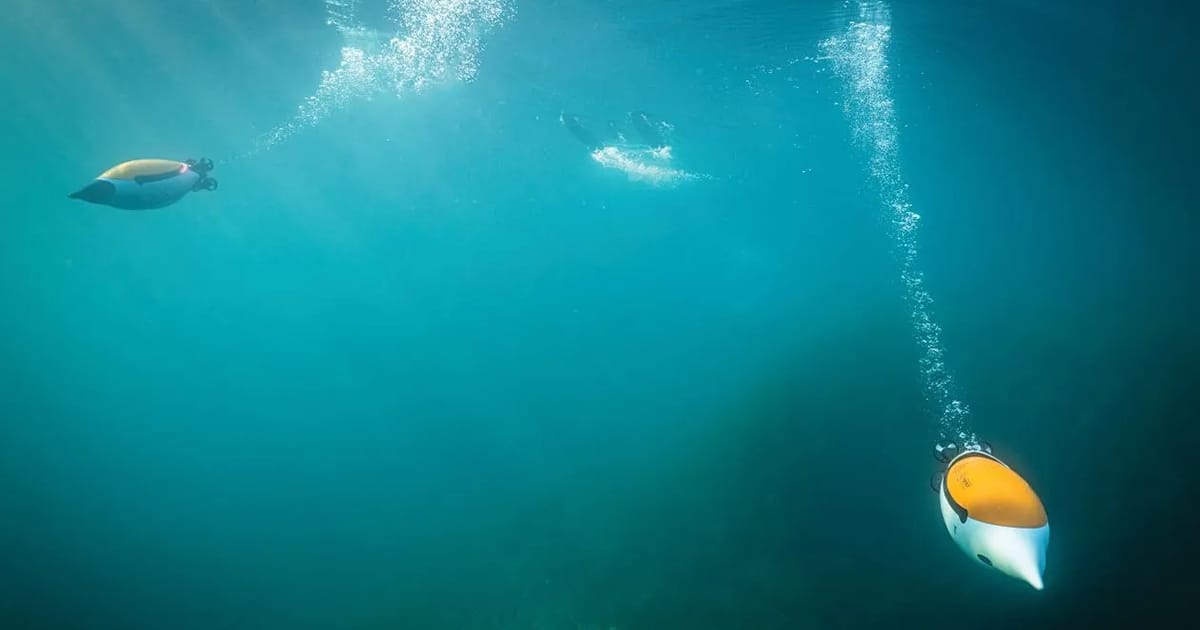
The Quadroin AUV combines hydrodynamic efficiency with onboard intelligence. Its penguin-inspired hull minimizes drag, allowing the vehicle to achieve speeds up to 10 knots while maintaining energy-efficient operation for missions lasting up to 12 hours.
The AUV carries a payload of instruments for imaging and analysis—a side-scan sonar, a downward-looking HD camera, and a dedicated AI module for object recognition and collision avoidance. The object recognition system processes raw sonar and video feeds onboard the vehicle, automatically detecting and classifying submerged objects of interest.
EvoLogics)
Through the acoustic link, the Quadroin transmits status updates and object detections, including their accurate locations, to the surface gateway, which then forwards them to both the control station and divers in the field. This creates a real-time loop of detection, communication, and verification that accelerates underwater investigations.
SURFACE HUB FOR SUBSEA AWARENESS
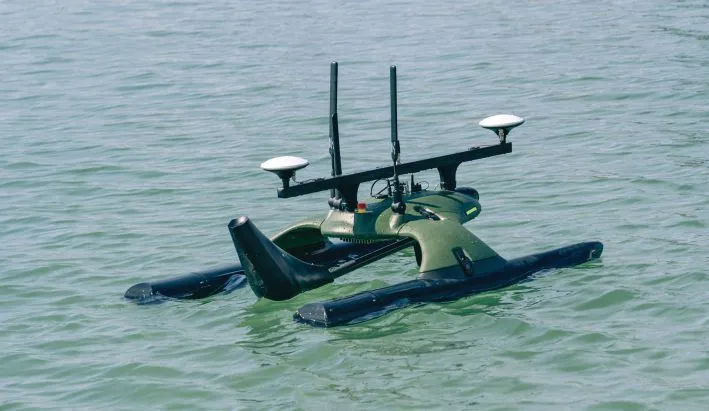
The EvoLogics Sonobot 5 is a compact USV for autonomous hydrographic surveys, inspections, and environmental monitoring. Portable and easy to deploy by a single operator, it supports a range of sonar, camera, and radio communication payloads, with optional AI-based modules for object recognition and collision avoidance.
In a cooperative multi-modal setup, Sonobot 5 units can take on different roles. Configured with advanced sonar systems, the Sonobot performs bathymetric mapping and object detection. A Sonobot equipped with a USBL antenna arm serves as a mobile acoustic gateway, linking AUVs, divers, and shore control through the underwater acoustic network and the radio link above the water, and following the subsea nodes to ensure they are always within the acoustic range.
For extensive, large-scale operations, multiple USBL-Sonobots and stationary USBL buoys can be linked together into a hybrid surface gateway grid, enhancing positioning accuracy and extending communication coverage.
EXPANDING CAPABILITIES WITH AI
Running on embedded hardware, EvoLogics’ AI modules process high-volume sonar and camera data directly on the vehicles, providing object detection, recognition, and obstacle avoidance.
AI-based object recognition acts as the catalyst that makes the multi-vehicle network more responsive and efficient.
Available for both Sonobot 5 USV and the Quadroin AUV, the Object Recognition (OR) system uses neural networks trained to identify key subsea features, such as unexploded ordnance, wrecks, ghost nets, coral formations, or archaeological sites, without operator intervention. Over acoustics, results are transmitted to the surface gateway and other nodes in the network, enabling coordinated reactions from vehicles and divers alike.
A supporting OR cloud-based ecosystem allows users to upload datasets, request AI training for new object classes, and receive software updates, ensuring the OR system remains adaptable to evolving operational needs.
INTEGRATING HUMAN EXPERTISE
The inclusion of divers within the acoustic framework adds an invaluable human dimension. While AUVs and USVs handle autonomous data collection and mapping, divers can perform immediate, context- driven inspections guided by updates from the vehicles.
For example, if the Quadroin’s AI module identifies a potential UXO or wreck feature, the system transmits the detection and coordinates to the diver’s display. Divers can then be directed to approach the site to verify and document the finding, while dive supervisors monitor the progress in real time.
This connected workflow not only saves time but also enhances diver safety and mission efficiency, ensuring that human expertise is applied precisely where it is needed most.
OPERATIONAL SYNERGY
This hybrid approach—combining autonomous detection, acoustic networking, and human oversight—can offer practical advantages across numerous fields:
- Infrastructure inspection: Joint sonar and camera surveys to monitor critical offshore installations.
- Mine countermeasures and UXO detection: AI-assisted identification with diver verification.
- Environmental monitoring: Simultaneous surface and subsurface surveys for habitat mapping, pollution tracking, locating ghost nets and other abandoned gear.
- Search and recovery: Rapid localization of assets with real-time diver verification.
- Scientific research: Coordinated data collection with multiple vehicles and human teams.
In each case, the connected network enables faster, safer, data-driven underwater operations.
INTELLIGENCE FOR THE FUTURE
By linking autonomous vehicles and human operators through a shared acoustic data network, EvoLogics is advancing the fundamental shift in how data informs action underwater. The traditional, sequential workflow—where data is collected, retrieved, analyzed, and only then acted upon—is being replaced by a real-time, adaptive loop.
Networking the Sonobot 5, Quadroin, and Diver Communication System exemplifies an emerging operational model where connectivity defines intelligence. Cooperative frameworks are a significant evolutionary step for subsea technologies, and EvoLogics continues to drive the innovation toward a unified system awareness. Surface, subsea, and human domains functioning as one cohesive entity is the key to achieving the scale, safety, and efficiency demanded by the next generation of complex underwater operations.
This feature appeared in ON&T Magazine’s 2026 January Special Edition, The Future of Ocean Technology Vol. 6, to read more access the magazine here.