DEFENSE INITIATIVES
Initiatives like the US Department of Defense’s Replicator program, launched in August 2023, epitomize the sense of urgency to test, integrate, and scale the latest unmanned assets—by land, air, and, in the case of USVs, sea—into an increasingly autonomous military theater.
The initial goal of the Replicator program was always ambitious: to field “thousands” of attritable autonomous systems, relatively low-cost and expendable assets when compared to traditional hardware, by August 2025. While the exact number of systems successfully deployed remains classified information, all indications suggest that the targets were missed by some measure.
Back in September 2025, presumably in direct response to this shortcoming, the current administration announced a shake-up to the Replicator program, transitioning responsibilities from the Defense Innovation Unit to a newly formed Defense
Autonomous Warfare Group (DAWG). There are further draft proposals to bring command for this program—and reportedly 65 others—under the office of a single acquisition professional—the Portfolio Acquisition Executive Robotic Autonomous System (PAE RAS).
Suffice to say, as far as the US armed forces go, it is a dynamic situation. Speed to delivery appears to be the administration’s governing principle now, with ocean tech developers from the US defense industrial landscape—the likes of Anduril, Saronic, HII, and others— all competing for lucrative Pentagon contracts to define, test, and deliver battle-ready USVs at scale.
DESIGN CONSIDERATIONS
The business case for incorporating USVs as part of any future “hybrid fleet” is unquestionable—USVs can be produced at a fraction of the time and cost needed to build traditional naval vessels, while substituting active personnel for proven tech in active conflict zones. However, defining the precise application of any one class of USV is less clear-cut.
There is a tendency for developers to label their USVs as “multi-purpose”; by virtue of their modularity, they afford operators flexibility and versatility in the field. But does this translate into effectiveness on the battlefield? What exactly does the USV need to do in the heat of the moment to optimize its operational advantage and, given the pace of innovation feeding these platforms, what could it do in the not-so-distant future to stretch this tactical superiority further when it comes to range and tasking? Of late, we have seen the successful use of compact kamikaze-style USVs by Ukraine’s targeting of Russia’s so-called shadow fleet in the Black Sea, but this belies the potential scope of influence that USVs can have on remote operations.
BUILT TO HANDLE THE FUTURE
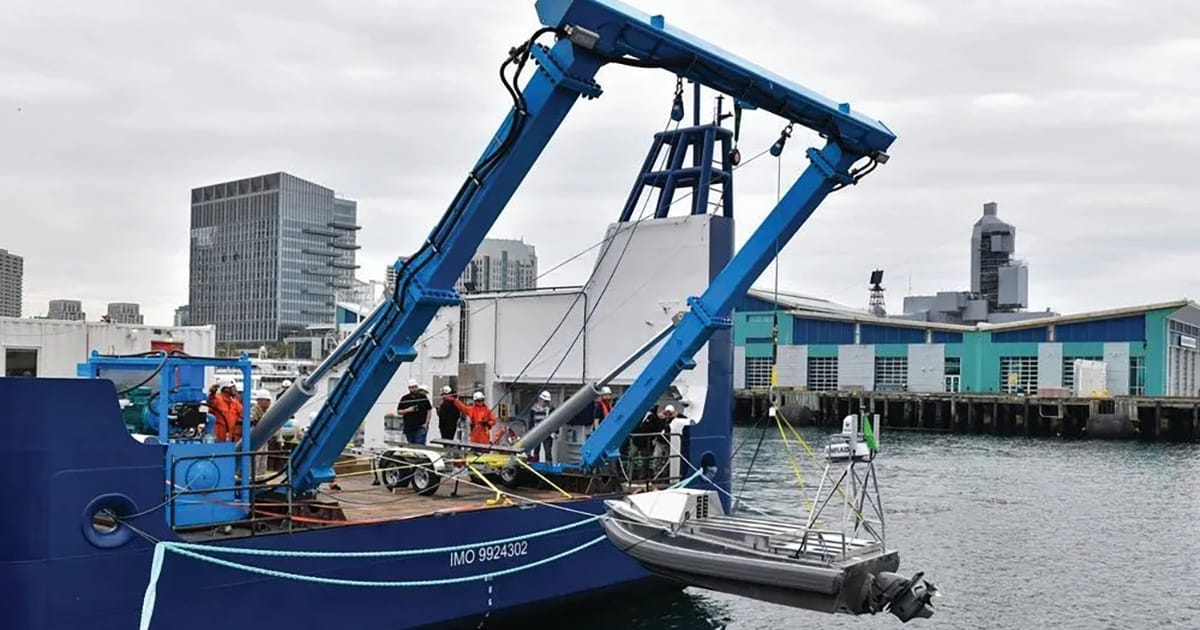
Much of future USV design and development will hinge, quite literally and figuratively, on the deck systems engineered to handle them, which refers not only to the hardware needed to deploy and retrieve the USVs themselves, but also their onboard automated equipment designed to launch and recover their carefully calibrated ancillary assets and payloads.
This is where outfits like Okeanus can make a real difference from the outset. We have been building robust and reliable handling systems specifically designed to expand the role of USVs for more than 20 years, a legacy backed by more than 45 years of producing industry-leading deck equipment for larger, manned vessels bound for the toughest offshore assignments.
We know that while USV concepts will always vary in form and factor, the key to rapidly scaling the adoption of these concepts is to subject them to available, triedand- tested manufacturing expertise and processes. That includes relying on equipment specialists to not only realize their vision but also enhance it as appropriate.
In recent years, we have developed several new heavy lift deck systems—including our 20-ton A-Frame—to safely and efficiently launch and recover USVs in challenging marine environments. While a degree of customization always comes as standard, modular arrangements that are somewhat USV-agnostic are beneficial.
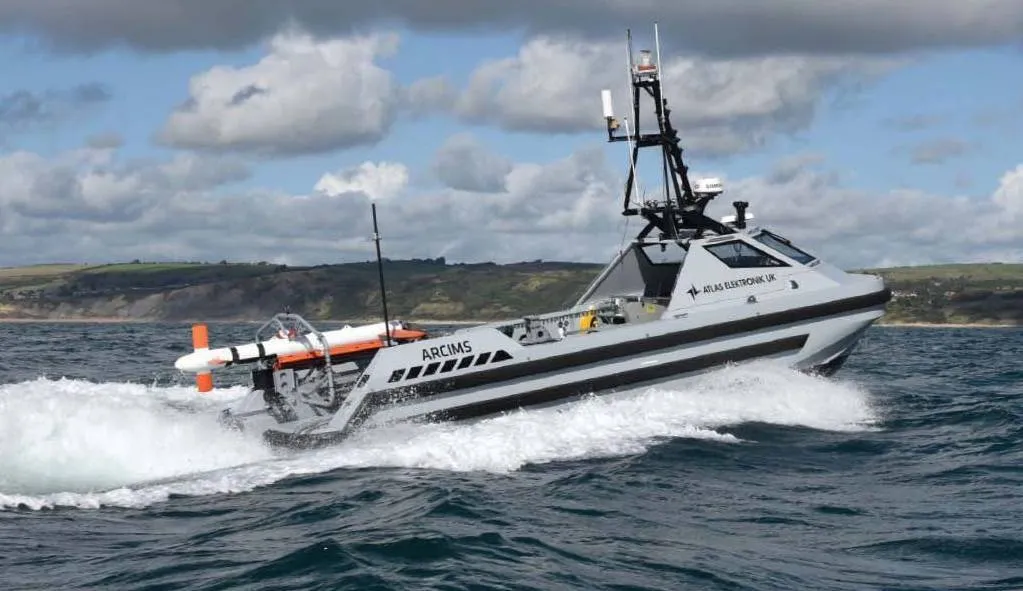
The use of smaller USVs (7–12 m in length) as force multipliers is central to the US Navy’s plan to cost-effectively broaden surveillance operations, whether above the waterline (e.g., contested waters, border patrol, etc.) or below (e.g., tracking submarines, mine countermeasures, etc.). Without the right configuration to reliably launch and retrieve USVs in unpredictable situations, these swarm units are tactically useless. Furthermore, these USVs are constantly modified to stretch mission capabilities in terms of endurance and execution; as the mission expands, so does the scope of handling requirements.
EXPANDING AUTONOMY
When it comes to implementing a mission- ready autonomous LARS for a USV, with which it can automatically deploy and retrieve critical payloads, there is rarely a COTS, plug-in solution. However, Okeanus is able to adapt any number of our proven set-ups or, as necessary, take a “build-to-print” approach. We partner with clients early and help define their in-field needs—today and tomorrow. We can facilitate rapid prototype design and fabrication from our state-of-the-art engineering facilities in Houston, TX, and Stuart, FL, where we also have access to a large test lake and tank.
Through our long-standing working relationships with major aerospace and defense contractors around the world, we have incorporated some of these very mission-specific USV innovations into our standard commercial portfolio, such as with our MCM-015 winch for mine hunting USVs. There is no doubt that future USV technology will redefine naval warfare if its potential is handled correctly.
This feature appeared in ON&T Magazine’s 2026 January Special Edition, The Future of Ocean Technology Vol. 6, to read more access the magazine here.