
Eelume AS, a Norwegian marine robotics company, has been at the forefront of this shift in design philosophy. Eelume’s journey began back in 2015 at the Norwegian University of Science and Technology in Trondheim, where cybernetics students turned to biomimicry to conceive and develop a snake-like robot that could serve as a mobile firehose. This idea evolved into a modular eel-inspired underwater vehicle for subsea inspection applications, leading to the development of the M-Series and eventually the S-Series models of AUV.
ALL-TERRAIN AUV CAPABILITIES
The Eelume S-Series All-Terrain AUVs are specifically engineered to map and operate close to challenging underwater topographies without the constraints of traditional underwater exploration. They provide a unique ability to capture 3D photogrammetry and photomosaics of complex underwater environments and structures, as well as class-leading photos, seabed bathymetry, and imagery.
Unlike any other AUV in the market, Eelume All-Terrain AUVs have 360 degrees of freedom in roll and pitch. They address conventional applications of AUVs and are poised to revolutionize new applications such as close-proximity imaging, photomosaic generation of marine environments, photogrammetry, bathymetric mapping of intricate underwater terrain and structures, under-ice mapping, stop-and-inspect functionalities, and more.
A DESIGN INSPIRED BY NATURE
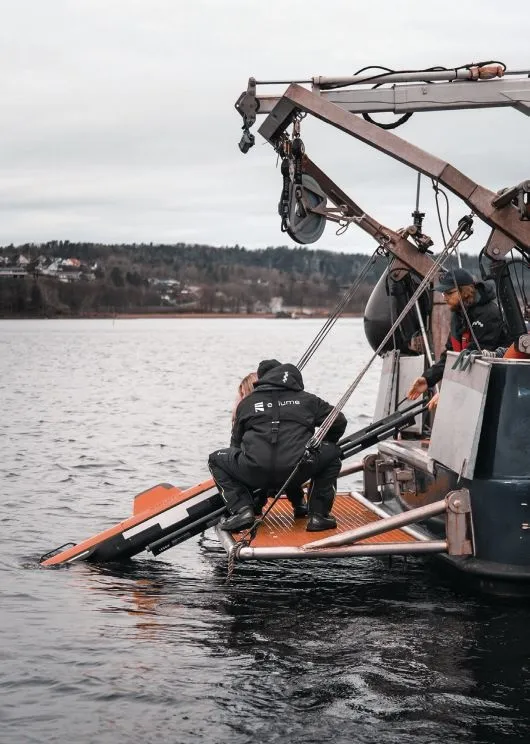
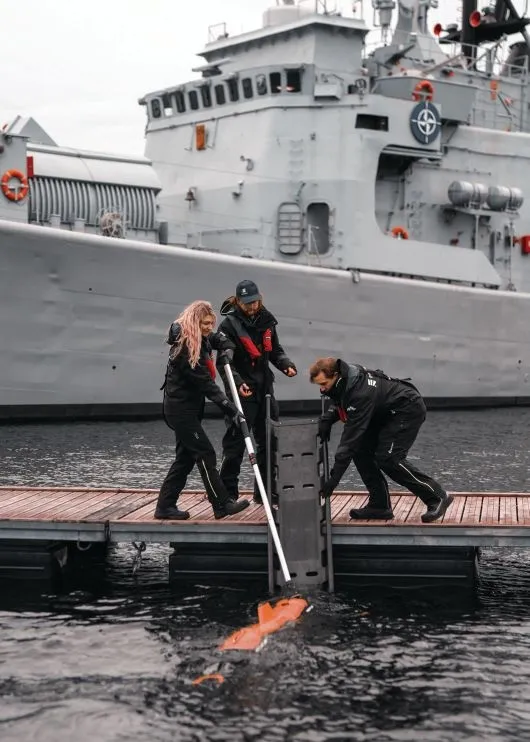
The flagship Eelume-S All-Terrain AUV looks like a bonnethead shark. It has a dorsal fin and twin tail propellers. The tail is articulated, giving the drone excellent stability and control. It can pitch and roll, or hover at zero speed. The standard configuration is 2.4 to 3 m in length, 30 cm wide, 20 cm high, and weighs 45 to 90 kg. Two people can easily carry it, making it very portable and quick to deploy.
The Eelume S-series is payload agnostic, with options including synthetic aperture sonar, multi-aperture sonar, multi-beam sonar, magnetometer, hyperspectral imager, subbottom profiler, chemical sensors, hydrophones, and echo-sounders. Recent models have been equipped with the VOYIS Observer camera for inspecting underwater infrastructure such as wall structures.
The drone’s inertial navigation system enables the controllability and precision required for three-dimensional photogrammetry. The system, along with the articulating tail, ensures the drone’s path and positioning stay true to the mission. By changing the weight balance, the drone can move upside down, sideways, and vertically, capturing detailed images of underwater structures.
In murkier water, the drone can be equipped with a multi-aperture or multi-beam sonar, providing depth vision and bathymetry. The history of the robot is a success story for the public-private model of research and development, with the seed idea germinating at the Norwegian University of Science and Technology.
The prototypes could crawl up vertically and into confined spaces. An offshore oil and gas developer later approached the engineering team with the challenge of transforming the robot into a modular serpent-style vehicle capable of safely accessing confined spaces around subsea infrastructure in deep waters. This led to the development of the M-Series designs and eventually the S-Series models.
A MODULAR APPROACH TO MISSION VERSATILITY
Eelume’s M-Series robotic platform is made of tubular modules that are integrated and can be replaced or removed depending on specific needs and the application. One module could be a battery module, a thruster module, a light module, a lighted camera, or a sonar. A module could also be a gripping arm or a tool. The design is very agile and versatile.
The Eelume-M has already achieved a certain degree of notoriety following its star cameo role in The Burning Sea (2021), a Norwegian disaster movie portraying the dramatic aftermath of a sinking oil platform off Norway’s coast—amid the chaos and confusion, the
Eelume-M is launched to successfully locate and rescue workers trapped in the underwater carnage. While this outing was fictional in nature, it perfectly depicts how the unique motorized articulation modules can navigate hazardous waters and access confined spaces that would prove inaccessible to conventional AUVs.
The vehicle’s adaptable design and payload options enable operators to ensure that the platform is primed and equipped for any specific mission profile. The Eelume M-Series has been developed with subsea residency in mind; that is, as an AUV that can spend prolonged periods in the field for ongoing monitoring and inspection campaigns around major subsea installations, such as offshore rigs, and therefore offers the oil and gas industry a more sustainable, safer, and cost-effective survey and intervention solution.
Whether the need is to navigate coastal shallows or safely inspect remoter targets in greater water depths, increased vehicle stability and sensor suite flexibility are what our clients are demanding. This makes Eelume’s expanding portfolio of AUVs ideally suited to a range of applications, from underwater security, mapping, and aquaculture to civil engineering and archaeology.
This feature appeared in ON&T Magazine’s 2026 February Edition, Exploring the Deep, to read more access the magazine here.