ADAPTABILITY IN THE FIELD
The company’s philosophy is simple but revolutionary: the most effective tools aren’t necessarily the largest; they’re the ones that can be deployed in minutes rather than days, can operate autonomously in denied environments, and can adapt to any mission.
RTsys’ systems are lightweight, portable, and acoustically intelligent, designed to give operators an edge in the most demanding conditions. Whether it’s clearing a mine field in a contested strait, training against a realistic submarine target, or conducting covert reconnaissance in enemy waters, RTsys’ technology is changing how modern militaries approach underwater warfare.
MANNED-UNMANNED TEAMING
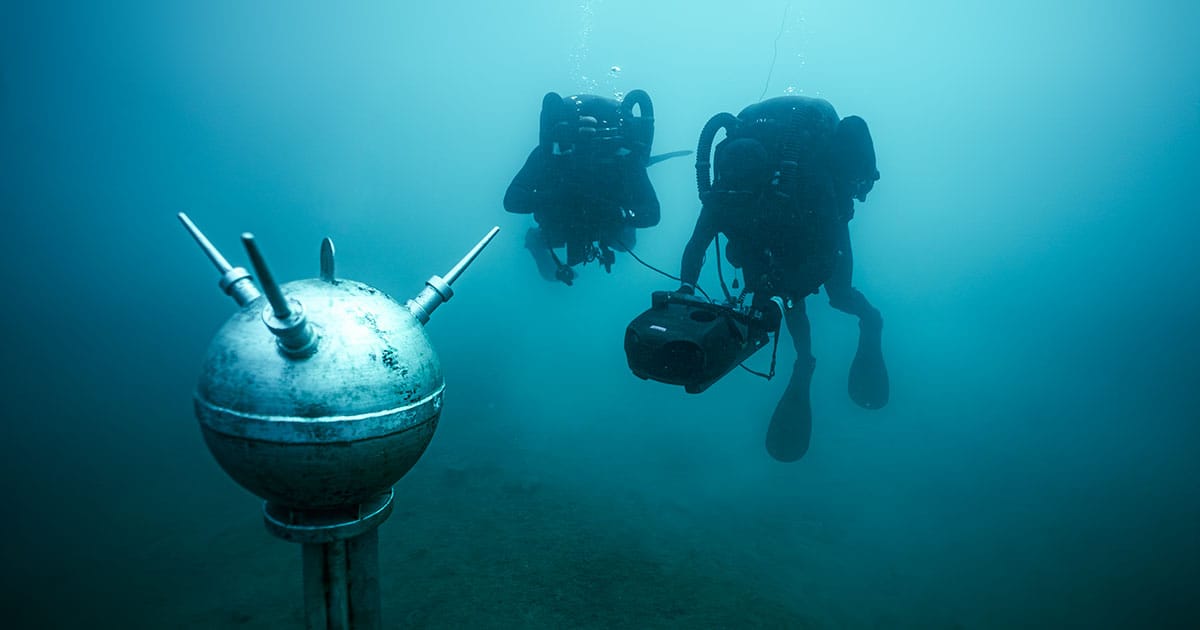
At the core of this transformation is the concept of manned-unmanned teaming (MUM-T), where human operators work alongside autonomous systems to multiply their effectiveness. A diver equipped with a SonaDive handheld sonar can navigate zero-visibility waters with confidence. A COMET-MCM autonomous underwater vehicle can scan an entire minefield in hours, not weeks. A NemoSens micro-AUV can slip into enemy waters undetected, gathering critical intelligence without risking lives. And when it comes time to neutralize a threat, the SonaBlow acoustic fi ring system can eliminate targets without wiring system, reducing collateral damage and keeping operators safe. These aren’t just tools: they’re force multipliers that redefine what’s possible in modern naval operations.
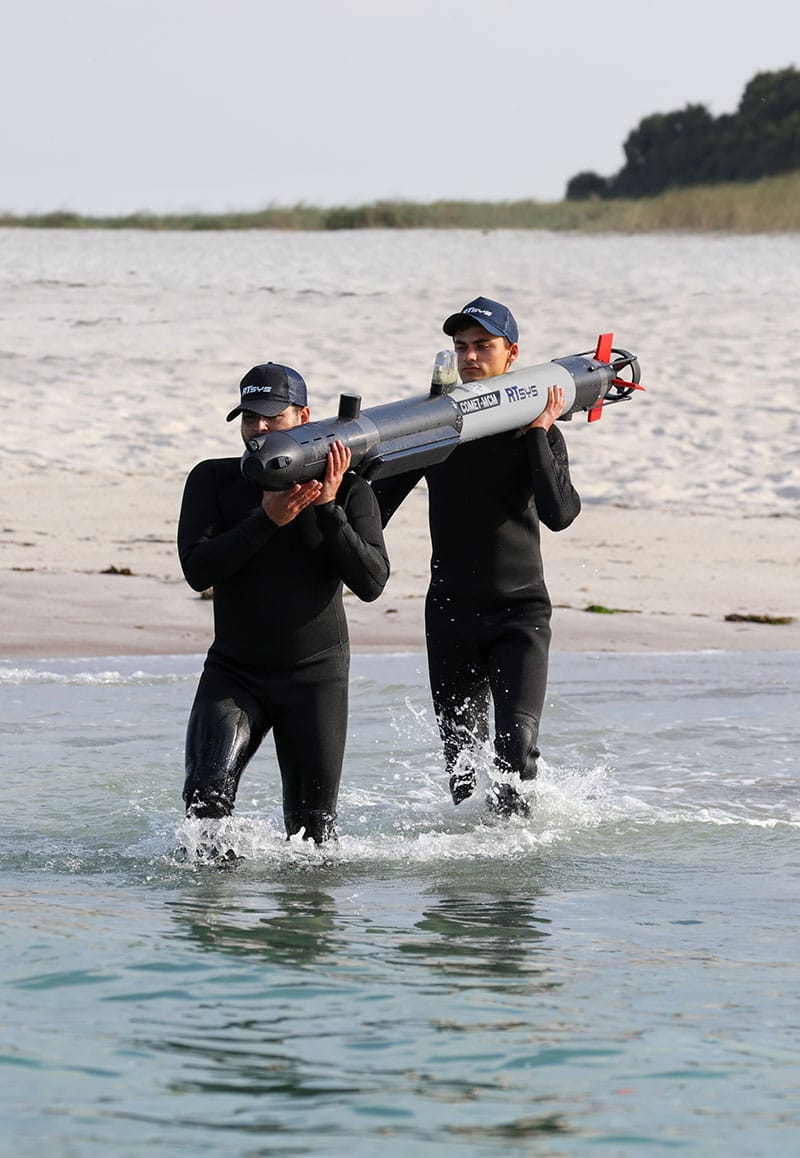 COMET-MCM launch from shore (Credit: RTsys)
SAFE & EFFICIENT MCM
The most dramatic example of this shift is in mine countermeasures. Traditional mine-hunting is a slow, resource-intensive process. A minehunter ship might take weeks to clear a single channel, exposing itself to enemy fi re while requiring dozens of sailors to operate.
RTsys’ approach flips this model entirely. The COMET-MCM AUV can be launched from a small boat or from shore, then left to operate autonomously. It doesn’t need an extensive crew, doesn’t require constant supervision, and can cover more ground in a single mission than a manned ship could in a week. When it detects a mine, it distinguishes clearly between real threats and false alarms with unprecedented accuracy thanks to its high-performance side scan sonar (SSS). And if neutralization is required, the Sonablow system can handle it without putting divers in harm’s way.
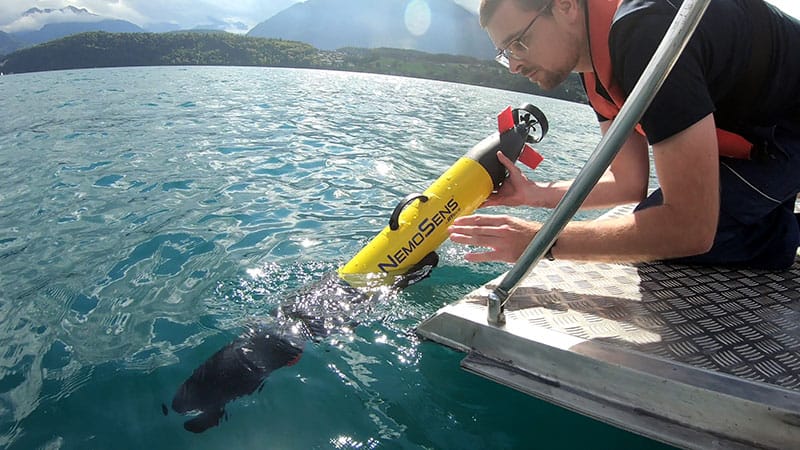 NEMOSENS micro AUV (Credit: RTsys)
COST-EFFECTIVE ASW
Anti-submarine warfare (ASW) presents another area where RTsys is making a significant impact. Training against real submarines is not only expensive and logistically complex but also limited by the availability of these high-value assets. The SEMA ASW training target addresses these challenges by providing a realistic, autonomous solution that has already proven its reliability in operational environments. As the only recoverable target on the market with demonstrated operational success, SEMA stands apart from other systems. Its proven track record has led to its adoption by more than a dozen navies worldwide and NATO first choice where it is actively used for ASW training and testing. SEMA can perform evasive maneuvers up to 15 knots speed, emit authentic acoustic signatures that mimic real SSK behavior, and even be used in firing exercises without risking real assets. For navies looking to sharpen their ASW capabilities efficiently and cost-effectively, SEMA represents a paradigm shift in training methodology.
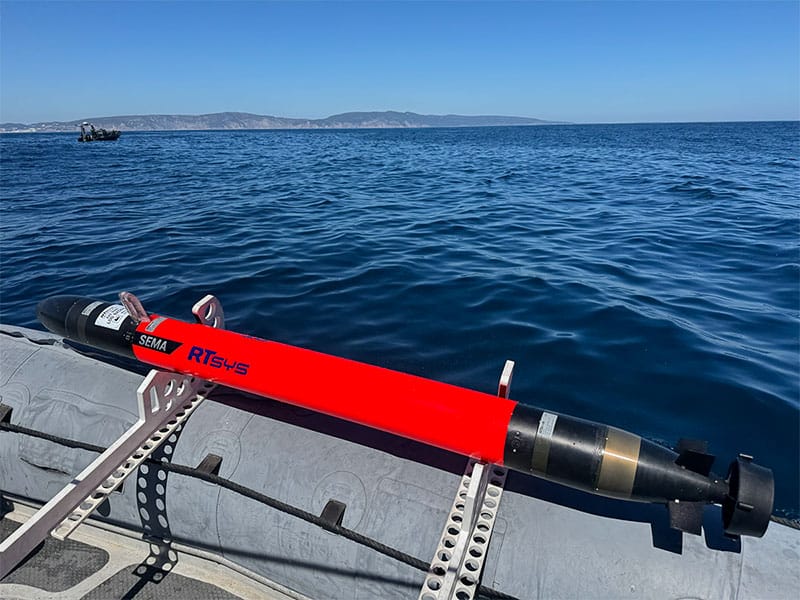 SEMA recoverable target for ASW training. (Credit: RTsys)
ENGINEERED VERSATILITY
Perhaps the most compelling aspect of RTsys’ technology is its versatility. These systems aren’t designed for a single purpose; they’re built to adapt. A NemoSens micro-AUV can conduct rapid environmental assessment one day and covert reconnaissance the next. A COMET-MCM can be reconfigured with different sensors depending on the mission requirements. Even the SonaDive handheld sonar can be mounted on an unmanned vehicle, transforming it into a force multiplier for larger operations, including manned alternatives when requested. This modularity means that naval forces can achieve more with less, deploying the same systems across multiple missions instead of investing in specialized platforms for each task.
The implications of this shift are profound. In an era where conflicts are increasingly fought in contested littorals and denied environments, the ability to operate quickly, quietly, and autonomously provides a decisive advantage. RTsys’ systems allow navies to project power without exposing themselves to unnecessary risk. They enable special forces to conduct missions with a level of flexibility that was unthinkable just a decade ago.
This isn’t just about technology; it’s about reimagining how wars are fought. The advantage will go to operators able to adapt the quickest to the evolving realities of maritime warfare. RTsys Underwater Technologies is leading that transformation. The silent revolution has begun, and it’s happening beneath the waves.
This feature appeared in ON&T Magazine’s 2026 March Edition, Unmanned Naval Defense, to read more access the magazine here.