

We had come to discover the final resting place of the SS Henry Steinbrenner, a 130 m (L) x 15 m (W) x 8.5 m (D) dry bulk freighter constructed to transport iron ore, coal, and grain across the Great Lakes in the early 1900s. She sank in May 1953 when her hatches failed during a storm on Lake Superior. Post initial news headlines, the story of the Steinbrenner —one of grainy black and white photos and blurry anecdotes—remained something of a mystery. But now, pending her discovery, a new chapter of exploration could begin.
Technology as the Enabler
Not long ago, an expedition like this would have been the preserve of well-funded teams, prestigious universities, and grand institutions. But there was no crewed research vessel or public investment here. Just a small team and a purpose-built ROV assembled just weeks earlier. As a testament to just how far the ocean tech industry has come in recent years, increasing access to advanced marine imaging technologies has shifted the boundary between professional and amateur naval archaeology. Today, compact commercial imaging sonars and subsea positioning systems are enabling even selfproclaimed explorers to attempt what was previously unthinkable.
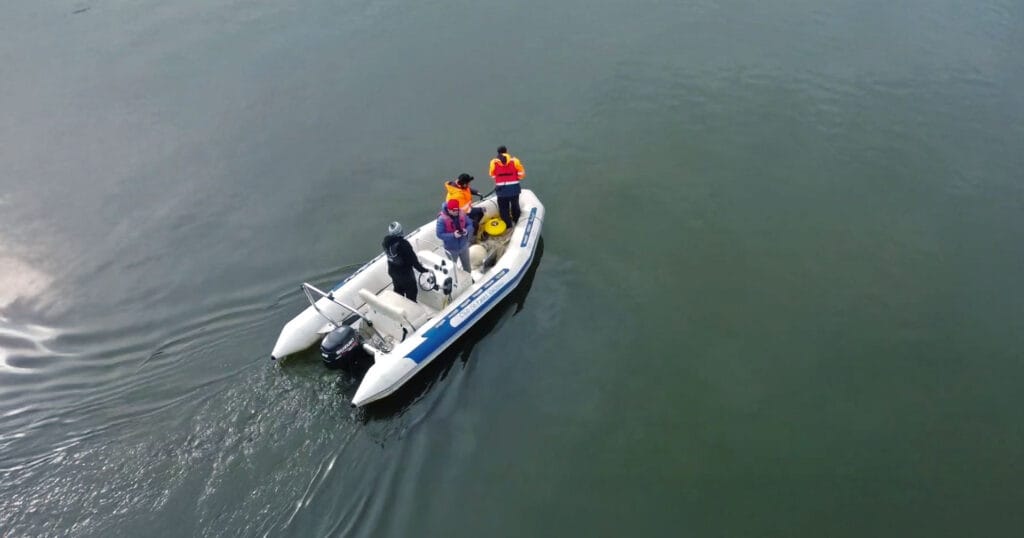
Our vessel for this mission, a 52-foot Vagabond Staysail Schooner, was operating significantly outside of its usual comfort zone, and it became unclear whether she would be able to hold position over the wreck while contending with Lake Superior’s notoriously violent gusts. We pressed on and set sail toward the approximate coordinates of the potential wreck site, just South of Isle Royale. With ideal weather conditions, we deployed the ROV. Who knew naval archeological discovery could be this straightforward and procedural…
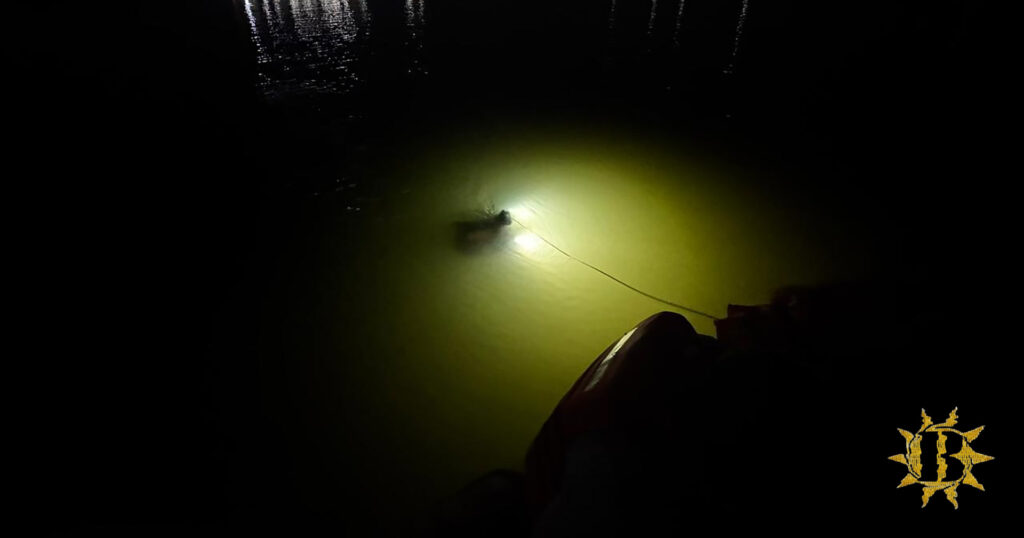
Quickly, the sonar picked up the Steinbrenner, and the ROV descent was smooth. On the surface, Captain Gordy held position steady with quiet precision while 1,000 feet of tether unspooled into the murky depths. Everything was performing exactly as expected—just like it had done in the test pool. Was all this down to meticulous planning and execution, or was it too good to be true?
Technology made the mission scope possible, but it was the application of that technology and the decisions, adjustments, and the persistence that made it successful.
Nature as the Leveler
At around 700 feet, the lake stopped cooperating. The tether, which had floated obediently in shallow tests, began to behave differently under pressure. Air bubbles compressed, and buoyancy vanished. What had been a controlled line became a sinking net. Within moments, it collapsed across the wreck’s debris field. The ROV was stuck in seven or eight places across the jagged steel wreckage that was scattered like broken bones across the lakebed.
The video from below was disorienting—metal edges, darkness, and the dawning realization that the mission might be in trouble. This is where technology reaches its operational limit, and human judgment must intervene.
In hindsight, it is relatively easy to critique what happened; we were unable to manage the tether from the surface, failing to account for how drastically depth would change its behavior. These are clear lessons learned after the fact, but in the moment, what mattered was response.
Switch to Manual
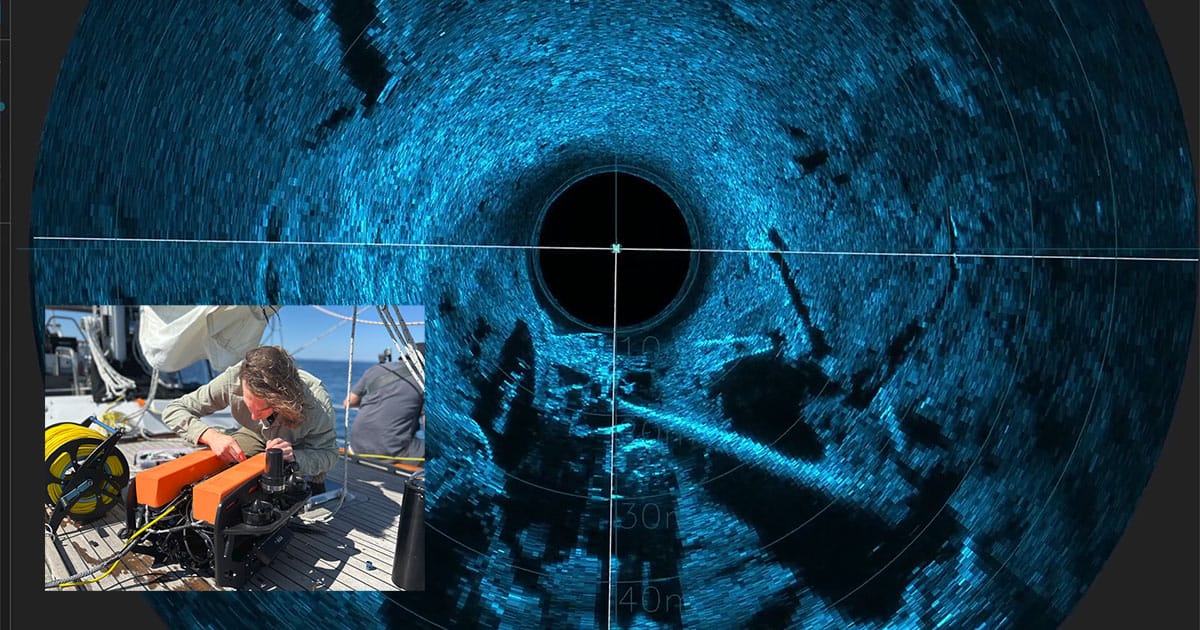
With no autonomous system to save us, no “Return to Home” button to activate, the outcome depended entirely on the pilot operating what looked like a standard gaming controller. Multiple data views provided the input: sonar on one side, live video on the other, and a mental map forming in real time. Slowly and deliberately, the ROV was worked free from the mangled wreckage.
Not in one move but many, each snag was carefully undone. Panic or sudden inputs would have only worsened visibility and burned up our limited battery capacity. What was needed was just patience under pressure. It took time, but eventually the tether drifted free. We pulled it to the surface, not in triumph, but in relief. Having narrowly recovered our vehicle, we paused to recalibrate and consider our options.
By now, our operational window was closing; it was mid-afternoon, and the wind was building. The return journey to Eagle Harbor would take four hours, and the lake was beginning to remind us of who was in charge. We could have stopped there and chalked it up as a near miss—a learning experience. Instead, we went again.
Meeting the Moment
This is when the real transformation happened, thanks to our access to the right tools and a growing confidence in our ability to adapt to and with them. Adjustments were made and lessons applied immediately. The second descent was a refinement upon the first.
Guided by sonar and the trajectory of the previous dive, the ROV dropped cleanly onto the wreck, and this time it worked.
What we captured was not cinematic in the traditional sense; shipwrecks at that depth rarely are. There were no sweeping silhouettes, only debris fields, scattered remnants, and fragments of a larger story. But when paired with sonar imaging scans layered against live video, a different kind of picture emerged.
With each new shot or sonar scan, a map was formed, and a narrative was constructed from data rather than speculation. The right technology was now transforming what was achievable and expanding the degree of knowledge being gained.
The real lesson is that access to technology does not remove challenges, but it does change their nature. The barriers are no longer purely financial. They are operational, practical, and solvable. Can you adapt when your assumptions fail? Can you interpret multiple streams of information under pressure? Can you stay calm when the margin for error collapses?
Technology made the mission scope possible, but it was the application of that technology and the decisions, adjustments, and persistence that made it successful.
As we turned the boat back toward Eagle Harbor, we had a moment of clarity: The tools are better than they have ever been, but they still depend on us to master them.
The full adventure will be documented on Ian Grant’s Culture Quest on PBS, with a scheduled broadcast date of November 1, 2026. ceruleansonar.com