Work class ROVs remain fundamental to drilling operations, supporting activities ranging from inspection and intervention to critical blowout preventer (BOP) functions. Operational efficiency of drilling campaigns continues to be a primary driver in overall project cost, demanding flexible ROV and tooling solutions that are available subsea throughout multiple stages of a campaign.
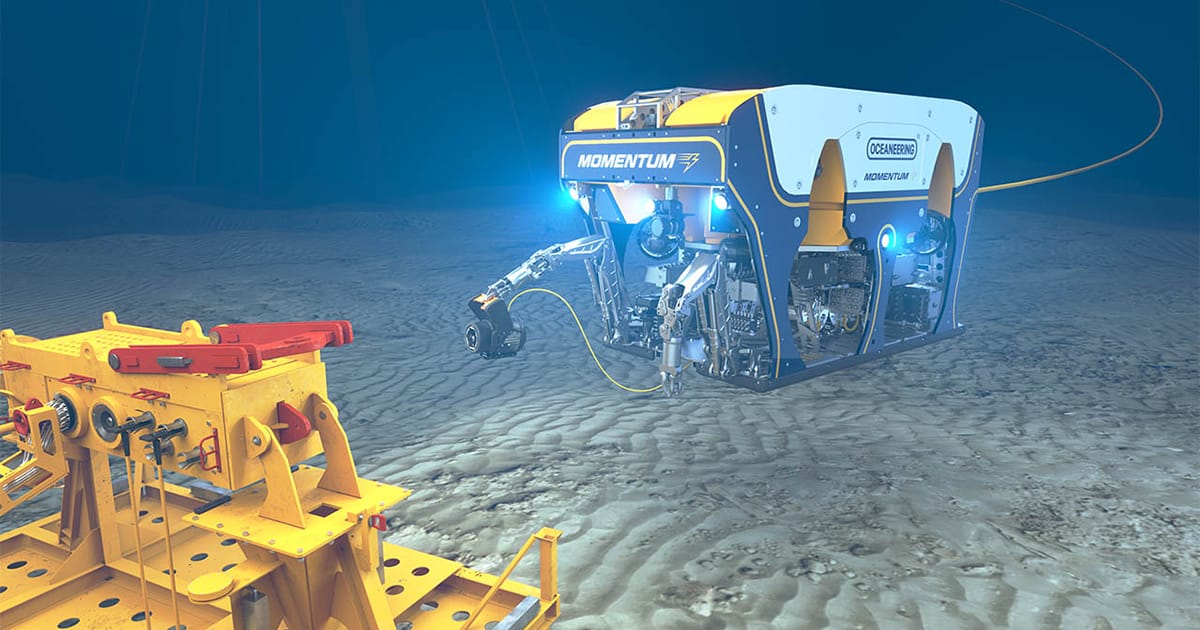
One of the most significant developments is the introduction of electric propulsion architectures, designed to improve reliability, reduce maintenance requirements, and enable extended subsea residency. For drilling support applications, this evolution introduces new opportunities. It also requires careful consideration of tooling integration and high-demand intervention tasks.
Reliability & Residency
A key requirement in modern drill support operations is system availability. Hydraulic work class ROVs have long demonstrated reliable performance across a wide range of subsea applications. As operators pursue longer-duration campaigns, greater emphasis is being placed on reducing maintenance frequency and improving operational continuity. In this context, electric propulsion architectures introduce an alternative approach, reducing dependence on pressurized fluid systems, simplifying subsea systems, and enabling isolation of components during operations.
This shift supports extended subsea residency, with systems designed to operate for up to 30 days without routine recovery or maintenance intervention. For drilling operations, this translates into fewer disruptions, improved rig utilization, and more consistent execution of subsea work scopes across longer campaigns. For electric work class ROVs to deliver value in drilling environments, however, propulsion is only part of the equation. Integration with intervention tooling, and the ability to execute high demand work scopes, remains equally critical.
Tooling for Multi-Scope Operations
Drill support activities require the ability to transition between inspection, manipulation, and intervention tasks while remaining subsea throughout a campaign. To enable this flexibility, increasing focus has been placed on standardized, plug-and-play architectures that allow tools to be exchanged subsea.
Systems, such as the Omnio™ subsea tooling system, provide a consistent mechanical, power, and communications interface between the ROV and a broad range of tools. This enables subsea tool exchange without recovery, supporting extended campaign residency while reducing downtime associated with intervention at the surface. The system’s electromechanical interface also eliminates the deleterious effect of seawater ingress into and eliminating exposure from subsea mate able hydraulics connections.
By delivering power and data directly to tools through an electromechanical interface, these systems support a range of drill support activities, including torque operations, cleaning, inspection, and light intervention. The ability to maintain continuity across multiple work scopes within a single deployment reduces non-productive time and supports more efficient execution of drilling programs.
Supporting BOP Intervention
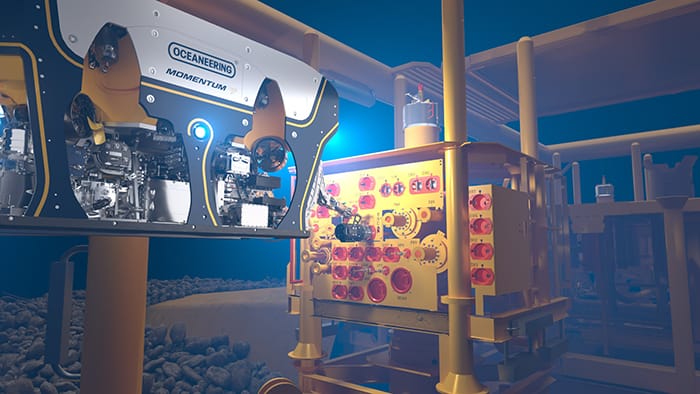
Despite the advantages of electrification, drilling operations continue to require high-pressure, high-flow hydraulic capability, particularly for BOP override functions; 20,000 psi BOPs also require higher pressures and larger volumes to operate shear rams.
To address this, an electrically powered BOP pumping skid provides the necessary hydraulic output. In this configuration, the electric work class ROV provides positioning, control, and system integration, while the skid delivers the hydraulic performance required for high-demand intervention tasks.
This approach enables operators to apply electric propulsion where it delivers the greatest value, particularly in reliability and residency, while maintaining the ability to execute critical drilling functions.
Evolving Offshore Operations
Capabilities such as extended residency, tooling flexibility, and high payload capacity, also support a broader range of subsea work, including inspection, maintenance, and repair (IMR), construction, and offshore installation activities.
As offshore operations continue to prioritize efficiency, predictability, and reduced environmental impact, electric work class ROVs and complimentary tooling expand the range of viable operating strategies. Rather than replacing existing systems, they provide an additional architecture that supports longer-duration campaigns and more flexible subsea operations. These same capabilities are also increasingly relevant for offshore renewable applications, where extended subsea residency, reduced recovery frequency, and flexible tooling enable more efficient installation, inspection, and maintenance of subsea infrastructure supporting wind and energy transition projects.