Hybrid Connectivity Configuration
Based on EdgeLab’s U_Tracker family, the hybrid configuration combines autonomous navigation and mission execution with a high-bandwidth fiber-optic connection. The cable is progressively deployed from an onboard spool during the mission, is expendable, and does not need to be recovered after the operation.
This configuration provides operators with real-time situational awareness while maintaining the ability to continue operating autonomously if the connection is lost. It opens new possibilities for Mine Countermeasures (MCM), critical infrastructure protection, underwater inspection, and the monitoring of cables and offshore installations.
Real-Time Data When it Matters
One of the main advantages of the hybrid architecture is the ability to transmit high-quality data during the mission. Traditional AUV operations generally involve autonomous navigation followed by vehicle recovery and data download. Sonar imagery, video, and other sensor data may therefore only become available once the vehicle has returned. The fiber-optic connection changes this model: during the mission, the vehicle can transmit payload data in real time, including sonar imagery and live video. Operators can monitor the mission as it unfolds, assess areas of interest, and maintain direct awareness of the vehicle’s environment.
This capability is particularly valuable when decisions need to be made quickly. In an MCM scenario, real-time sonar imagery allows operators to review potential contacts as they are detected, rather than waiting for the vehicle to return.
Automomy Without a Cable Link
The U_Tracker combines real-time connectivity with autonomous operation, ensuring that the vehicle remains independent even when the fiber-optic link is interrupted. Underwater environments are inherently unpredictable, and cables may become damaged, snagged, or cut. In these situations, the vehicle can continue its mission, adapt its operational profile, or return to base according to pre-programmed instructions, ensuring greater operational resilience and preventing communication loss from automatically terminating the mission.
From MCM to CUI Protection
The potential applications of a hybrid AUV are extensive. Mine Countermeasures are a key area of interest. An AUV can autonomously survey large areas while high-resolution sonar data is transmitted through the fiber-optic connection. Operators can review contacts in real time while the vehicle remains capable of continuing autonomously if communication is interrupted.
Another important application is the inspection and protection of critical underwater infrastructure (CUI). Subsea internet cables, power cables, pipelines, and other strategic installations require operations over long distances and in complex environments, where combining autonomous navigation with real-time data transmission can provide a significant operational advantage.
The same concept can be applied to offshore energy infrastructure, underwater installations, ports, and harbor environments. Live video supports visual assessment, while sonar can identify obstacles, detect seabed changes or inspect structures where visibility is limited. The hybrid architecture also offers opportunities for security and defense applications where persistent communication is desirable, but complete dependence on a tether would be an operational limitation.
A Scalable Platform
The hybrid concept has been developed starting from the U_Tracker IV, providing a compact and versatile platform for underwater operations. The architecture can also be extended across the wider U_Tracker family, including the U_Tracker Pro and U_Tracker L. This scalability allows the system to be adapted to different mission requirements, payload configurations, endurance, and operational ranges.
Smaller platforms can support rapid deployment and inspection missions, while larger vehicles can accommodate more demanding payloads, extended endurance, or complex multi-sensor operations.
Tested in Operational Environments
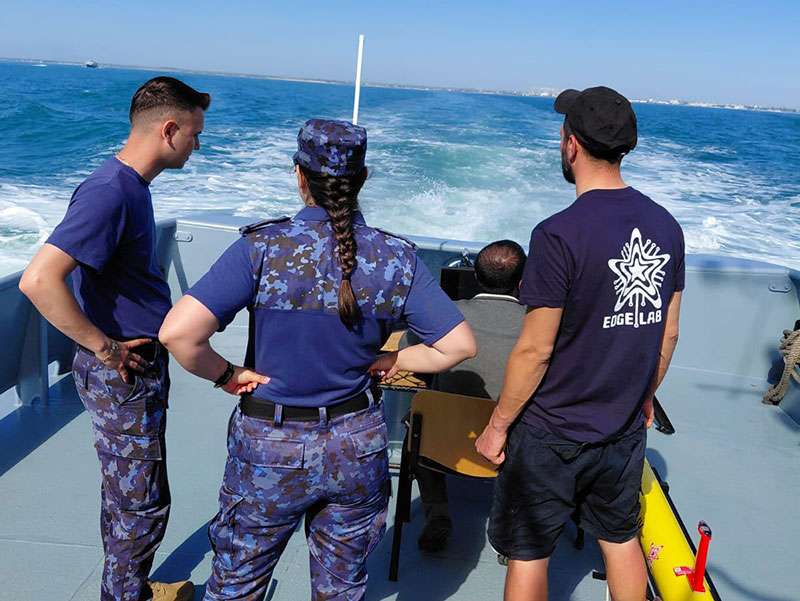
The hybrid concept is not limited to a theoretical architecture. The vehicle has already undergone testing in different operational environments, validating the combination of autonomous underwater operations, and fiber-optic connectivity under realistic conditions.
These activities have contributed to refining the interaction between vehicle autonomy, payload operation, and real-time communications, with the objective of combining two capabilities traditionally considered as alternatives: the independence of an AUV and the immediate situational awareness provided by remotely connected underwater systems.
The Future of Hybrid Subsea Operations
The underwater domain is becoming increasingly important for defense, security, science, and critical infrastructure protection. At the same time, operators need systems capable of delivering more information, more quickly, without sacrificing endurance or operational resilience.
The hybrid U_Tracker concept addresses this requirement by combining real-time fiber-optic connectivity with autonomous mission capability. When the communication link is available, operators benefit from live access to sonar imagery, video, and other mission data. If the connection is lost, the vehicle can continue its mission autonomously or execute a predefined recovery procedure. Rather than choosing between a fully autonomous vehicle and a permanently tethered system, operators can combine the advantages of both.
For applications ranging from Mine Countermeasures and subsea inspection to cable monitoring and critical infrastructure protection, hybrid underwater vehicles represent a step towards a new generation of more connected, resilient and operationally flexible subsea systems.