Lately, AUVs have begun playing a more significant role, and interest in using them has intensified in the wake of international incidents involving damaged critical underwater infrastructure (CUI).
RESPONDING TO CUI DAMAGE
Recent incidents demonstrate the need for robust subsea critical infrastructure defense capabilities. One of the most notable was an episode on September 26, 2022, that left three of four Nord Stream gas pipelines in the Baltic Sea inoperable.
This was not an isolated incident, and subsequent serious attacks have underscored the need to monitor and safeguard subsea pipelines and cables.
The most recent CUI damage occurred at the end of 2024. In late December, four data cables in the Finnish exclusive economic zone were cut, along with the subsea ESTLINK 2 electricity cable that connects Estonia and Finland, marking the ninth incident in the Baltic Sea in less than 14 months.
The disruption in the affected countries and the cost of implementing alternative services were significant enough that the North Atlantic Treaty Organization (NATO) moved to address this threat in mid-January 2025. The organization issued a press release on January 14 announcing the creation of Baltic Sentry, a program to deter future attempts to damage critical undersea infrastructure in the Baltic Sea. The same day, NATO Secretary General Mark Rutte co-hosted a summit of Baltic Sea allies in Helsinki, along with President Alexander Stubb of Finland and Prime Minister Kristen Michal of Estonia, to address the growing threat to critical undersea infrastructure.
Other organizations like the International Cable Protection Committee and the International Telecommunication Union have stepped up activity as well. Meanwhile, government agencies like the UK National Protective Security Authority are focusing on assets that deliver essential services that, if damaged, would have a significant impact on national security, national defense, or the functioning of the state. And in the US, the National Oceanic and Atmospheric Administration, the Department of Homeland Security and the Department of Defense (DoD) are increasing investment in technology that will help safeguard subsea infrastructure.
TESTING FOR SUITABILITY
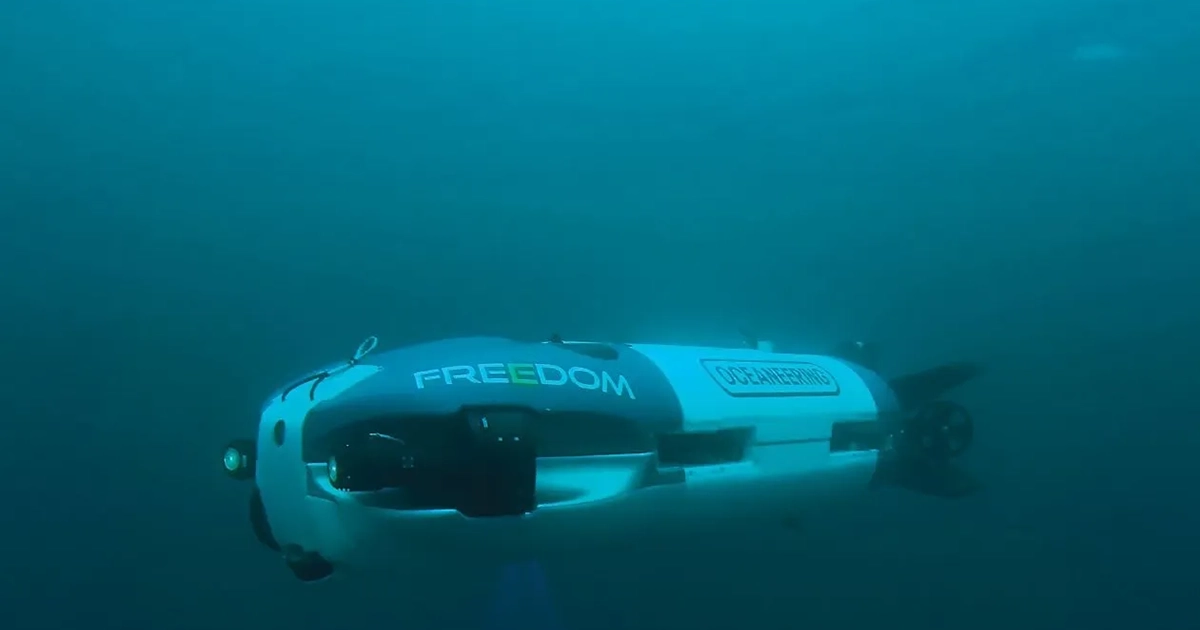
In February 2024, the Defense Innovation Unit (DIU), a DoD organization, awarded a contract to Oceaneering’s Aerospace and Defense Technologies business segment to develop and test the
Freedom AUV as a potential Large Displacement Unmanned Undersea
Vehicle (LDUUV) prototype for the US Navy’s Program Office for Advanced Undersea Systems. The contract included a manufacturing readiness review to assess production capacity and tradeoffs that could be performed to speed LDUUV capabilities to the fleet.
SUBSEA RESIDENCY
The uniquely designed Freedom AUV had recently completed a five-year test and development program. It has been deployed commercially since 2023. On the projects Freedom executed in the oil and gas sector, its capabilities in four specific areas made it a prime candidate for the DIU.
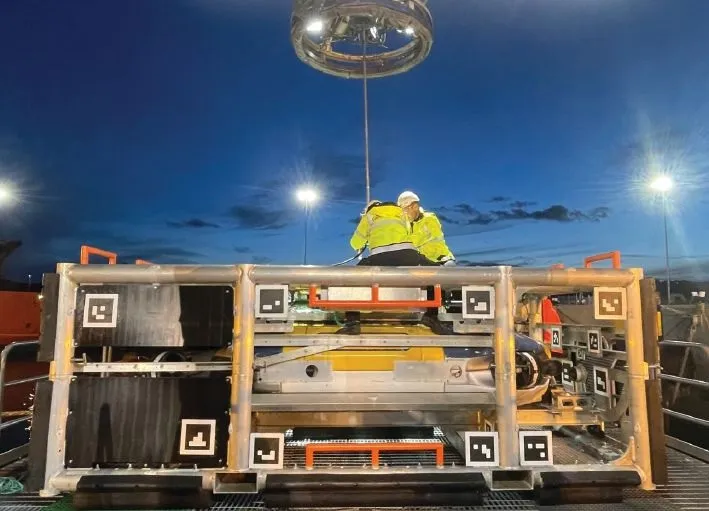
For one thing, the AUV is being developed for deployments up to six months—residing and recharging in a suspended cage between missions—and can reliably take in and offload data for the duration of its subsea residency. Multi-sensor influenced flight control is another enabler, providing six degrees of freedom in vehicle maneuverability that allows the AUV to execute detailed protection programs from shallow water harbors to deep subsea critical infrastructure. Unlike traditional AUVs, the Freedom AUV can independently assess a pipeline or cable and can follow the asset at a specified distance close to the sea floor. The unit’s ability to stop, hover, orbit and reverse makes it particularly adept at detailed, close inspections.
Technology building blocks (thrusters, connectors, batteries, etc.) are key to the performance and reliability of the Freedom AUV system. Building blocks streamline configuration, making it easy to outfit the vehicle with the modules appropriate for a given program and ensure functionality on future AUV designs. Modularity is a key differentiator. All essential modules have been proven and refined across the world’s largest fleet of ROVs, and a global supply chain is in place to provide support.
A common interface allows a range of sensors and tools to be plugged in and activated without extensive reconfiguration, essentially providing a plug-and-play connection for sensors, batteries, and thrusters. The AUV also has a single, common cable design that simplifies interconnectivity and improves reliability.
The Freedom AUV’s track record in commercial applications for long-duration subsea residency and reliable performance is predicated on mature maintenance and logistics systems, the same systems used by the company’s fleet of work class ROVs—the largest in the world—which performed more 450,000 hours of subsea robotic services in 2023. Defense organizations realize maintenance and logistics are as important as the technological capabilities provided by the vehicle itself because of the harsh operating subsea environment. Without proven maintenance and logistic processes, what starts out looking like impressive technology can easily end up as rusting junk on the seafloor.
CHARTING THE FUTURE
Built on experience gained over more than six million operational hours, the Freedom AUV design and its unparalleled performance led to the DIU’s decision to awarded Oceaneering a multi-million-dollar contract in
October 2024 to build a Freedom AUV and set up an Onshore Remote Operations Center for the US Navy. The vehicle is being manufactured at Oceaneering’s Morgan City, Louisiana facility.
It is a mistake to pursue novel technological approaches without an accompanying foundation of mature maintenance, logistics, and operations processes that can stand up to the rigors of the harsh sea environment. Creating prototypes “at scale” without this foundation, will not speed capabilities to the fleet.
Millions of hours of operations led to the development of the Freedom AUV, and testing has proven it can consistently execute missions to the high standards required for military operations.
This feature appeared in ON&T Magazine’s 2025 March Edition, Naval Defense & Intelligence, to read more access the magazine here.