The evolution of the fabled remotely operated vehicle, perhaps best known by its ROV acronym these days, is a case in point. The history of ROVs is well documented, with rapid R&D stemming from the US Navy in the 1960s and accelerated by widespread adoption by the oil and gas industry in the 1980s. Today, ROVs come in all shapes and sizes, depending on their target application in the field. Their capacity to facilitate subsea inspection and intervention tasks at previously unfathomable depths is undisputed. Over the years, marine engineers have focused on extending the utility of ROVs by concentrating on their modularity; the ability to swap out sensor payloads and tooling packages continues to bring greater flexibility to operators, especially in the offshore energy sector.
The harsh, and largely unknown underwater landscape associated with seabed exploration, typified by hostile conditions, demands that ROVs be designed and manufactured not only to prove extremely durable, but also highly adaptable. At every stage of a deployment, operators must be poised to overcome operational hurdles—many of which are hard to predict, such as from extreme weather events and strong currents, effectively halting ROV use in volatile environments requiring precise navigation.
For deep-sea research and marine exploration, ROVs often contend with freezing temperatures, complex terrain and unpredictable currents throughout the water column.
In offshore oil and gas fields, ROVs are exposed to hazardous environments. Navigating underwater infrastructure can be difficult, especially in low-visibility conditions. Corrosion from saltwater also poses an ongoing threat to the integrity of ROVs, necessitating frequent maintenance.
In offshore infrastructure construction, and where additional power can be a requirement for tasks such as laying pipelines and cables, connecting manifolds as well as welding and cutting operations where precision is crucial.
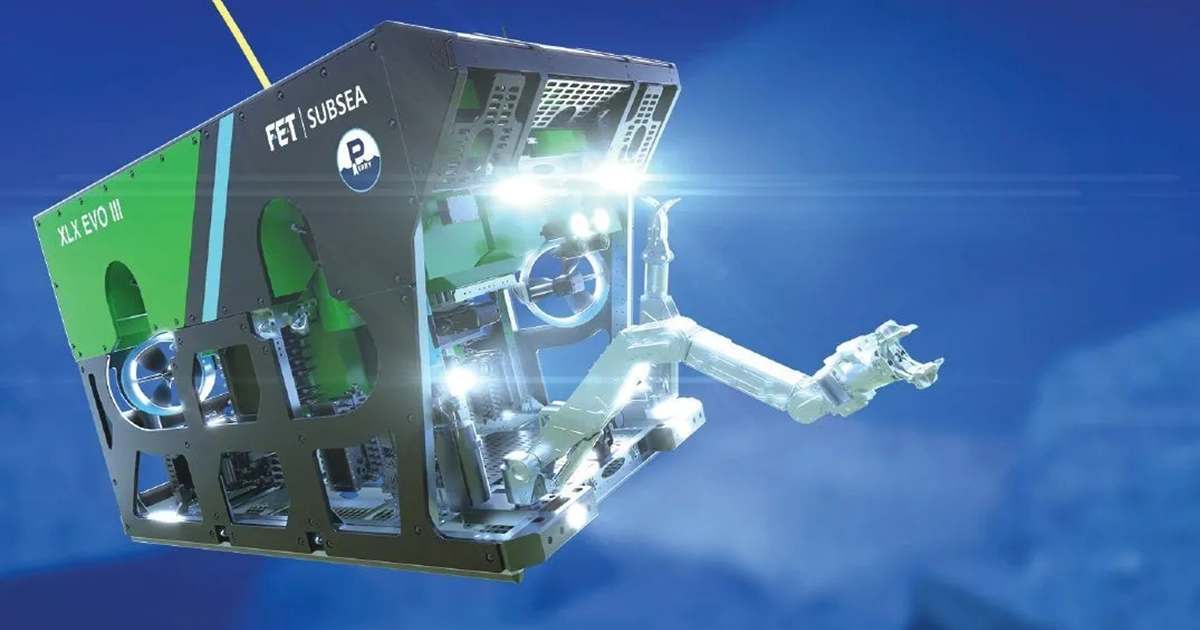
To overcome these hurdles, Forum Energy Technologies’ (FET) new XLX EVO III ultra-heavy duty ROV has been designed to contend with the multifaceted nature of underwater challenges at every stage of development.
UNMATCHED POWER & PRECISION
FET’s latest ROV builds on the legacy of the Perry XLX series, which has set the standard for heavy-duty subsea operations since its inception in 2007. The latest model is built to tackle the most demanding subsea tasks, offering unmatched power and precision.
Key to the vehicle’s versatility is its 200 horsepower (150 kW) motor, providing the necessary thrust to carry out challenging operations at depths of up to 4,000 m. The vehicle is also enhanced by larger thrusters (four horizontal Ø420 mm and four vertical Ø300 mm), enabling superior maneuverability and control even in the harshest and unpredictable environments.
The EVO III can handle payloads up to 500 kg, supported by a through-frame lift capacity of 4,000 kg, an increase of over 30% from its predecessor, the EVO II.
With a new CNC machined frame, the vehicle’s design has been optimized for both maintenance access and tooling capability, ensuring that it can withstand the demands of prolonged underwater work with the latest tools installed, while also being easy to service. Additionally, the increased bollard pull—1,200 kg forward and lateral, and 940 kg vertically—allow the ROV to hold station and move heavy loads with complete confidence. This is an increase of over 10% of the XLX EVO II’s capacity.
THE FUTURE OF USER CONTROL
On the user side, FET has perfected control and comfort. The EVO III is equipped with FET’s innovative ICE Unity control system which facilitates real-time remote operations. This software platform integrates a streamlined user interface and advanced diagnostic capabilities, allowing operators to remotely control the ROV with ease and efficiency.
Features such as machine learning-driven trend analysis and a comprehensive historian function make it easier to track the vehicle’s status and performance, providing a smooth execution of complex tasks.
The system also offers a range of automatic functions including heading control, pitch and roll control, depth control and altitude control, allowing the ROV to maintain precision even in challenging conditions. Operators can monitor the ROV via 43-inch HD 4K monitors, so tasks can be undertaken with complete definition.
REMOTE SUBSEA OPERATIONS
The EVO III represents a shift in how subsea operations will be carried out in the future. As industries increasingly look to remote and automated solutions for subsea work, the capabilities of the EVO III make it an ideal candidate. Whether it’s for oil and gas exploration, renewable energy projects, defense, or deep-sea research, the EVO III delivers safe and efficient operations.
The vehicle’s capabilities will also play a significant role in improving safety standards across subsea operations. By allowing operators to perform complex tasks from off-site locations, the EVO III reduces the need for humans offshore, improving on both safety and costs. The EVO III is more than just an upgrade; it is a glimpse into the future of remote subsea operations.
This feature appeared in ON&T Magazine’s 2025 April Edition, Offshore Energy Transition, to read more access the magazine here.