Traditional maritime signals such as radar, GNSS, and AIS were never designed to be fully trusted in adversarial conditions. Today, they are routinely degraded, spoofed, or deliberately manipulated. GPSPatron reported that more than 10,000 vessels were affected by GNSS interference in a single quarter of 2025. In 2024, AIS data briefly showed more than a hundred ships apparently operating from an international airport in Beirut. These are no longer anomalies. They reflect the operating reality at sea.
For uncrewed vessels, unreliable perception is not a nuisance. It is an existential problem. Autonomy only works if the vessel can trust what it believes about its surroundings.
WHY SIGNALS ARE MANIPULATED
Maritime signal manipulation happens because it works. It enables concealment, deniability, and advantage.
Commercially, AIS and GNSS interference supports sanction evasion, illegal fishing, and trafficking. Kepler estimates that shadow fleets now move around 6 to 7 percent of global crude oil, much of it enabled by AIS spoofing and signal suppression. That activity continues to grow year on year.
From a defense perspective, the threat is more direct. GNSS jamming denies positioning altogether. Spoofing injects false location data into navigation systems. Carry-off attacks quietly and gradually pull vessels off course without triggering alarms. AIS identities can be cloned, falsified, or selectively disabled.
The core problem is reliance on cooperative systems. When autonomy assumes honesty, it inherits risk. False confidence, not uncertainty, is what causes failures.
CONTESTED ENVIRONMENTS
In contested environments, radar cannot always be assumed. It may be degraded by electronic attack, unavailable on smaller platforms, or deliberately disabled to reduce emissions and preserve survivability.
This creates a fundamental trade-off. Radar is effective, but it is also active. In some missions, transmitting is the risk.
At the same time, GNSS and AIS interference has become routine across large areas of the globe. European coastal states have formally acknowledged sustained spoofing and jamming across the Baltic and North Seas, attributing much of it to state-level activity. These issues are not confined to declared conflict zones.
Even outside of the defense realm, the maritime domain is full of blind spots. Research published in Nature suggests that most industrial fishing vessels are not publicly tracked, and a significant portion of global maritime activity is effectively invisible.
For uncrewed vessels, the question is unavoidable. How do you maintain situational awareness when you cannot rely on signals, cooperation, or even the ability to transmit?
TRUST IN OPTICAL PERCEPTION
Optical perception answers a simple question first: what is physically there.
Vision does not depend on declared identity, external broadcasts, or cooperative behavior. It observes the world as it is, and as humans have for thousands of years on the water. In environments where signals are denied or deceptive, that matters.
Modern electro-optical and infrared sensors, paired with purpose-built computer vision, can detect and track vessels that actively avoid detection. This makes optical perception especially valuable when radar use is constrained or when GNSS and AIS cannot be trusted.
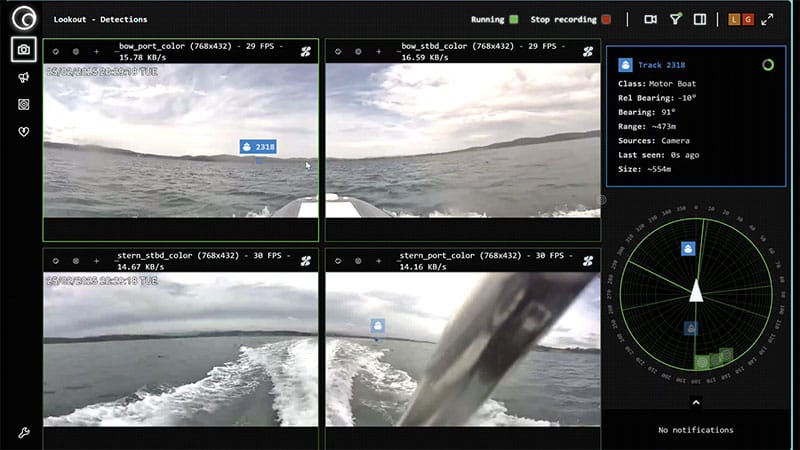
One example is Greenroom Robotics’ Lookout+ software, which applies optical AI specifically to maritime operations. Lookout+ processes camera feeds (electro-optical and infrared) and uses AI to detect, classify, track and geolocate objects on the water. With edge-processing, Lookout+ has been designed from the outset for communications-limited and contested environments.
The real value comes from fusion. Optical detections can be cross-checked against radar returns, inertial navigation, and any available AIS or GNSS inputs. Does something exist where a signal claims it does? Does its behavior match its reported identity? Confidence comes from corroboration, not assumption.
WHY ARCHITECTURE MATTERS
Optical AI is not interchangeable. Just because a UAV or “self-driving car” uses AI, it doesn’t mean that it will work in the maritime environment. Architecture determines whether it works when conditions deteriorate.
Systems that depend on cloud connectivity introduce latency, bandwidth constraints, and cyber exposure. Others fail in real sea states, mistaking clutter for contacts or losing track stability when conditions become dynamic.
In defense and safety-critical applications, optical AI must run at the edge, on the vessel itself. Edge-processing supports air-gapped operation, passive perception with EM emission control, and resilience against upstream signal manipulation.
Just as importantly, maritime optical AI must be built by people who understand the ocean. Glare, sea state, horizon effects, weather, vessel behavior, and watchkeeping realities cannot be learned from datasets alone. Experience shapes architecture.
LIMITS & TRADE-OFFS
Optical perception has limits. Fog, heavy rain, and extreme sea states reduce performance. These are known constraints and reinforce the need for layered sensing rather than reliance on any single modality.
But the inverse is equally true. In many contested scenarios, vessels will deliberately operate below the threshold of radar or outside cooperative systems altogether. Optical sensing fills that gap.
The goal is not perfection. It is resilience.
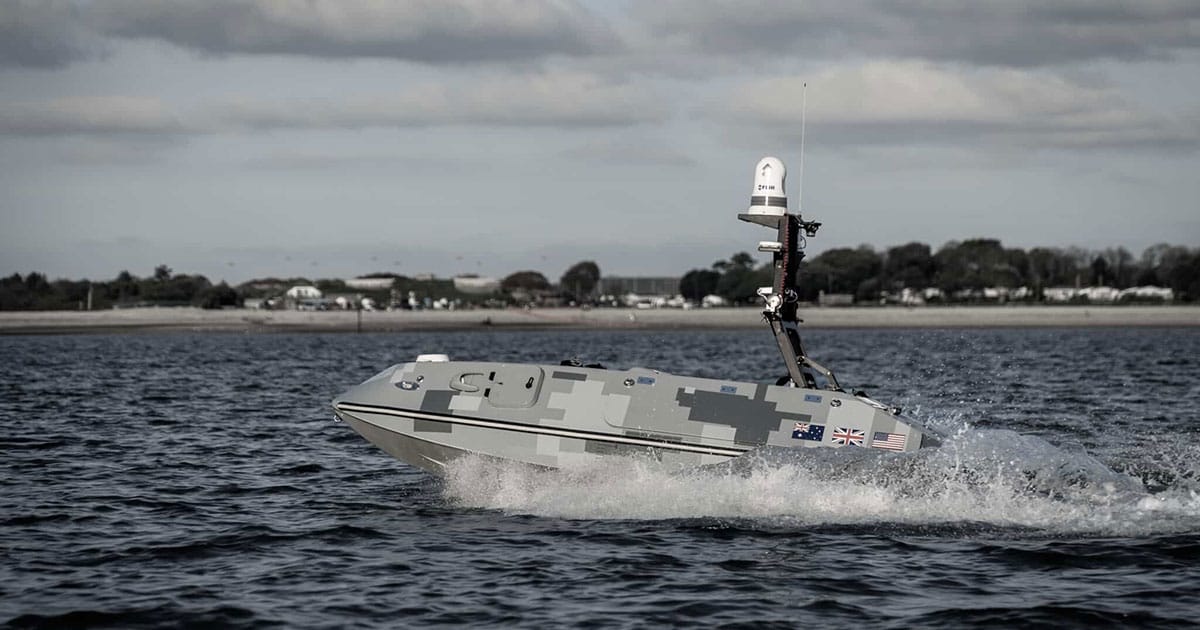
 Austal Australia’s Patrol Boat Autonomy Trial demonstrated how autonomy reduces crew workload, improves safety, and optimizes naval operations. (Credit: Greenroom Robotics)
FROM AUTONOMY TO ADVANTAGE
Uncrewed vessels only become operationally useful when they can trust their understanding of the environment around them.
In contested waters, autonomy built on fragile or deceptive signals will fail. Autonomy grounded in physical observation, resilient architecture, and sensor fusion will not.
Optical AI, when designed for the maritime domain and built by those who understand it, is no longer experimental. It is foundational. Combined with edge processing and intelligent fusion, it enables safer navigation, higher mission assurance, and broader adoption of uncrewed systems across defense, security, and commercial operations.
Perception is not the constraint. Getting it right is the advantage.
This feature appeared in ON&T Magazine’s 2026 March Edition, Unmanned Naval Defense, to read more access the magazine here.