This new strategy is grounded in the challenging operational realities facing the US Navy, which require flexibility and adaptability. General-purpose forces—the carrier strike group, nuclear-powered submarines, and other capital assets—will remain central to the Navy’s future force structure. But they also must remain focused on their core missions of deterrence and forward power projection.
Through the CNO’s concepts of “tailored forces” and “tailored off sets,” unmanned systems augment manned warships. They give commanders optimized capabilities to handle specific operational problems and impose costs on adversaries, while allowing capital ships and exquisite battle force assets to focus on missions only they can perform.
Through a strategic collaboration, Lockheed Martin and Saildrone, the global leader in maritime autonomy, are bringing together proven autonomous platforms and battle-tested defense payloads that are scalable, ready to be integrated, and deliverable today. By integrating platforms and payloads that are operational, rather than aspirational, the companies will collectively deliver resilient hedge forces that the Fighting Instructions describe.
THE POWER OF CONTAINERIZED PAYLOADS
To deliver the vision of the Fighting Instructions, the US Navy must come to the fight equipped with the right combination of sensors: to sense and make sense of the threat, and be armed with the appropriate kinetic and non-kinetic effects to counter it. The ability for commanders to mix and match sensors and payloads to deliver the right effect when and where needed is integral to the theory of “tailored off sets.”
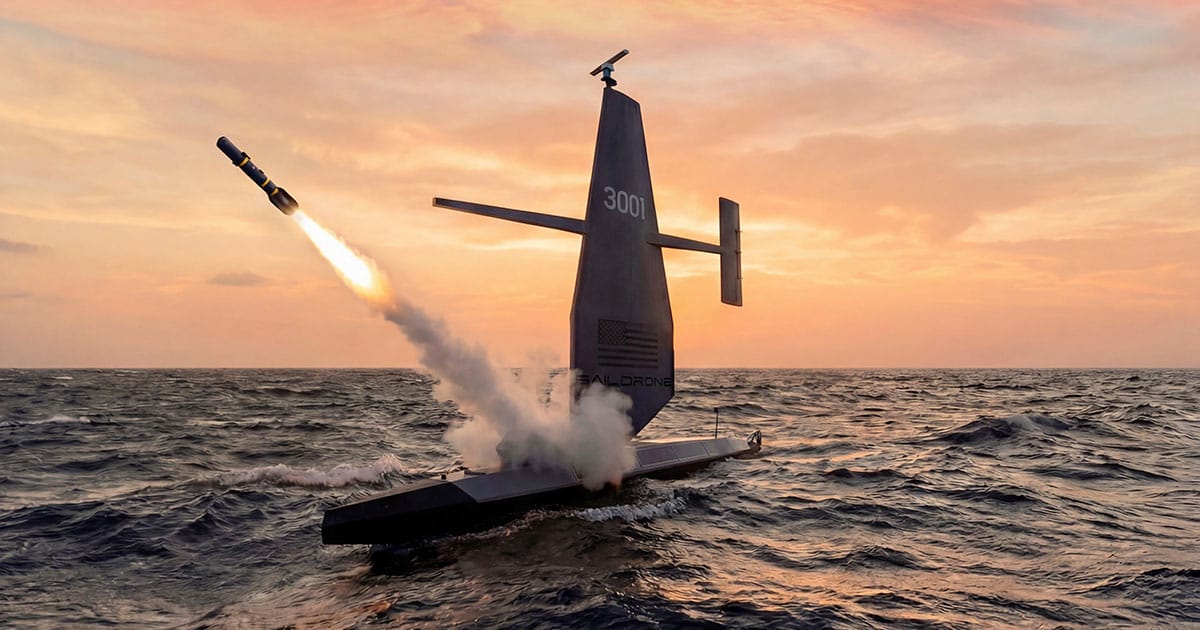
Containerized payloads provide this flexibility. By standardizing the requirements for space, weight, and power of any payload that may be employed on an unmanned surface vehicle (USV), commanders can match sensors and effects to their missions and the anticipated threats. Furthermore, the nature of containerized payloads creates a layer of strategic uncertainty. The fact that an adversary saw one USV fi re a containerized surface-to-air missile does not mean that the next USV they see is similarly configured. In fact, though visually similar, it may be equipped with an electronic warfare capability or a towed array.
DELIVERING AT SPEED & SCALE
Lockheed Martin and Saildrone’s proven operational capabilities enable the companies to collectively deliver platforms at the speed and scale the US Navy demands.
Saildrone’s fleets of unmanned surface vehicles have proven their endurance and resilience through more than 2,000,000 nautical miles transited globally in support of various navies and government customers in every ocean on the planet.
All Saildrone platforms achieve extreme range and endurance through the innovative design of the patented Saildrone Wing, which harvests energy to supplement the platform’s engine. The design enables months-long operations at sea, allowing for persistent presence where traditional assets are limited by range, cost, availability, or risk. Both the Saildrone Voyager and Surveyor have received full classification from the American Bureau of Shipping—the only unmanned systems to do so—setting anew global benchmark for unmanned systems and highlighting Saildrone’s leadership in developing fully classed, open-ocean-capable USVs.
Lockheed Martin’s combat-proven defense payloads offer the range of effects commanders need to maintain a warfighting advantage. For decades, Lockheed Martin has supplied advanced autonomous systems to the US military and its allies, supporting a variety of missions. Through strategic investments and non-traditional partnerships, Lockheed Martin is defining Mission Autonomy to deliver leading-edge autonomous capabilities at speed and scale. By evaluating and testing autonomous algorithms, Lockheed Martin is equipped with high-fidelity digital twins that replicate real-world behavior; these testing and simulation environments help understand the implications of live demonstrations, prepare for edge cases, and validate operational capability. This ensures rapid and reliable performance for maritime solutions.
PROVEN DESIGN, TESTED PAYLOADS, BIGGER PLATFORM
A new, larger platform that will take advantage of Saildrone’s proven design and Lockheed Martin’s combat-tested payloads is in development. This new platform can employ containerized payloads, such as the Mk70 VLS launcher, and be ready to take advantage of the wide range of effects Lockheed Martin brings to bear.
While much of the autonomous maritime landscape today remains aspirational, Saildrone and Lockheed Martin are partnering to produce capabilities that are operational at the pace the Navy and modern threats demand. The companies collectively illustrate the best of operational autonomy when platform endurance, proven command and control, and combat-ready payloads converge. Not as a future concept, but as a deployed reality shaping today’s maritime security.
This feature appeared in ON&T Magazine’s 2026 March Edition, Unmanned Naval Defense, to read more access the magazine here.