
TACKLING THE BASICS
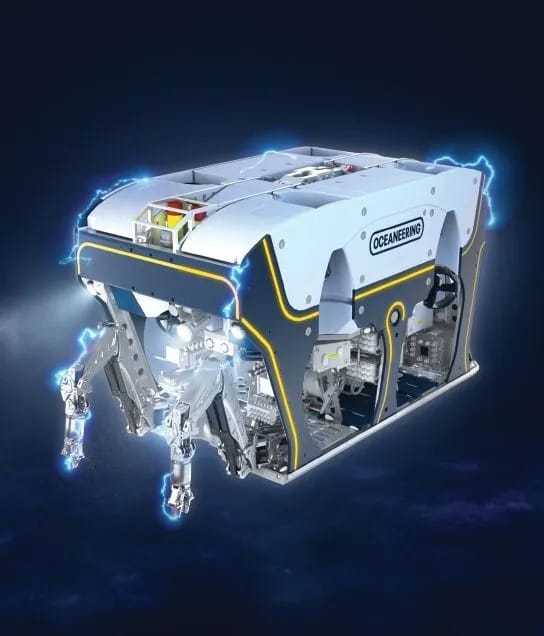
One driver for electrifying the ROV power system was environmental stewardship. Reducing the pressurized hydraulic fluid on the vehicle minimizes the likelihood and volume of hydraulic fluid leaks. Electrification improves system efficiency, which reduces the power required through the umbilical and tethers, extending and improving umbilical and tether life. Lower power draw enables the work class ROV to be deployed from uncrewed surface vessels or Oceaneering’s Liberty™ Resident System.
Electrification of the power train and tooling eliminates failures caused by water ingress into the hydraulic system. Dual electric power trains enable the continuous operation of an electric ROV even after critical subsystem failures. Improved reliability and reduced maintenance extend subsea ROV residency up to 30 days, keeping the ROV at the seabed ready to complete tasks on demand. The electric ROV maintains a small hydraulic power unit to operate the work class manipulators and has the ability to exchange tooling subsea without subsea hydraulic connections.
The electric ROV’s bolted frame design is based on the field-proven eNovus and Isurus vehicles. The frame enables faster swap out of skids and increases the vehicle’s through frame lift to 4,000 kgf. Pressure tolerant electronics have reduced the overall system weight in water, increasing the payload available for additional sensors and tools. The integrated Power and Ethernet Module (iPEM) backbone enables quick connection of power and communications to sensors, tools, and ROV skids.
REPLACEMENT & IMPROVEMENT
The system has been designed with a standard sensor package that includes forward-facing stereo cameras to provide depth perception, 360-degree camera coverage to provide situational awareness, and 360-degree acoustic sensors to deliver situational awareness even in low visibility.
The new electric ROV is backward compatible with the existing Millennium® ROV cage or top-hat tether management system, tether, umbilical, launch and recovery system, and ORCA controls system, to enable electric upgrade with a tether re-termination in less than a shift. Reliability targets for the electric ROV were based on analysis of eight years of operations with more than 3.4 million hours of operation and 99% uptime. Reliability projections indicate a 20% improvement in reliability compared to hydraulic systems.
Field performance data has been used to define component, sub-system, and system qualification requirements, including a 33-day endurance testing program, running 24 hours a day, that is in process at the Oceaneering test facility in Morgan City. The first production units will begin executing offshore commercial work in Q4 2025.
This spotlight appeared in ON&T Magazine’s 2025 July Special Edition, Uncrewed Vehicles Buyers’ Guide, to read more access the magazine here.
