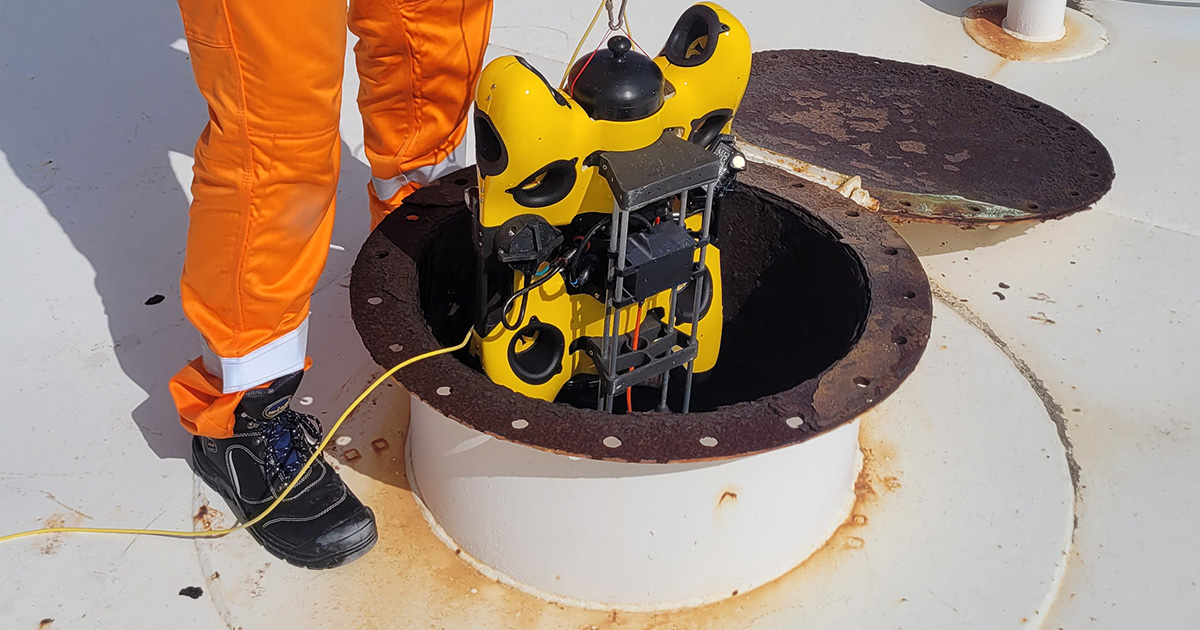
EXRAY™ is a class-approved underwater inspection robot built specifically for these environments. Compact, modular, and certified for NDT work, it is gaining traction with operators who need reliable data from spaces that are structurally complex, access-restricted, or simply too hazardous for human entry.
A 20 CM Clearance. Not a Problem.
During a 2025 FPSO deployment, an asset operator needed ultrasonic thickness (UT) measurements taken at a bell mouth plate with less than 20 cm of clearance between the plate and the floor—a geometry that eliminates most ROV options outright. EXRAY™ navigated under the plate and collected UT data with automatic A-scan generation for on-the-spot measurement validation. The result: the client formally adopted robotic inspection as company policy for ballast tank work, replacing human entry across the board.
What Makes it Work in Tight Geometries
EXRAY™’s 6 Degrees of Freedom (6DOF) drive system—with semiautonomous pilot assist —lets it pitch, roll, and translate laterally to align sensors precisely against irregular internal structures. This isn’t a standard ROV retrofit; the frame and thruster configuration were designed from the outset for confined-space campaigns.
Its hubless thrusters eliminate the most common cause of mission failure in debris-laden water: entanglement. In a January 2026 harbor test conducted by a client, EXRAY™ passed through algae-dense water without interruption while conventional thrusters on competing vehicles stalled.


Pre-mission CAD drawing and the real-life view of the bell mouth from the EXRAY™ camera during the mission. (Credit: Hydromea)
Data Architecture, Not Just Data Collection
EXRAY™ integrates with the NAVIA™ Suite, which logs Point of Interest (POI) localization alongside video and sensor data. The structured output is designed for year-over-year trend tracking—useful not just for the current inspection campaign but for building a longitudinal integrity record that survives personnel turnover and platform transitions. For clear, confined spaces where even a tether creates snag risk, an optional wireless FLYOUT module extends the system’s reach up to 30 meters using LUMA™ optical communication—a tether-free link that still delivers zero-latency HD video and full pilot control.
The Operational Case
Compared to conventional dewatering and human entry, operators report a 10x reduction in deployment cost and 5x faster time-to-results. For asset managers weighing inspection strategies, those numbers are the starting point—not the headline.