MRV: Supplying Profiling Floats Across Industries
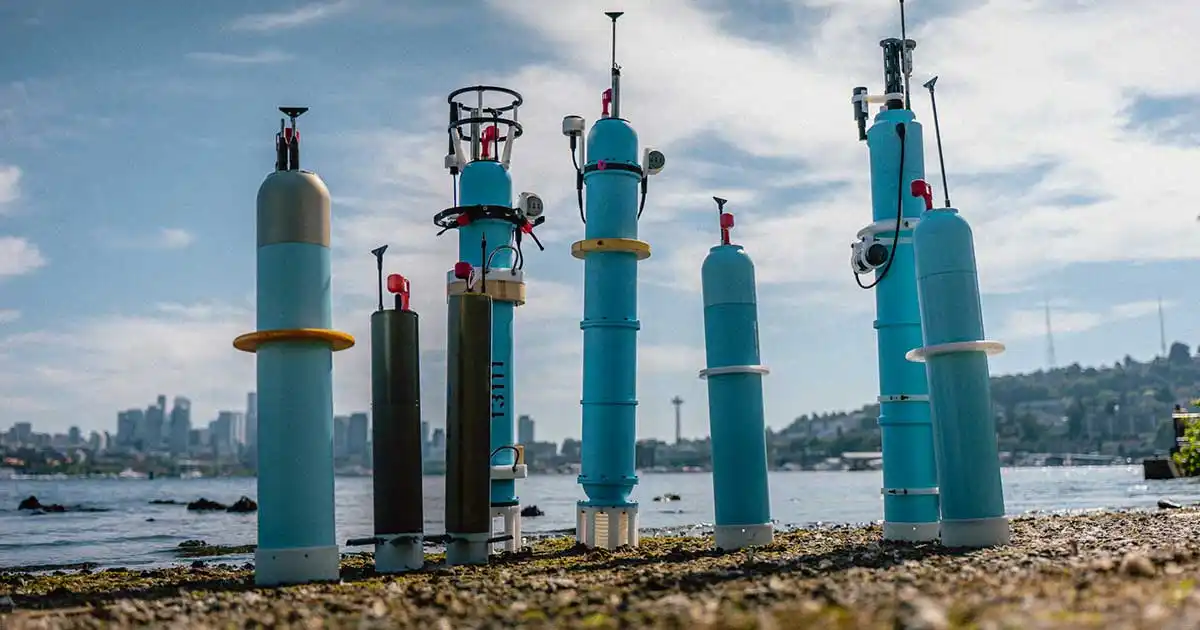
Founded in 2010 as a Scripps spin-off, MRV was established with a licence to manufacture the SOLO-II profiling float. Its S2-A is the commercial version of that platform for the international Argo programme, which uses autonomous floats to collect repeated profiles of ocean temperature and salinity. A profiling float changes its buoyancy to move vertically through the water column and spends most of a mission below the surface. It then rises while its sensors record measurements at different depths and upon reaching the surface, obtains a position and sends its data by satellite before descending again. The approach complements a single ship visit with repeated observations over months or years.
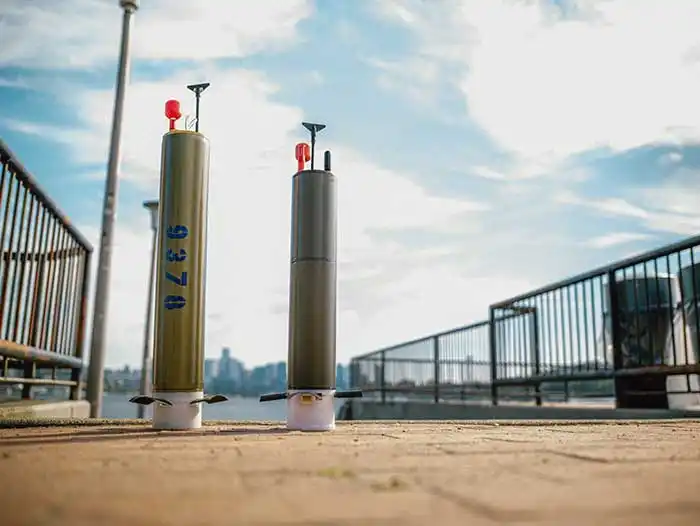
For ocean science, temperature and salinity profiles help researchers understand the ocean’s role in climate, calculate changes in ocean heat storage, and improve climate models. The same types of observations can also support defense-related environmental awareness with temperature and salinity profiles utilised in anti-submarine warfare. MRV’s Air Launched Autonomous Micro-Observer, or ALAMO, shows how the core observing concept can be adapted around a more targeted requirement. The compact profiler was originally developed for deployment near hurricanes and tropical cyclones, where repeated ship-based sampling would be difficult and potentially hazardous. Its compact format allows deployment from aircraft equipped with compatible launch tubes, as well as from ships and small boats.
MRV also manufactures Spray2, the commercial version of Scripps Institution of Oceanography’s next-generation Spray glider. Unlike a profiling float, which drifts horizontally, Spray2 changes buoyancy and uses its wings to convert vertical movement into forward travel. This allows it to follow planned survey routes while collecting measurements through the water column. The Spray2 can exceed 100 days at sea and 500 profiles, depending on operating conditions and sensor configuration.
Adapting to the Needs of Different Markets
Scientific users and defense operators both value accurate sensors, low power consumption, and reliable autonomous operation. Defense applications may add different expectations for launch qualification, communications, data access, interfaces, and mission- specific payloads which General Oceans’ companies have adapted their technology to, as can be seen in MRV’s development of air deployable floats. Adaptation is therefore about matching a proven technical foundation to a defined task, not simply applying a new label.
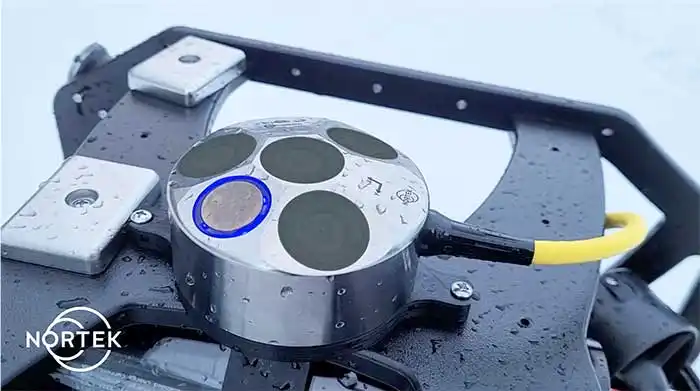
Nortek, one of the founding companies of General Oceans, produces acoustic Doppler current profilers (ADCPs) which are well established as a scientific tool for measuring currents, waves, and turbulence. Nortek additionally manufactures Doppler Velocity Logs (DVLs), which use similar technology to estimate how a subsea vehicle is moving relative to the seabed or surrounding water. This technology helps an autonomous or remotely operated vehicle navigate where satellite positioning is unavailable.
Today, both Nortek’s ADCP and DVL technologies are used across industries, including in energy and defense. Nortek has worked closely with vehicle manufacturers with stringent navigation requirements for their military end users on DVL development. Additionally, as defense operators grow increasingly interested in environmental information, ADCPs provide critical in-situ measurements of the ocean environment.
Another example is Nortek’s DVL333 for Unmanned Surface Vehicles. With origins as a vessel mounted ADCP for offshore operations, this instrument has been adapted as a navigation aid essential for sustained surface vehicle navigation in increasingly challenging, GNSS denied environments. The flush-mounted design minimises drag and reduces the risk of cavitation at the head, offering an ideal navigation solution for USVs.
Acoustic Monitoring for Defense Applications
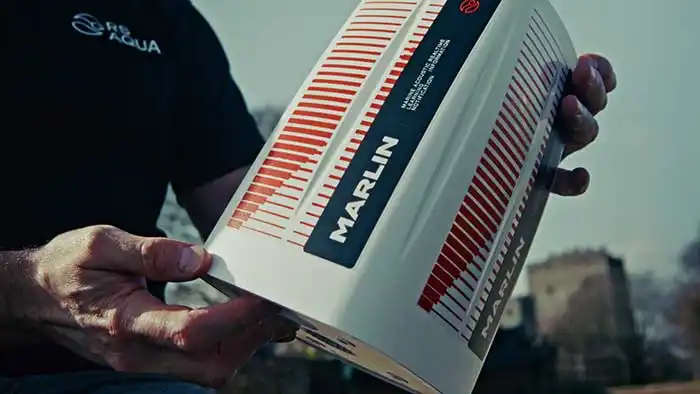
RS Aqua shows a similar widening of purpose in underwater acoustics. The company entered passive acoustic monitoring (PAM) with recorders that collect high-fidelity, broadband sound for scientific survey work, including marine-mammal studies. This scope has since broadened: RS Aqua’s Marlin system combines broadband acoustic recording and real-time data delivery alongside the ability to detect and classify underwater acoustic signatures in real-time for marine-mammal and defense and security applications.
Marlin was recently deployed during NATO’s REPMUS exercise this year, where it demonstrated this combination of real-time detection and machine-learning classification in anti-submarine warfare and maritime-awareness roles.
Across the Group, the direction of travel is not to retreat from science but instead to recognise the opportunity that a crossover of requirements between scientific customers and defense customers brings. The distinction lies in the mission, configuration and handling of the data, but both demand better endurance, richer datasets and more efficient autonomous observation.