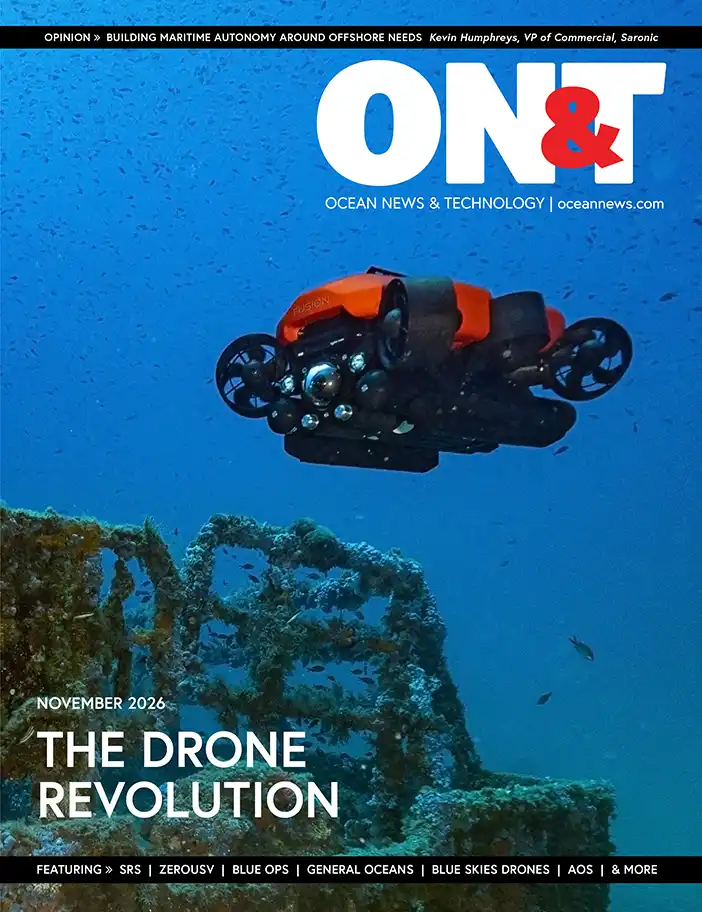
From October 6–8, 2026, in Washington, DC, speakers from US Navy unmanned programs, a Caribbean coast guard, an energy major, research labs, and startups kept returning to that same point. The vehicles have earned their place at sea. What remains unsettled is everything around them: procurement, data sharing, certification, and how their builders survive long enough to scale.
The Bottleneck is the Framework
“From our members’ perspective, the main barrier today is not technical,” Keith said. She cited export controls that block interoperability, certification repeated nation by nation, and funding that ends at demonstration rather than production. Her fixes included government-owned interface standards, mutual recognition of testing, faster export licensing for trusted partners, and funding that follows prototypes into production.
Michael Stewart, Founder of N86U, LLC, and former Director of the Navy’s Disruptive Capabilities Office, advised technologists to lead with the operational problem, not the specification sheet. He mapped entry points by maturity—SBIR and STTR for early-stage firms, the Defense Innovation Unit for well-capitalized newcomers, program offices for mature products—with ITAR a significant hurdle for foreign entrants.
Partnership as Capability
For small states, the framework question is existential. Commander Kele-Ann Bourne Jessen, Trinidad and Tobago’s defense attaché, described a coast guard that “cannot be everywhere,” and framed autonomy as a force multiplier for scarce crewed assets. “Partnership itself is the capability,” the commander said. During questions, the commander urged vendors to move “from a vendor customer model to one where we have a problem-solving partnership.”
Others reported similar maturity in harder environments. NOAA’s Great Lakes Environmental Research Laboratory discussed sending updated missions to a Saab Sabertooth over an acoustic link under ice, while Woods Hole Oceanographic Institution cited two decades of AUV Sentry operations and a 95 percent mission success rate, even with deviations on 43 percent of dives. Chesapeake Technology made the case for processing sonar data onboard so vehicles surface with answers, not raw data.
Proven at Sea
Michael Scherer of Chance Maritime Technologies described 2025 Florida seafloor mapping with Woolpert, split evenly between a crewed vessel and Chance’s USV. The uncrewed platform was slower but more productive overall, thanks to its endurance and ability to work in higher sea states. This summer, Chance ran what Scherer described as Woolpert’s first fully uncrewed survey, 20–50 nautical miles offshore in 200–400 m of water with no mothership, then switched payloads so the same USV could track an AUV as a USBL gateway.
Founders Weigh the Defense Wave
Founders from Bubble Robotics, Juice Robotics, Open Ocean Robotics, and Orpheus Ocean offered a candid counterpoint to the defense surge: commercial first, defense second. Stephen Piper, CEO of Juice Robotics, recalled early investors telling him, “we’re not investing in science projects,” making dual use a requirement. Julie Angus, Co-Founder of Open Ocean Robotics, noted that new security requirements carry real costs for a 25-person company, and offered the panel’s most quotable lesson: “everything takes longer and costs more than you think it will.”
What Comes Next
The forward look converged on systems of systems: surface vehicles launching underwater robots, aerial drones lowering tethered sensors, and AI at the edge turning data into decisions. If TechSurge is any guide, the next phase of maritime autonomy will be decided less by what the vehicles can do than by how quickly policy, procurement, and partnerships can keep up.