Traditionally, underwater security has relied on periodic inspections conducted by divers, remotely operated vehicles (ROVs), and survey systems. While effective, these deployments provide only point-in-time assessments of conditions within harbor approaches, navigation channels, anchorages, and other critical areas. Between inspections, changes can occur that may affect infrastructure integrity, operational safety, or security.
“Once a baseline is established, the operating model changes significantly. Operators no longer need to treat the underwater domain as a broad search problem. Instead, they can focus on identifying deviations from known conditions.”
As governments and infrastructure operators place greater emphasis on protecting critical subsea infrastructure, attention is increasingly turning toward technologies capable of providing persistent awareness of the underwater domain. NATO
ONT August 2026 has expanded initiatives focused on subsea security, while maritime authorities continue to strengthen maritime domain awareness and infrastructure resilience efforts. At the same time, the commercial offshore industry has spent decades developing technologies that address many of the same operational challenges through remote operations, resident robotics, autonomy, and integrated monitoring architectures.
These developments are driving a shift away from periodic underwater inspection and toward persistent surveillance architectures capable of maintaining continuous awareness of critical maritime environments.
Ports as the First Proof Point
Ports may become the first environment where persistent subsea surveillance transitions from concept to operational reality.
Modern ports contain dense concentrations of critical assets, including berths, navigation channels, subsea utilities, communications links, energy infrastructure, and military logistics facilities. At the same time, they experience continuous vessel traffic, changing environmental conditions, dredging activity, and infrastructure maintenance.
This combination creates a challenging operating environment. Port operators must maintain awareness of a dynamic underwater domain while ensuring the security and availability of critical infrastructure. Historically, that awareness has been generated through recurring surveys and inspections. Emerging surveillance architectures are enabling a fundamentally different approach based on continuous monitoring and rapid identification of meaningful change.
Rather than increasing inspection frequency, the objective becomes maintaining an accurate and continuously validated understanding of the operating environment.
Why Baselining Matters
A subsea baseline extends beyond a hydrographic survey or infrastructure inventory. It represents a continuously validated understanding of environmental conditions, infrastructure status, bathymetric features, vessel activity patterns, acoustic signatures, and other characteristics that define an operating area.
Within ports, this baseline is inherently dynamic. Sediment movement, vessel traffic, weather conditions, maintenance activities, and infrastructure modifications continually influence the underwater environment.
Maintaining awareness therefore requires ongoing validation of the baseline rather than periodic verification alone. Once a baseline is established, the operating model changes significantly. Operators no longer need to treat the underwater domain as a broad search problem. Instead, they can focus on identifying deviations from known conditions.
These deviations may include the appearance of new seabed objects, unexpected sediment disturbance around critical infrastructure, unusual activity within protected areas, or other anomalies that warrant further investigation. By comparing current conditions against a continuously updated baseline, operators gain a faster and more efficient method for identifying potential risks while reducing the resources required for broad-area surveillance.
In this model, change detection becomes the core security capability.
Inspection to Surveillance
Traditional inspection programs provide snapshots of conditions at specific points in time. Although valuable, they cannot necessarily reveal what occurred between inspections.
Persistent surveillance addresses this limitation by combining resident systems, autonomous vehicles, distributed sensors, and integrated monitoring technologies into a continuous monitoring architecture. Rather than waiting for the next scheduled survey, systems can collect information on a routine basis, validate baseline conditions, and detect anomalies as they occur.
This approach transforms subsea security from a periodic assessment activity into a continuously informed operational process. Change-detection and anomaly-recognition technologies compare current conditions against established baseline data, allowing operators to focus resources where meaningful deviations occur. Artificial intelligence, automated target recognition, and sensor-fusion technologies further enhance this process by prioritizing events that warrant human review while reducing operator workload.
The result is faster situational awareness, more efficient use of resources, and improved decision-making across complex maritime environments.

Persistent Presence
Maintaining a continuously verified baseline requires platforms capable of collecting data, updating environmental models, and investigating anomalies when they emerge. Recent advances in subsea residency and autonomy are making this possible.
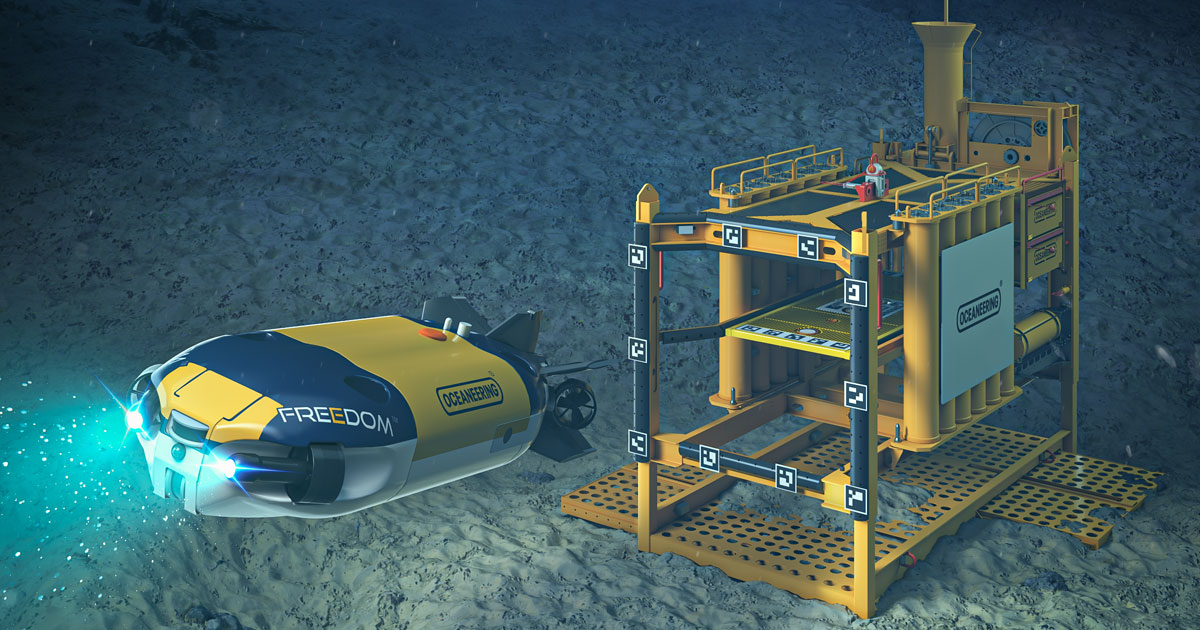
Resident systems allow robotic assets to remain deployed near critical infrastructure for extended periods. These systems provide power, communications, docking capability, and operational readiness without requiring repeated mobilization from shore or support vessels.
When paired with autonomous vehicles, resident systems support routine surveys, baseline validation, and targeted investigation of detected anomalies. Instead of deploying assets only when a vessel becomes available, robotic systems remain positioned near the mission area and can be tasked when required.
For ports, this capability enables continuous monitoring of harbor approaches, navigation channels, anchorages, and critical infrastructure. Autonomous systems can revisit areas of interest, collect higher-resolution information, and determine whether a detected change represents normal environmental variation, routine port activity, infrastructure degradation, or a potential security concern.
Persistent presence therefore becomes an operational capability rather than a deployment strategy.
Remote Operations
Persistent surveillance is not solely a sensing challenge. It is an operational challenge.
Ports already generate large volumes of information. The challenge is not acquiring additional data. The challenge is transforming those data streams into actionable awareness.
Oceaneering’s defense-configured Onshore Remote Operations Centers (OROCs) address this challenge by providing a single pane of glass for unified oversight of uncrewed systems and mission-critical infrastructure. Rather than introducing another standalone system, OROCs integrate mission-planning tools, vehicle control software, surveillance feeds, sensor networks, and infrastructure monitoring data into a cohesive operational environment.
This architecture provides operators and decision-makers with a shared operating picture across both offshore and onshore assets. Autonomous vehicles, resident systems, acoustic sensors, radar inputs, AIS feeds, and infrastructure monitoring technologies can all contribute data to a common operational framework, enabling faster situational assessment and more informed decision-making.
The operational advantages extend beyond visibility. Remote operations architectures enable expert reach-back support, allowing specialists to assess anomalies, support mission planning, coordinate investigations, and assist response activities without requiring deployment to the affected location. Secure communications pathways and low-latency connectivity enable remote piloting and intervention while reducing the forward deployment of personnel and increasing access to specialized expertise.
For ports and critical infrastructure operators, this operating model shortens decision cycles, improves coordination among stakeholders, and provides greater continuity between detection, assessment, and response. The result is not simply more information, but a more effective framework for operational decision-making.
Port Security to Assurance
The next generation of underwater security will not be defined by inspection frequency or the number of patrol assets deployed. It will be defined by the ability to continuously understand the operating environment, identify meaningful change, and respond with confidence.
As resident systems, autonomous vehicles, OROCs, and integrated monitoring architectures continue to mature, ports may become the first large-scale demonstration of persistent underwater awareness. The same concepts can then be extended to naval facilities, offshore energy assets, subsea cables, pipelines, and other forms of critical subsea infrastructure.
Persistent surveillance enables operators to establish and maintain a continuously verified baseline, rapidly detect anomalies, and coordinate response through a common operating picture. Together, these capabilities support stronger maritime domain awareness, improved infrastructure resilience, and more assured access to critical underwater assets.