Ship-borne sonar systems and, more recently, autonomous underwater vehicles (AUVs) have been used to remotely map the seafloor. However, while these long-distance acoustics-based techniques can be very effective at producing high-resolution terrain maps, there are enormous challenges in collecting the additional types of data that add color to these maps: geological, chemical, biological, and environmental data still require physical access to the seabed.
CHALLENGING CONVENTION
Traditional methods of seabed access have relied on heavy, expensive assets that are almost always connected to a surface vessel by means of a power-and data-carrying tether, such as in remotely operated vehicles (ROVs). This allows for fine manual control of seafloor intervention tasks and live feedback for the operator but intrinsically limits the speed and scale of data collection and requires enormous shipside infrastructure and operational support.
With scalability and flexibility key to operational efficiency, these conventional methods are no longer suitable for a new and prosperous Blue Economy. In a time of shifting priorities, facilitated by accelerating technological advancement and changing business models, we—the collective ocean industries—must focus on deploying the most cost-effective, fit-for-purpose tools to perform subsea tasks.
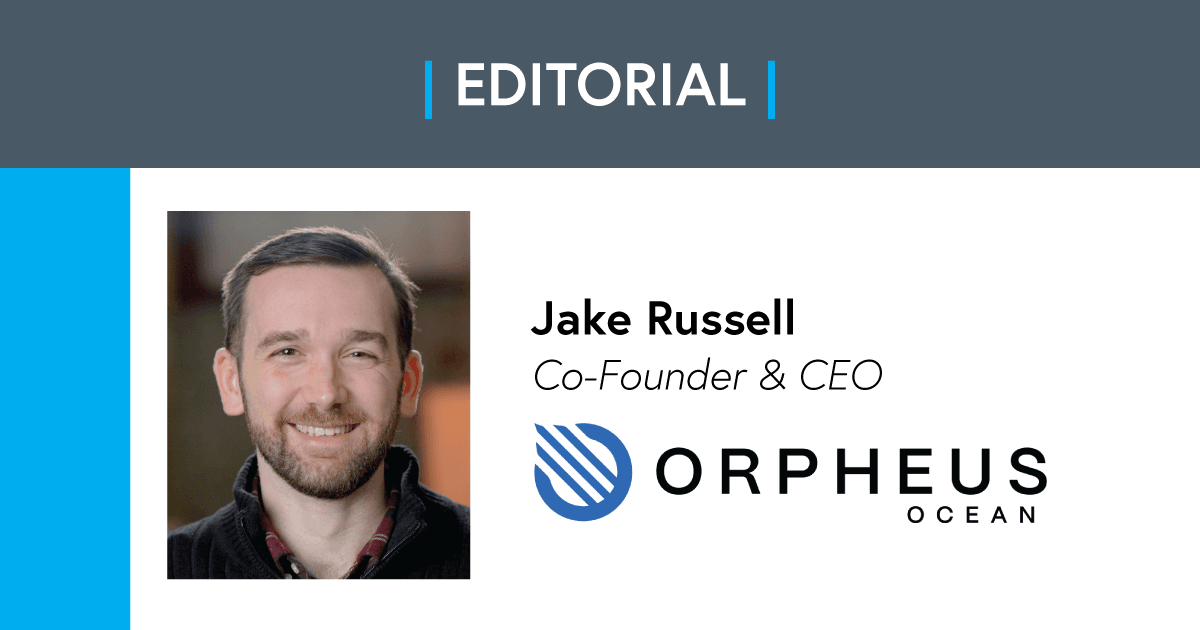
Orpheus Ocean is building the future of deep-sea intelligence. Designed specifically for the needs of emerging ocean sectors, the Orpheus AUV is the first platform to enable autonomous, untethered access to seafloor environments, including physical interaction and high-resolution survey.
AGILE, FLEXIBLE, & SCALABLE
Three core principles drive our technology’s innovative design: agility, flexibility, and scalability.
Exploring the deep is no longer a Herculean endeavor. With a 6 x 2 ft fuselage, and weighing only 550 lbs., the Orpheus AUV is easily transported via air freight for rapid mobilization in remote locations. It is also capable of deployment from even small vessels, requiring nothing more than an over-the-side utility crane, and opening up a much wider range of vessels of opportunity.
Orpheus is the “pickup truck” for seafloor data collection. With a modular payload capacity of up to 50 lbs., the vehicle can be outfitted for a large variety of geotechnical or environmental seafloor tasks. A unique form factor allows for three different operational modes: survey (including terrain following, at ~2 m altitude), land (for sample collection), and loiter (enabling long duration passive or periodic monitoring).
Despite the utility packed into just one small unit, Orpheus is intended to be deployed in “constellations.” Due to the limits of remote sensing, the only way to accelerate most types of seafloor data collection is through physical presence in the environment, and so we are designing the Orpheus AUV to operate in fleets—five to ten deployed from a single vessel for large scale survey and monitoring, increasing coverage and reducing overall time at sea. Coordination between vehicles will enhance overall campaign efficiency.
ILLUMINATING THE DEEP
As we consider the next phase of expansion into deeper, remoter waters, realizing the optimal form and function of increasingly autonomous technologies, to be developed and deployed at scale, will prove instrumental to sector ambition and progress.
Developed at one of the world’s leading ocean research institutions and already demonstrated to depths of 5,700 m, the Orpheus AUV is ready to support the next wave of offshore projects.
This spotlight appeared in ON&T Magazine’s 2025 August Edition, Lights, Camera, Action!, to read more access the magazine here.