The recent geopolitical landscape has painted the West in a corner to defend and combat various threats with new technology, equipment, and platforms. Industry is charged with the responsibility to innovate, rapidly prototype, and mass-produce new technological advancements. However, we’re not always given clear guidance—or commitment—to deliver the best value solutions at scale. This is a systematic issue relating to how specs are derived and communicated vs. what might be the optimal package for the mission, as well as how the problem is assessed/defined at different levels of classification. Often bureaucracy hinders logic, as does a lack of technical expertise making assumptions about various components within a technical system.
FRAGMENTED BRIEFINGS LEAD TO INFERIOR PRODUCTS
In the spirit of accelerating competitive solutions and industrial base expansion, Government frequently breaks procurement for systems into the parts. However, as the adage goes, the whole seldom equates to the sum of its parts. Unfortunately, by the time the segregated components are detailed in a spec at a lower-classification level to send to industry, ocean tech developers are often constrained by a “dumbed down” spec that is costly to manufacture and has a degraded performance once integrated into the final system. This is a lose-lose scenario for all stakeholders; Government is left with an overengineered and underperforming system; industry is left underutilized and often isolated; and taxpayers are left to pay for a product that misses the mark.
Unmanned platforms must scale, but how they are equipped and outfitted for any given mission is often eclipsed by the attractiveness of the vehicles’ broad operational capabilities. When it comes to the integration of remote sensing payloads and communications systems, this can—and must—be better thought through.
Furthermore, amid mounting global tensions, many reminiscent of the geopolitical uncertainty preceding earlier wars, it is imperative to educate and empower the American population. Adequate preparation—as a nation, with allied partners, as industry, as citizens, and as a military power—requires a “systems-of-systems” mentality. This allows for strategic innovation and smart engineering that can be mass produced to meet the demands appropriately, opposed to mismanaged resource allocation.
SYSTEMS THINKING IS ESSENTIAL
There is no isolated cause-and-effect but rather an intertwined series of events that impacts any system. When we design products and deploy solutions to preserve our sovereignty, we are wise to embrace public-private collaboration and consider all things (the tactical mission objectives, the geopolitical strategic-thinking of our friends and foes) to fi eld the most advanced products capable of delivering true advantages to our warfighters and reinstate the US as a global leader in marine engineering and manufacturing. Systematic thinking also translates into cultural perspectives at play among Allies and Adversaries. In educating American citizens we empower them. In so doing we inspire creativity, purpose, and partnership in careers of innovation, production, and in diplomacy.
It is both naïve and misguided to believe that the recent acceleration of the Defense Industrial Base (DIB) and the push to be prepared for war is the same as warmongering. It is quite the opposite. The intentions of our adversaries are not in the interest of freedom, and their controlled narrative has seeped into certain media as a means of undermining shared international norms and values.
Commitment to monitor and defend the Arctic as well as the commitment to protect a free and open Indo Pacific with a readiness to counteract against coercive action between now and 2027 is in the interest of the free world. Where ice once acted as a barrier, there are increasingly open passageways for submarines and military vessels. Russia is very much aware of this. Fortunately, so is America and her allies. This is where autonomous and unmapped platforms and systems become so essential in the defense of contestable seas.
RETURN TO SMART INNOVATION & ACQUISITION
Many UUVs and AUVs come in slight variations of size and shape. However, the customer/end-users often don’t know what’s exactly needed for an optimized sensing platform. Embracing open architecture and interchangeable payloads is an advantage. However, when this thinking is extended arbitrarily to include sensors, the mission-critical performance suffers. When corners are cut in system design and integration, over engineered software to compensate for the use of outdated transducers/sensors is too often the costly result. There is often a significant difference between COTS solutions and the latest and best technology available. Sensing systems are fundamental for informing autonomy, control, surveillance, detection, communication of data, targeting, and so fundamental to maintaining an undersea advantage. Ensuring maximum return on investment—and return on innovation—should, therefore, be prioritized.
Department of War (DoW) states in the “Acquisition Transformation Strategy, Rebuilding the Arsenal of Freedom” a focus on a systems-of-systems approach and yet they end up splitting sensors from the systems and essentially ordering the equivalent of “over-priced Lego kits” from which they end-up repurposing “bricks”—i.e., hardware such as sensors and transducers—from other older designs to hopefully (and unrealistically) meet the requirements of modern systems. Upgrading the software and incorporating AI is not enough.
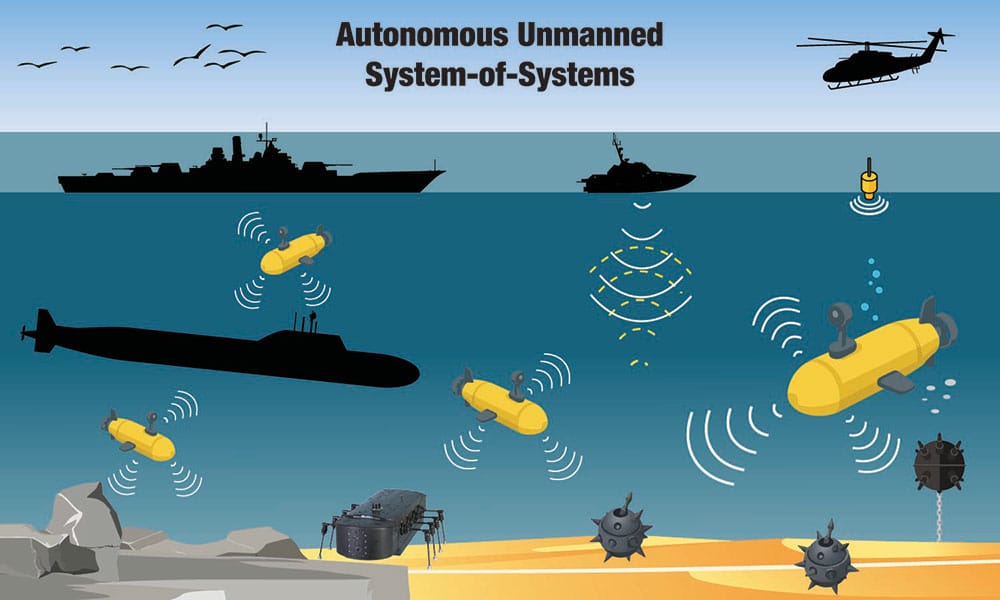 A technological ecosystem that embraces unmanned platforms must prioritize the role and integration of intelligent sensors. (Credit: MASSA)
The UUV/AUV space sits in limbo, alongside sensor design and integration, between the traditional government procurement avenues and the more wallet friendly and practical sales and development/ modernization avenues that the commercial industry allows. This is confusing for the greater DIB and Maritime Industrial Base (MIB), especially Small Businesses, due to mixed messaging. We hear intentions from formal announcements and published documents, such as the DoW’s 2026 National Defense Strategy among others, but in many cases the procurement process and strategic implementation has not yet been fully embraced and adapted.
REVOLUTIONIZE WHAT’S POSSIBLE
Industry must lead by example to shift this thinking and take the lead in bringing America back to its innovative and manufacturing roots. But this requires support from the Government. The DoW’s November 10, 2025 “Acquisition Transformation Strategy” Establishing an America First Arms Transfer Strategy—The White House emphasizes things like the importance of system-of-systems architectures and enhanced warfighting capabilities—of which UUVs/ AUVs are central—but the current understanding of what is possible in the outfitting of these unmanned systems with various sensing capabilities is based on what is “available” in the market as opposed to what is actually “possible” from industry. Innovative businesses remain competitive due to their IP and internal advancements, much of what is not public information.
To achieve sensing superiority, the US needs to do two main things: first welcome mission-specific discussions between the Government and industry experts from both the unmanned and sensor design and manufacturing spaces; and second, give a clear demand signal to purchase the optimized platform at quantity. By encouraging the producers of unmanned systems to seek partners in advanced sensing capability and production, we extend the realm of what is possible in real-world naval defense, and this can only be good for tactics in the Indo Pacific and Arctic.
Cutting red tape and fostering a culture of collaboration is how Allied Nations won WWII. These measures are once again required to preserve the freedoms, and comforts, that we all cherish. FY-27 begins in October 2026.
This feature appeared in ON&T Magazine’s 2026 March Edition, Unmanned Naval Defense, to read more access the magazine here.