Prior to the late 1990s, most AUVs were one-off research platforms. Since then, commercial deliveries now significantly outnumber university builds, with an estimated 3,000–4,000 systems produced to date. Yet despite that growing fleet, more than 90% have been designed around a single purpose: data collection.
Cruising, cylindrical AUVs still dominate in terms of numbers. Powered by batteries and fitted with acoustic and environmental sensors, they have proven effective across science, energy and defense missions alike. But only recently have we begun to see the emergence of platforms designed not just to observe, but to operate.
At Cellula Robotics, we pivoted toward autonomous systems in 2017 after more than 15 years delivering subsea geotechnical equipment. From the outset, our philosophy has been simple: solve real operational constraints instead of following existing convention. That approach has led to new capabilities for both commercial and defense users.
Our family of Envoy®, Porter®, and Guardian® AUVs goes beyond traditional data gathering. Each vehicle is capable of extended- range missions, seabed dormancy, and the deployment of off-platform assets. They share a common architecture, software base and modular hardware integration—but each is optimized for different mission outcomes, spanning science, survey and security.
REIMAGINING AUV SURVEYS
Envoy is a survey-grade AUV that, at first glance, resembles a standard deep-water system: cylindrical, sensor-equipped, and rated for full ocean depth. But its hydrogen fuel cell power system sets it apart. With up to 2,000 km of range—or 15 days of continuous operations at 3–4 knots—Envoy enables a fundamentally different approach to survey logistics.
The advantage is most visible in deep-water operations. At 3,000 m, a typical battery AUV burns two hours of every dive simply descending and ascending, then requires several hours on deck between dives. Over a 15-day survey, that can mean 14 recoveries, each adding operational risk and lost time.
Envoy, by contrast, completes that entire mission with a single launch and recovery. Operational efficiency is nearly 98%, with >1,900 line-km completed—round 15% more than an equivalent battery-powered system—and significantly fewer weather and handling hazards.
Envoy can also deploy micro-AUVs or sensor nodes mid-mission, as demonstrated during previous work with ecoSUB. That capability opens new operational windows that have traditionally required multiple platforms or surface support.
PAYLOAD-CENTRIC XL AUV OPERATIONS
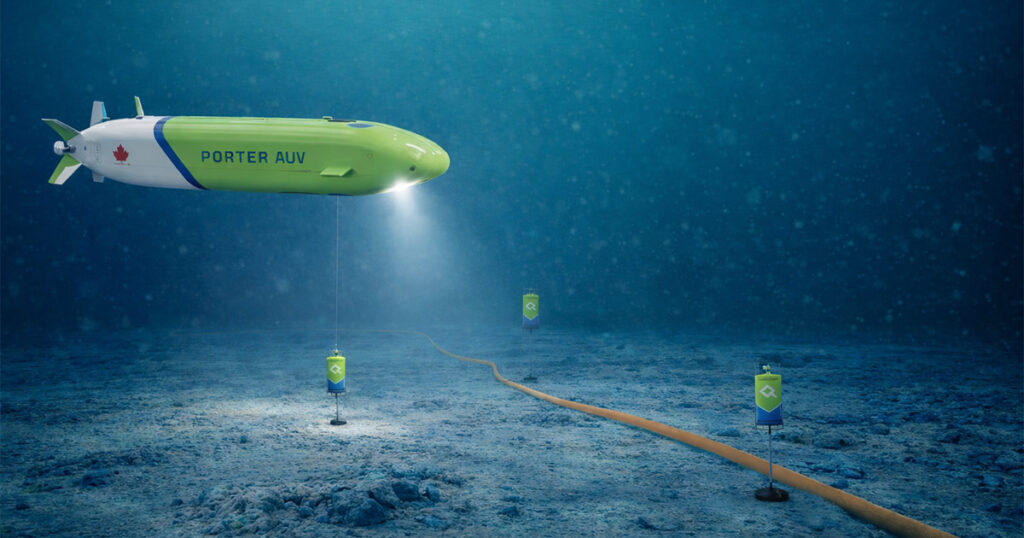
At the other end of the spectrum, Porter and Guardian occupy the true XL class. Their square cross-section and structural layout were designed around payload, not the other way around. Both platforms meet similar technical requirements, but address distinct markets: Porter for commercial operations, Guardian as a COTS solution for defense.
Powered by the same fuel cell technology as Envoy, these vehicles can carry enough energy for 5,000 km or up to 45 days submerged. They can function as survey platforms, generating more than 100 TB of raw data per mission—but they are also built to deliver and recover assets.
A central payload bay, suspended within a strong-back chassis similar to a Sikorsky S-64 Skycrane, allows tools, power modules, sensor nodes such as our Subsea Sentinel®, and other mission payloads to be transported and deployed with precision. Unlike most AUVs, Porter and Guardian are designed not just to slow down, but to stop, hover, station-keep, and reposition using integrated ducted thrusters and seabed reference systems.
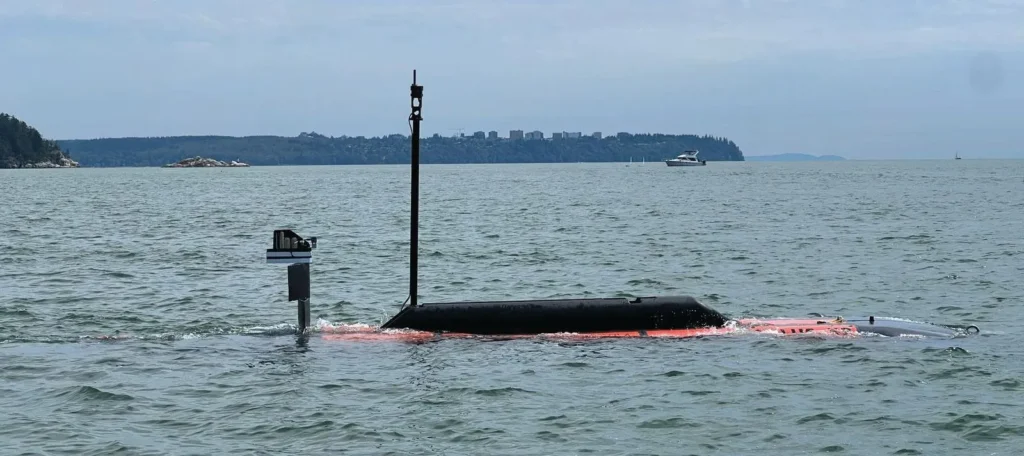
This capability becomes essential when operating mobile assets. Working with partners, we have already deployed, controlled, and recovered an observation-class ROV from the prototype Solus-XR platform. During the operation, the AUV maintained position, launched a tethered communications buoy to the surface, and enabled over-the-horizon ROV control without a crewed surface ship.
RETHINKING SURVEY LOGISTICS
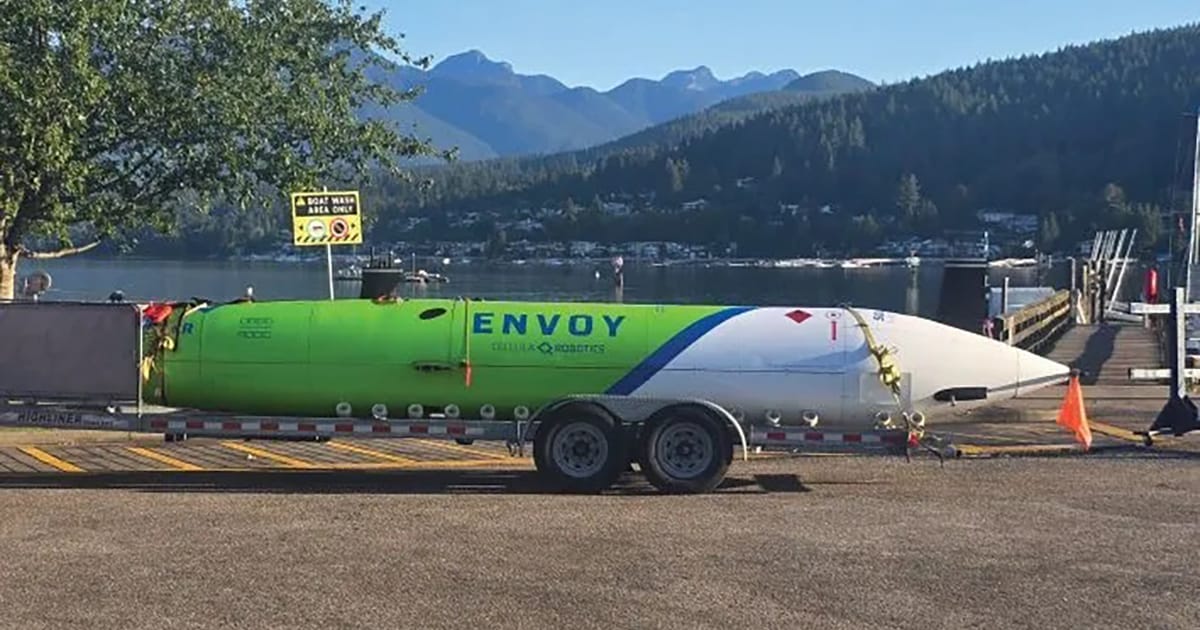
The extreme endurance of Envoy, Porter, and Guardian enables operators to rethink their entire operational model. All Cellula AUVs can be operated from shore and launched with minimal surface infrastructure—in fact, we launch and recover Envoy using a simple boat trailer.
That means many missions can be run with no dedicated geophysical survey vessel in support. A deep-water DP2 survey ship operating for 15 days can cost upwards of $700,000 and generate hundreds of tonnes of CO2 emissions. By shifting work to long-endurance autonomous platforms, operators can not only reduce risk and cost but dramatically shrink the carbon footprint of subsea data acquisition.
TRANSITION BETWEEN SEGMENTS
Defense requirements are accelerating the maturation of long-range AUV technology. Modern naval planners are preparing for operational environments where access is contested, surface visibility is a liability, and persistent subsea presence is required without giving away intent. XL-class AUVs capable of remaining dormant on the seabed, deploying off-board assets, or acting as forward sensing nodes are being viewed as force multipliers rather than research tools.
Unlike traditional military AUVs, these systems can support ISR, seabed warfare, logistics, and modular payload delivery at strategic ranges—all without a crewed platform in proximity. As new naval concepts of operations evolve, the line between commercial and defense AUV technology is blurring, and the ability to adapt rapidly to mission needs may become the decisive factor in future subsea capability.
THE FUTURE IS NOW
The future of subsea autonomy will not be defined by vehicles that only collect data, but by systems that can persist, decide, and act. Platforms like Envoy, Porter, and Guardian illustrate where the industry is heading: long-duration, low-logistics, multi-role autonomy that enables payload delivery, remote intervention, and presence without platforms.
As global demand increases for secure seabed infrastructure, offshore energy transition, deep-ocean research, and undersea defense, the question is no longer whether AUVs will replace legacy operations—but how quickly.
The technology exists. The operational advantages are clear.
This feature appeared in ON&T Magazine’s 2026 January Special Edition, The Future of Ocean Technology Vol. 6, to read more access the magazine here.