
From Metron’s perspective, a simulation-first approach must come at every stage of autonomous systems development. Adopting a simulation-first approach early in the process that can test, validate, and evaluate software, platforms and systems long-before in-water deployments, fundamentally speeds up the development cycle while also mitigating risk and controlling costs. Full cycle testing, evaluation, and validation can shorten the time from innovation to real-world mission success. However, the type of simulation employed across development can be the difference between a strategic advantage and an innovation failure.
VEHICLE DYNAMICS VS WHOLE-SYSTEM SIMULATION
Traditional simulation environments were designed primarily to reproduce physical vehicle dynamics in nominal environmental conditions. Today’s challenge is broader: validating autonomy (software, hardware, mission plans), across a growing mix of vehicles, sensors, and command-and-control systems in a broad range of environmental conditions.
Autonomous operations—whether a single vehicle, networked vehicle, or platforms and systems working across a multi-agent scenario—do not run in a static environment. Simulation must incorporate external environmental forces such as ocean currents, wind, vessels, and subsea and surface infrastructure. Having the flexibility to model external assets—static, moving, and hovering beyond the platform—plays a critical role in determining mission success rates.
In addition, the ability to separate the software testing; the vehicle platform, sonar and payload testing; and testing environmental conditions against mission priorities, determines speed to capability. Only through high fidelity faster-than-real-time simulations that incorporate software-in-the-loop (SIL), hardware-in-the-loop (HIL), and advanced modeling of the environment and mission plan, can you achieve the right kind of insight.
With these priorities in mind, Metron developed a physics-based maritime simulation framework called Volans to solve these challenges and provide an extensible architecture that can evolve with platform, software, and payload changes as new innovations come onto the market and environmental conditions change.
EVALUATING AUTONOMY AT SCALE THROUGH SIMULATION
Volans was developed to evaluate and test Metron’s Autonomy, Navigation, Command and Control (ANCC) software as part of Metron’s prime role in the Office of Naval Research, LDUUV Innovative Naval Prototypes program to design, integrate, and experiment on LD and XL class UUVs.
Today, Volans has over a decade of proven simulation capabilities for defense, commercial, and scientific applications and is being used to simulate a wide range of autonomous systems—USVs, UUVs, UAVs, and manned operations including submarine and seal delivery systems—in close to real world environments.
Volans simulations provide interoperability to match customer requirements allowing for the integration of any autonomy, any single or multi-platform dynamics, plus navigation, or C2 software— whether proprietary, government-standard, or experimental. A plug-and-play interface enables developers to connect autonomy code via a software bridge to a working digital twin before hardware is built.
With advanced simulation capabilities, customers can optimize complex procedures and mission requirements while allocating more efficient use of resources. Users can trade off modeling/simulation accuracy and simulation speed based on mission parameters. Often, new vehicle models can be generated in as little as two days, and integration timelines that once required months are now measured in weeks. Because Volans interacts with the autonomy stack via the same interfaces as the autonomy stack interacts with a real system, it facilitates rapid integration and validation of new autonomous capabilities onto new systems before those systems are even built. By the time a system reaches the water, it has already executed hundreds of simulated missions under varied environmental and operational conditions, each one refining control behavior, validating model fidelity, and reducing reliance on costly at-sea testing.
VOLANS AT A GLANCE: VEHICLE DYNAMICS
Volans can simulate multiple heterogeneous vehicles concurrently, each with its own dynamics model, sensors, and autonomy stack. Volans supports simulation of different vehicle types (UUVs, USVs, and UAVs) and three classes of vehicle dynamics (Fossen, reduced order closed-loop, scripted) which can be mixed and matched within a single simulation environment. Simulations can run for hours or weeks, covering hundreds of miles, while maintaining spatial accuracy through a true geodetic coordinate system.
Vehicle models are built using manufacturer-supplied parameters—mass, buoyancy, thruster configuration, and control surfaces—and refined by fitting parameters to data from in-water experiments.
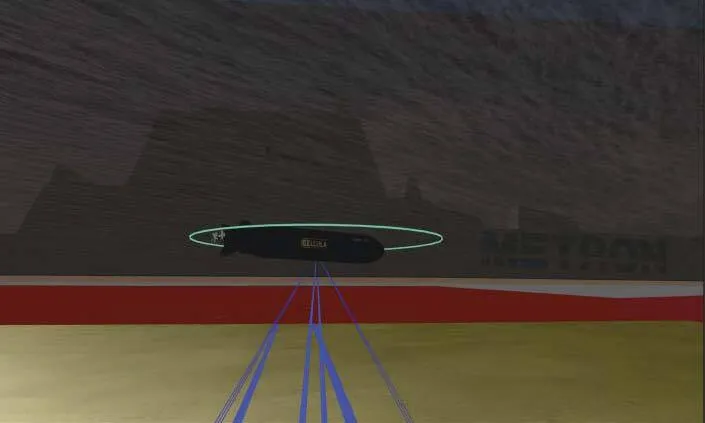
- 6-DOF Fossen Model: A high-fidelity hydrodynamic model with more than fifty tunable parameters that capture forces, moments, buoyancy, Coriolis effects, and added mass. This configuration is used for precision operations such as docking, recovery, and close-proximity maneuvers.
- Reduced Order Closed-Loop Model: Approximately twenty parameters tuned to match measured in-water behavior. This model has been able to achieve a good fit to field data for several vehicles. Environments with several such vehicles can typically be simulated at 15x faster than real-time speed on standard desktop hardware, supporting large-scale or long-duration simulations.
- Purely Scripted Motion: For simulating non-reactive traffic or background vessels, in proximity of the area of interest. This model interpolates states for identified traffic from a series of key-framed trajectories where each keyframe contains a waypoint and timestamp.
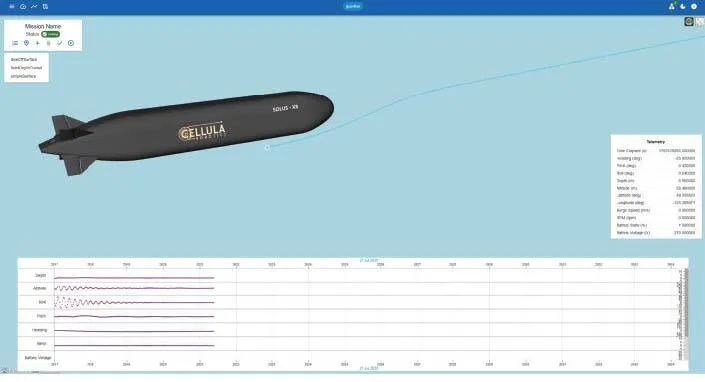
For operations covering large geographic areas, the desired spatiotemporal scale of simulation makes detailed simulation of, e.g., fluid dynamics, impractical. Instead, Volans focuses on simulation at a resolution that (1) affects autonomous decision making and (2) can be validated via in-water testing. This results in efficiencies when simulating sensors, controllers, and communication devices.
Examples:
- For long transits a simple simulated controller might be sufficient, while for docking a UUV to a USV a more precise model could be used.
- For an INS or other sensor-dependent capabilities sometimes a “qualitatively correct” approximation is sufficient, while other times we may want to use a more detailed model.
- Similarly, for basic communications a simple abstraction might be sufficient, while other times it is beneficial to include environmental factors (like salinity and water temperature) that affect speed of communication.
ENVIRONMENTAL MODELING
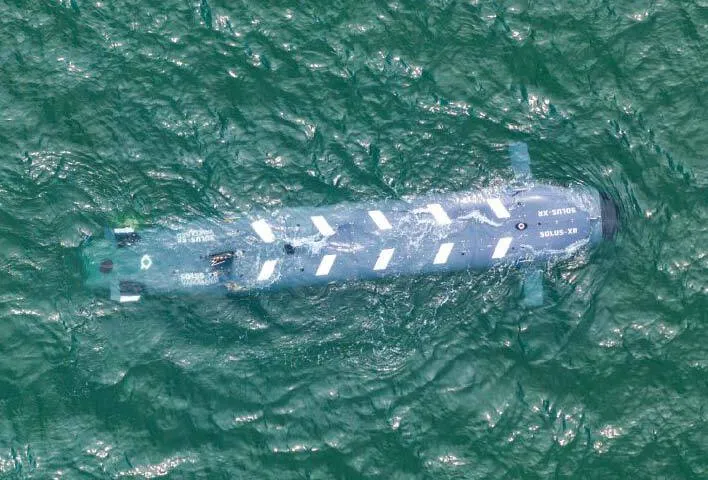
Simulating a static ocean environment will not validate autonomy intended for the dynamic conditions of the real ocean. Volans can read in historical/predicted geospatial data in a variety of standards including NetCDF (a commonly used for-mat). High-resolution bathymetry, time-varying currents, temperature, salinity, surface wind, and tidal data is organized into dynamic patches that load and unload as vehicles transit the simulated world, much like turning pages in a digital atlas. The result is a time-varying, physics-based ocean environment that tests autonomy under the same physical constraints it will encounter in operation. Environmental effects update continuously as vehicles move, influencing vehicle navigation, sensing, and communication.
NAVIGATION, SENSING, AND PERCEPTION
The Volans framework contains models of several sensor and payload configurations used in current maritime autonomous operations.
Navigation: Volans models the sensors that inform an inertial navigation system (INS) including a Doppler Velocity Log (DVL), GPS, USBL, and IMU. Different INS models are simulated that can take in IMU readings, position/velocity fixes, depth fixes, and DVL beam fixes and perform state updates using, e.g., an unscented Kalman filter. These differing levels of sensor simulation fidelity allow users the flexibility to trade off computational speed (i.e., number of scenarios run for a given amount of time) and the cost of running high fidelity sensor models.
Target Recognition: Perceiving and reacting to obstacles or other vessels is an important aspect of autonomous performance. Volans includes an abstracted target recognition capability that can be used for target identification, target classification, and target tracking. The probability of detecting, identifying, and tracking an obstacle or vessel is dependent on the distance to the target. The range threshold for detection is user configurable as is the noise model used for sensor performance. Bearing and range measurements are combined with INS own-state estimates to predict tracks for all detected targets.
Introspective Health Modeling: Volans includes an introspective power consumption model. This model accounts for hotel power, power used by sensors, and propulsor power. Each of those components can be configured to match parameters from real vehicles. This capability enables an autonomy to evaluate whether the current mission is still feasible with remaining power or if, e.g., stronger than expected ocean currents have reduced remaining power to the point that a mission needs to be aborted.
MULTI-AGENT SIMULATION
For many scenarios, customers need to define new behaviors for vehicles without having to build or extend an autonomy software stack. For example, they may want to test whether a particular USV autonomy stack adheres to international collision regulations (COLREGs). This requires simulating the interactions of the customers’ vehicles with other vehicles (which can be made as cooperative or adversarial as desired).
The ability to easily create a large set of agents for maritime vehicles, each with its own set of behaviors, is an important step towards capturing the complexity of the real world. Volans provides a stepped approach where:
- External vessel/traffic behavior can be specified with a set of parameterized building blocks called Non-Player Character Tasks (NPC tasks; the terminology originates from the game industry).
- These tasks be composed into more complex tasks and triggered by events.
- Basic tasks that can be associated with vehicles include driving a route (repeatedly), loitering, deploying other vehicles (e.g., a USV can deploy another USV or UUV/UAS), and relaying messages (i.e., ad hoc networking).
- Vehicles can also be configured to follow a vehicle when it detects it or a detection message is received from a nearby friendly asset.
INTEROPERABILITY
While the original use case for Volans was to test our own Metron autonomy, we have since built software bridges for several third-party autonomy software stacks using different messaging frameworks. The integration of these disparate software stacks is enabled by the Gazebo publish/subscribe architecture that delivers commands to the simulated vehicles and gets updates for vehicle state, sensor measurements, environment from the simulation. Supported messaging frameworks include MOOS, ROS, “raw” DDS, and custom TCP/UDP interfaces.
MITIGATING RISK & INCREASING MISSION SUCCESS
From Metron’s perspective a simulation-first approach must be incorporated at every stage of autonomous systems development. From platforms, to systems, from manipulators to energy grids, full cycle testing, evaluation, and validation can shorten the time from innovation to real-world mission success. For every modern autonomy program, simulation is not a single pre-deployment checkpoint but a continuous resource that supports the entire system lifecycle.
- Development: Thousands of test variations can be executed safely in simulation to evaluate fault handling, degraded navigation, and mission resilience.
- Operations: Digital twins mirror live missions, allowing operators to run “what-if” scenarios or rehearse responses before issuing new commands.
- Post-Mission: Recorded vehicle data feeds back into model refinement, improving accuracy for future missions and closing the loop between simulation and at sea truth.
This iterative process shortens the time between discovery and deployment. Each mission strengthens the next, transforming autonomy development into a continuous, data-driven cycle of learning and development.
This feature appeared in ON&T Magazine’s 2026 January Special Edition, The Future of Ocean Technology Vol. 6, to read more access the magazine here.