The US Navy has innovation in its DNA. It leveraged the transition from sail to steam, the introduction of steel warships to replace wooden ones, and especially the change from the battleship to the aircraft carrier to the centerpiece of the Navy fleet modernize the service. These changes have helped the US Navy keep the peace on the global commons and prevail in war.
During the Cold War this penchant for innovation gathered momentum: from the introduction of the first nuclear submarine, USS Nautilus, in 1954; to the first of the Nimitz-class nuclear aircraft carriers in 1975; to the first Aegis-class warship, USS Ticonderoga, in 1983. These technological developments kept the Navy at the forefront of innovation.
Leveraging Groundbreaking Technologies
Technological developments, especially with unmanned systems, have dramatically changed the character of war over the last several decades. One only need to have a passing knowledge of the conflicts in Europe and the Middle East to see that the use of these unmanned systems is dramatically changing how adversaries fight one another.
While many nations and militaries have engineered advances in the development, fielding, and use of unmanned systems, the US Navy has been a leader in this effort. There were several initiatives that the Navy took over the past several decades such as the use of unmanned air and unmanned ground systems to meet urgent operational needs in Iraq and Afghanistan. That said, these were essentially “one-off” events without staying power.
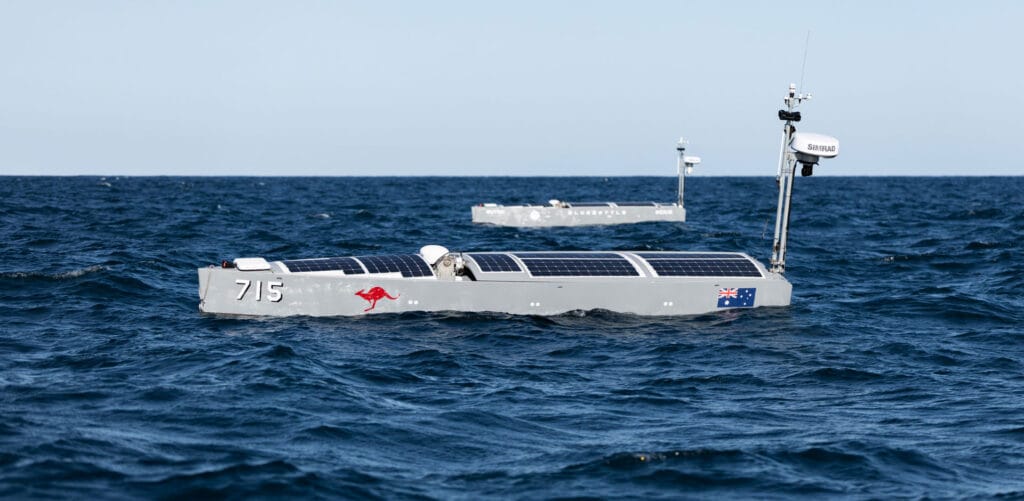
Today, USVs are being developed and fielded worldwide. Like their air and ground counterparts, these uncrewed systems are valued because of their ability to reduce the risk to human life in high threat areas, to deliver persistent surveillance over areas of interest, and to provide options to warfighters that derive from the inherent advantages of uncrewed technologies.
Unmanned Does Not Mean Autonomous
When people talk about systems that are unmanned—meaning that there is no human operator aboard the craft—they often conflate the terms “unmanned” and “autonomous” and use the terms interchangeably. This leads to confusion and obscures that fact that there is a human footprint—and often a very large one— needed to operate and maintain an “unmanned” system.
To be sure, one of the most pressing challenges for the all the US military services—and especially the US Navy—is to reduce the prohibitively burdensome manpower footprint currently necessary to operate unmanned systems. Military manpower makes up the largest part of the total ownership cost of systems across all the Services. This leads to the compelling mandate to move beyond the “many operators, many-joysticks, one-vehicle” paradigm that has existed during the past decades for most unmanned systems.
The need to increase the autonomy of its unmanned systems is especially acute for the US Navy. For autonomous aerial and maritime systems deployed from US Navy ships, every operator and technician must embark on the ship. Each person has a bunk, must be fed, generates administrative and overhead requirements, and has quality of life needs that must be met. This, in turn, generates its own additional manpower needs.
US Navy Efforts to Enhance Autonomy
A recent Joint Staff (J7)-sponsored demonstration brought together two small defense firms—Maritime Tactical Systems (MARTAC) and Turbine-One—to determine if surface system collaborative autonomy could be achieved through collaboration and technical integration. By merging artificial intelligence/machine learning (AI/ML)-driven automatic target recognition (ATR) with unmanned surface vessels, the two industry teams demonstrated real-world capability that is tactically relevant.
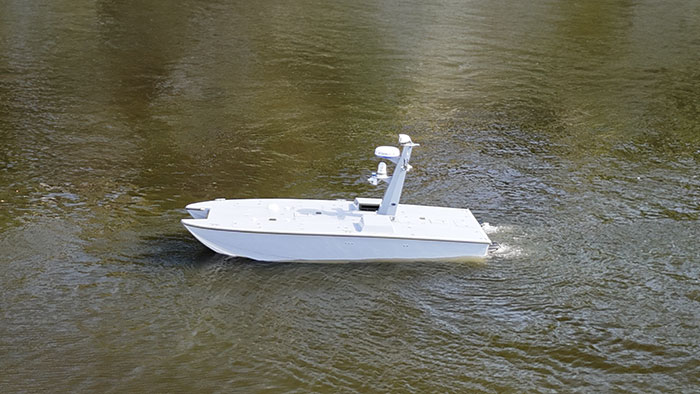
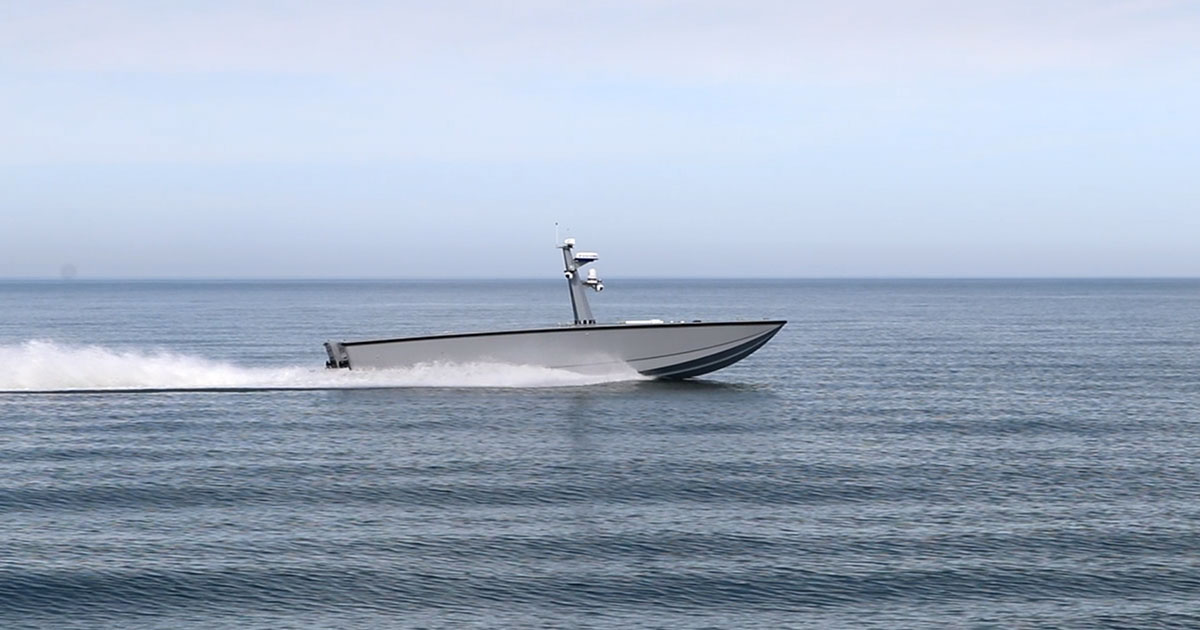
The objective of this Joint Staff demonstration was to evaluate and document the combined capabilities of MARTAC’s USVs and Turbine-One’s Frontline Perception System (FPS) in delivering an integrated, AI/ML-enabled, autonomous maritime ISR and targeting solution. During this demonstration, the FPS-enabled USVs patrolled maritime areas detecting, identifying, and targeting specific maritime “threat” vessels. The threat vessels were identified by FPS, validating the concept of AI/ML-driven maritime ATR and targeting. Upon detection, MARTAC T24 and T38 “Devil Ray” USVs maneuvered to conduct fully autonomous swarming operations to simulate threat mitigation.
Three MARTAC USVs patrolled designated waypoints in zigzag formations. Each USV was equipped with a suite of electro-optical, forward- looking infrared, and marine radar sensors. Turbine-One’s FPS AI/ML software was installed onboard all three vessels, enabling each USV to process sensor inputs locally and autonomously detect, classify, and track simulated threat vessels in real time.
FPS triggered confirmation of the contact of interest (COI) on the detecting USV. This message was then relayed through MARTAC’s mesh network triggering the autonomous swarm. The vessels accelerated into a coordinated intercept formation, executing an overtaking maneuver and maintaining formation around the contact. This is important tactically, operationally, and even strategically as swarming is increasingly recognized as the “coin of the realm” in autonomous operations.
The Future of Uncrewed Systems Autonomy
In 2025, Defense Secretary Pete Hegseth announced sweeping changes to the way the Pentagon buys and fields unmanned systems with a goal of establishing “domain dominance.” The new initiative is designed to ensure that potential US adversaries do not outpace the United States in developing and fielding unmanned systems.
The successful Joint Staff demonstration will likely help achieve these goals by establishing a pathway for scalable AI/ML-enabled maritime ISR operations, confirm the readiness of autonomous USV swarming behaviors, and validate the ability of AI/ML to support time-sensitive threat detection missions.
It is highly probably that similar efforts will take place in upcoming Navy and the Marine Corps exercises, experiments, and demonstrations. Concurrently, via its reconciliation bill, the US Congress has earmarked over $3 billion for unmanned maritime systems, including roughly $2.1 billion for the development, procurement, and integration of medium unmanned surface vessels, and approximately $1.53 billion to expand the production of small USVs.
Implications for Industry
As Congress and the US Navy allocate substantial funding to enable industry build medium and small USVs to meet operational needs, the implications for the maritime industry are clear. First, industry has developed and fielded USVs and have performed well in demonstration exercises. Now is the time for these companies to demonstrate that they can “scale up” production to meet the Navy’s needs.
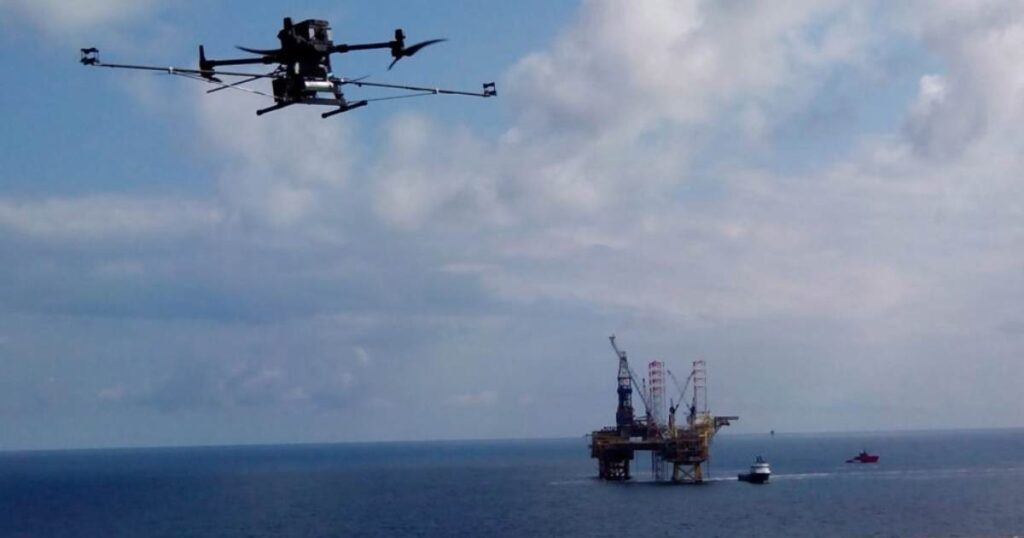
Serendipitously, meeting the US Navy’s needs for medium and small USVs will likely drive down the unit cost of these vessels, making them more attractive and cost-effective for a host of civilian uses such and oil and gas platform monitoring and security, remote ocean monitoring, port and harbor security, hydrographic surveys, delivering supplies, and other missions currently conducted by crewed vessels.