
For OMS Group, a leading provider of end-to-end submarine cable installation and marine survey solutions, this transition is now taking shape with USV Elite, a long-range DriX O-16 Uncrewed Surface Vessel developed by Exail. During recent Sea Acceptance Tests off the South of France, the platform demonstrated strong early performance in vessel handling, stability, systems integration and deepwater survey capability. A key milestone was validating the integration of the Kongsberg Discovery EM124 deepwater multibeam echosounder, marking a major step toward full-ocean-depth uncrewed operations.
Deepwater Payload on a Long-Range USV
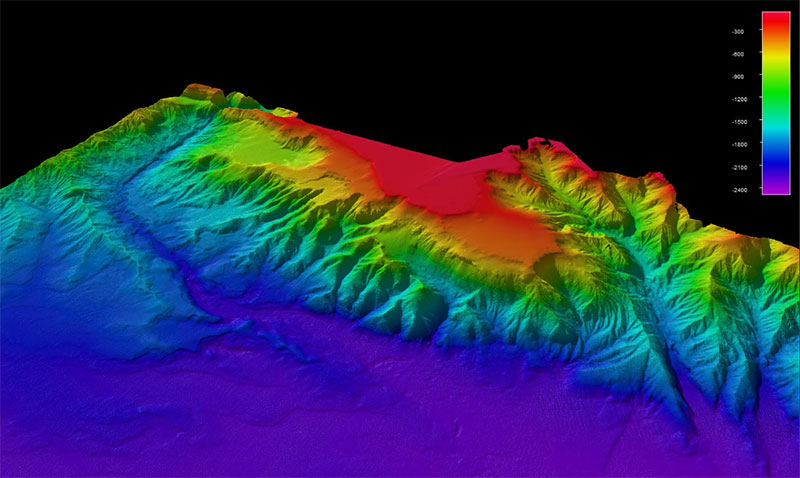
The EM124 is designed for full-ocean-depth seabed mapping, making it a natural fit for cable route surveys, deepwater corridor mapping, and large-scale infrastructure support. Integrating such a system on a USV required more than installing a sensor. It required a vessel architecture capable of supporting the payload mechanically, electrically and acoustically, to ensure high quality bathymetric data.
For this project, Exail designed a specific gondola to convey the EM124. The objective was to provide the sonar with a bubble-free and hydrodynamically efficient installation, while maintaining the platform’s seakeeping, endurance and low-noise characteristics.
Data Quality as a Design Parameter
In offshore survey, platform performance is only valuable if it improves the quality, reliability and repeatability of the data. The DriX O-16 was developed with this in mind.
Its long, slender hull form is designed for efficient transit and stable survey operations. The platform’s hybrid propulsion architecture supports long-duration missions and provides a high level of redundancy of all the vessel critical functions.
The result is a low-noise survey environment intended to support high-quality seabed mapping, even during extended operations offshore. Early results from the SAT program indicate robust full-swath bathymetric acquisition performance aligned with the requirements of full-ocean-depth cable route surveys.
The Drix O-16 is configured with best-in-class PNT (Positioning, Navigation, Timing) to ensure robust motion compensation for the MBES. Navigation relies on Exail Phins C7 inertial Navigation System. Timing distribution through the vehicle is done via the internal network using PTP (Precision Time Protocol).
30 Days of Autonomous Endurance and Reliability
The DriX O-16 was developed for long-range, long-duration offshore operations. With an endurance of up to 30 days and a transoceanic range, the platform is designed to scale survey operations globally, allowing operators to bypass the massive daily OPEX of traditional crewed vessels for missions that require persistence, repeatability, and offshore-grade payload capacity.
For subsea cable operators, this opens new operational possibilities. USVs such as the DriX O-16 can support pre-lay surveys, route verification, post-lay inspection support and monitoring operations, while helping reduce fuel consumption, emissions and human exposure at sea. The same model can also benefit offshore energy, wind farm development, pipeline route surveys, environmental monitoring and scientific mapping campaigns.
This endurance isn’t just theoretical; the DriX USV range is thoroughly sea-proven, having accumulated more than 300,000 hours at sea and logged over 1 million nautical miles of autonomous navigation globally.
A prime example of this operational capability was demonstrated during NATO’s REPMUS exercises, where a DriX O-16 completed a flawless, fully autonomous round-trip transit between Troia in Portugal and La Ciotat in France through the Gibraltar Strait, proving its capacity for persistent, over-the-horizon offshore missions.
Open Architecture for Custom Payloads
One of the key lessons from the EM124 integration is that offshore autonomy cannot be limited to a standard vessel-and-sensor package. Offshore operators have different survey requirements, different payload preferences and different operational concepts. The DriX O-16 was built to address that reality.
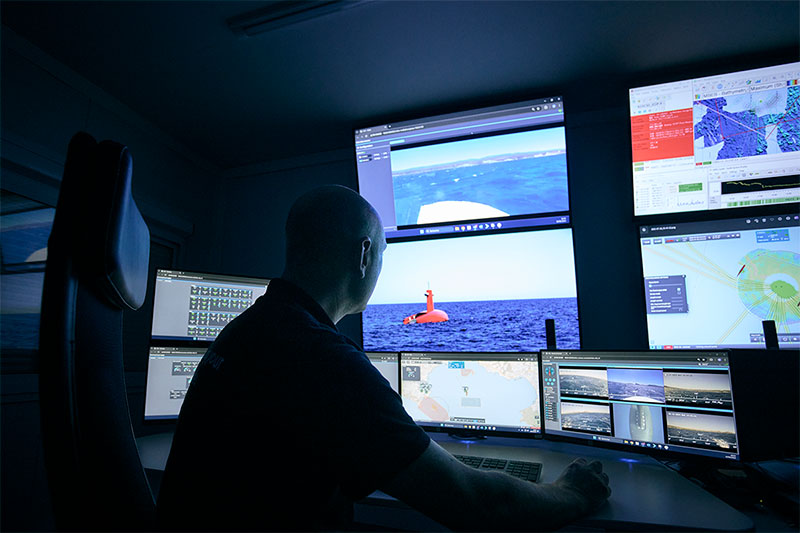
As an open and technology-agnostic platform, the O-16 can be configured around the customer’s mission. Its architecture accommodates diverse payloads, from multibeam echosounders and subsea positioning systems to environmental sensors, AUVs, or ROVs launched from the aft deck, while supporting remote, over-the-horizon supervision.
A New Model for Offshore Survey
The integration of the EM124 on DriX O-16 is more than a technical achievement. It points to a changing model for offshore survey operations.
By combining full-ocean-depth sensor capability, long endurance, hybrid propulsion and remote supervision, the DriX O-16 offers offshore operators a way to acquire high-value data with a smaller operational footprint. Crewed vessels will continue to play an essential role in complex offshore campaigns, but long-range USVs can increasingly complement them by taking on repetitive, persistent or remote survey tasks.
As demand for subsea infrastructure continues to grow worldwide, autonomous and remotely operated systems are expected to play an increasingly important role in supporting the next generation of offshore operations.