Legendary names like Jacques Cousteau and Edwin Link led the way as of the 1950s by engineering vessels capable of extended underwater immersion. These early pioneering submerged human habitats, like Conshelf and Sealab, introduced a brave new dynamic to subsea exploration and inspired legions of scientific minds to harness technology to advance the in-situ study of marine environments.
DEEP VISION
The tech advances afforded present-day explorers—materials, sensors, comms systems, etc.—have facilitated a fresh look at the role of subsea human habitats. This is central to the mission of DEEP, an international research and development organization seeking to apply breakthrough marine engineering principles and technologies to realize a unified mission: to make humans aquatic.
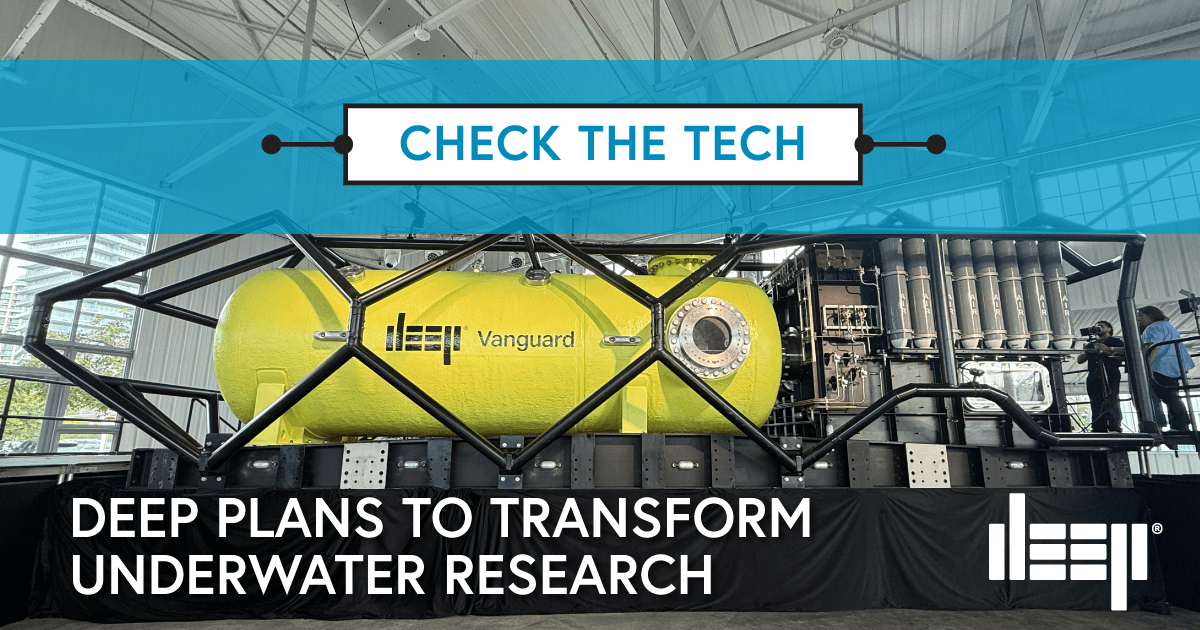
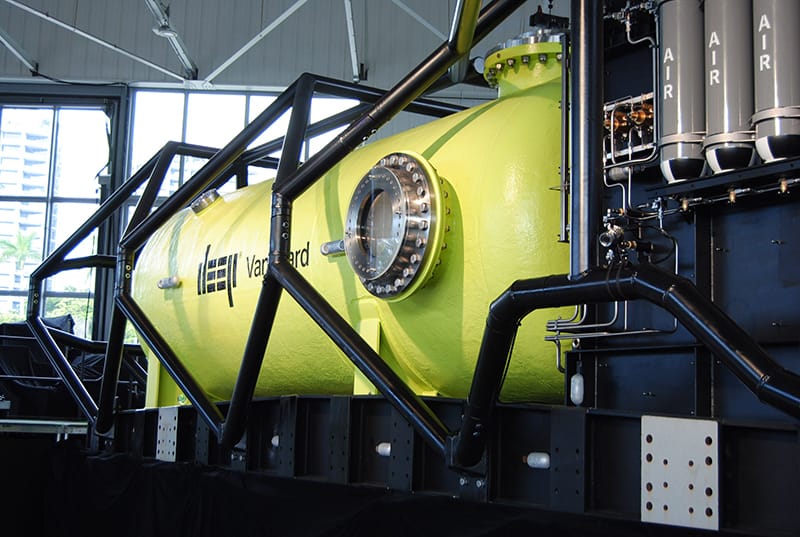
On Wednesday, October 29, 2025, ON&T’s editorial team was invited to an exclusive event in Miami to find out how, which included an opportunity to experience DEEP’s pilot subsea human habitat, Vanguard—the first crewed subsea human habitat of its kind to be constructed in four decades.
Norman Smith, DEEP’s Chief Technology Officer, led us through Vanguard, describing the science and reasoning behind the subsea habitat’s custom engineering. Smith has more than 35 years of experience launching complex technology products for manned space flights with NASA and for deep-water equipment at Oceaneering International.
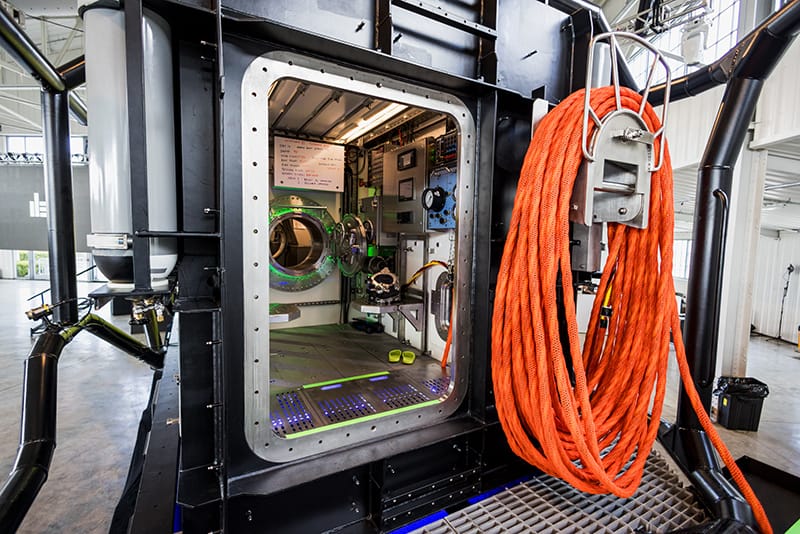
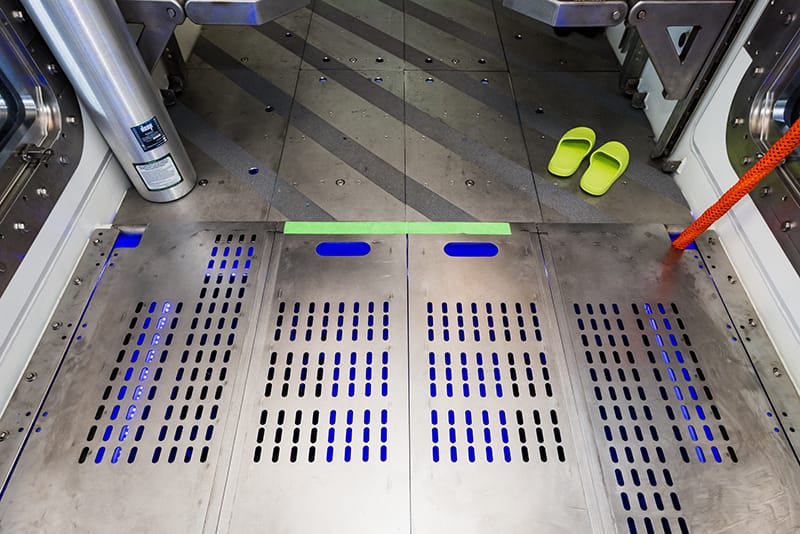
From multi-use seating to strategically placed windows, every inch of Vanguard was custom-engineered and optimized to maximize space and utility for a four-person crew to carry out medium-duration missions of seven days or more. Depth-rated to 50 meters, the habitat comprises three main parts: the living chamber, where the crew eats, sleeps, and works; the dive center, the point of entry/exit; and the foundation, mounted to the seafloor. At the surface, a buoy supplies compressed air, power, and communications to Vanguard.
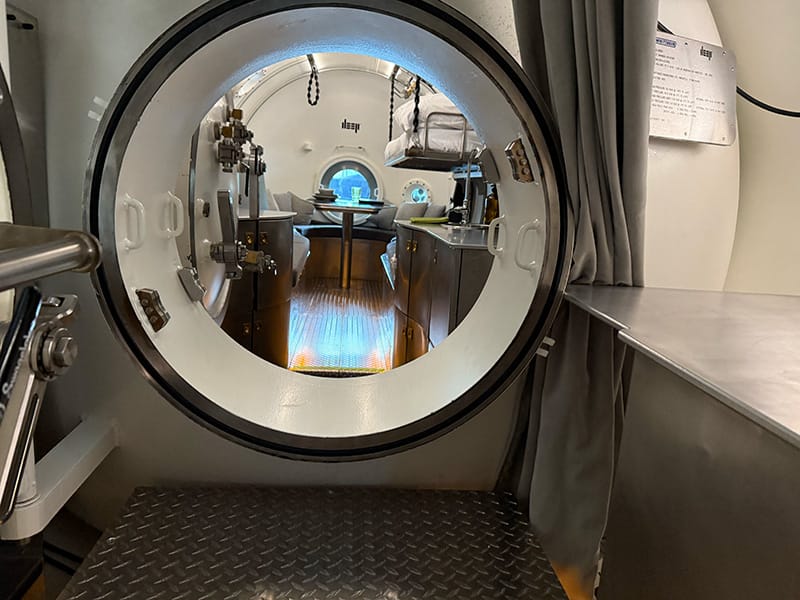
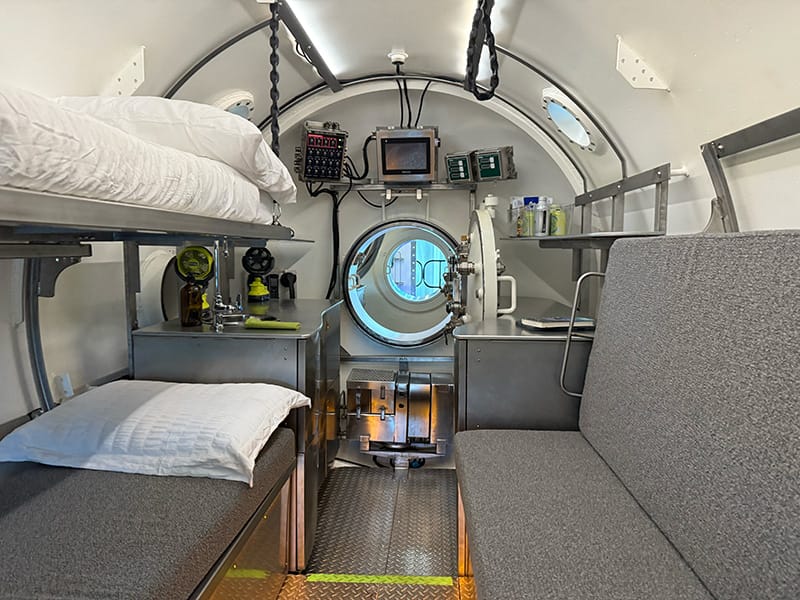
Referencing the pace of DEEP’s technological innovation, Smith shared, “Compared to Jacques Cousteau’s day, there’s a lot of new technology here. All of the electronics, the atmosphere monitoring…they didn’t have any of that. But the bread and butter of Vanguard—the pressure vessels, the hatches, the steel—that’s all engineering.
“The single most important thing this past year to keep pace with this level of innovation and development of Vanguard was DEEP pulling together the team that was able to execute this project. Cherry picking the companies and individuals that we wanted to work with and bringing them together, getting them focused, and beginning the ‘storming and norming’ phase.”
Ironically, when asked about some of the main challenges Smith’s engineering team faced, he pinpointed the livability of Vanguard.
“This is our second or third version of the interior, and we still aren’t done tinkering.
“Bringing human factors into this realm has been difficult. It has been done in the space world, space modules, space stations…they are faced with a lot of human factors. But as far as the ocean realm is concerned, there isn’t as much experience there.
“Stitching the human factors into the way we develop and engineer these systems is going to take us some work to get it right—but it is doable.”
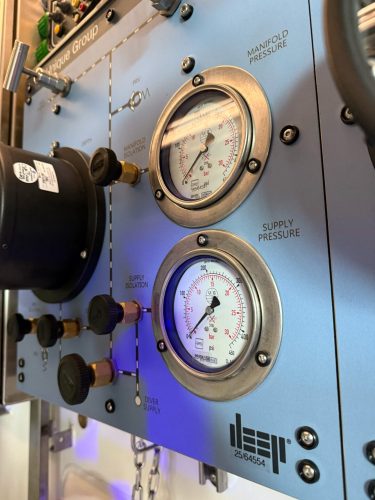
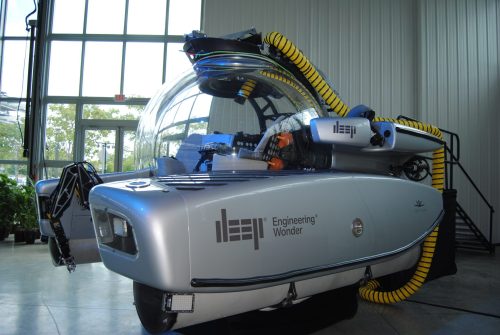
Engineered by a hand-selected team with vital, multidisciplinary subject matter expertise, Vanguard was built at Triton Submarines’ facility in Sebastian, Florida. Notably, Vanguard will be the first underwater habitat to be classed by DNV, a leading global certification provider for maritime technology, establishing a new global benchmark for safety in subsea habitation. DEEP’s choice of partner in Triton Submarines afforded teams the opportunity to leverage the company’s expertise in pressure vessel design, certification, and underwater systems integration. Bastion Technologies and Unique Group further strengthen the Vanguard project team with world-class expertise in aerospace and subsea engineering, as well as diving and marine services, respectively.
DEEP LEARNING
Future applications for Vanguard were teased as reef restoration operations, simulating future spaceflight conditions for astronauts, technical diving studies, and more.
Dr. Dawn Kernagis, DEEP’s Director of Science Research, who is also a NASA-trained Aquanaut who participated in the NEEMO (NASA Extreme Environment Mission Operations) mission in the Aquarius Reef Base, expressed the benefits of remaining saturated at depth in a subsea habitat.
“During our NEEMO mission, we worked on 24–25 projects over a 16-day period. With a traditional SCUBA dive, we would only be capable of completing a fraction of those projects. The subsea habitat allowed us to really amplify the research and tasks being completed efficiently and safely.”
Dr. Kernagis shared excitement for Vanguard’s future applications, “One of the big things we will be using Vanguard for in the future is to study subsea human-machine teaming—how humans and machines work together. How do human divers augment undersea robots, AUVs, ROVs, etc., and vice versa to optimize performance.
“Additionally, we will be looking at the human. We are going to be expanding on past research that has been done on humans at saturation—most of which was completed in the 1970s and 80s. We will collect data on individuals before, during, and after missions to see how the body responds and how their performance is impacted.”
DEEP INVESTMENT
As DEEP looks to the future, Vanguard is just the beginning. In October, DEEP announced a $100 million investment in a permanent engineering and development hub in Florida and a state-of-the-art manufacturing facility in Houston, Texas, signaling that DEEP is gearing up to make its future project called Sentinel—a 200-meter depth-rated modular subsea habitat—a reality.
To find out more about DEEP, visit: https://www.deep.com
This spotlight appeared in ON&T Magazine’s 2025 November Edition, Remote Operations & Force Multiplication, to read more access the magazine here.