
As naval forces attempt to assert at-sea dominance through intelligent unmanned systems, there has been a pronounced diversification of UUV form and factor. Akin to their surface and aerial counterparts, USVs and UAVs, vehicle developers are adapting tried-and-tested platforms for very specific mission profiles, resulting in prototypes and COTS systems that range from handheld units to XLUUVs, like Boeing’s Orca or BAE’s Herne—both being developed to support a variety of payloads, weapons, or ancillary robotic assets. These larger units prioritize efficient hull designs, advanced propulsion, and large battery (or fuel cell) power sources to stretch operational endurance—the ultimate leveler for UUV technology.
BIOMIMICRY BLUEPRINTS
Enter the “hitchhiking” UUV. In the last month, we have seen Lockheed Martin unveil its Lamprey Multi-Mission Autonomous Undersea Vehicle (MMAUV), which, when deployed from a submarine or aircraft, can stealthily attach itself to a friendly asset below the waterline. Named after a fish known to latch onto larger marine animals, the MMAUV brings a new operating dimension to subsea endurance.
Underwater drones of this ilk are designed to turn allied hulls into mobile, underwater charging stations. Larger vessels, whether crewed or uncrewed, can deliver these units fully charged to a designated site for stealthy deployment.
Another underwater drone tapping into biomimicry as a means of stretching endurance and bringing a new lethality to subsea operations is Cadona Marine Group’s Sea-Predator 7. This advanced prototype, similar to the Lamprey, can attach itself to the hull of most ships or submarines by using its Multi-Vessel Attachment System (MVAS).
TACTICAL ADVANTAGES
The drone’s 13-foot unique shape, riblet coating, and custom Buoyancy Flume Drive propulsion system make the AUV virtually undetectable. The hull is built with ballistic composites developed over 15 years of R&D. Inspired by shark skin hydrodynamics, the riblet-textured armor combines Kevlar, carbon fiber, ceramic, and modified fiberglass to reduce drag, enhance stealth, and improve fuel efficiency.
The Sea-Predator 7 can generate its own power with a proprietary buoyancy wake generator, meaning it can approach and attach in stealth mode and stay attached for days, weeks, or even months. The drone can stay in communication with surface assets while attached to the vessel using another proprietary innovation, known as the “B-pod” communication system.
Speaking exclusively to ON&T, President of Cardona Marine Group John Cardona, said: “The Sea-Predator 7 can operate alone or as part of a swarm, staying submerged until the right moment to detonate or to surface, deploy its armaments or a One Way Attack mission, and then vanish again from detection. This is a game-changer for missions that demand rapid response tactics.”
The Sea-Predator 7 is being primed for air dropping from an MH-60R or MV-22B helicopter, with the capacity to support a payload potential of 800 lbs of explosives plus 2 CMG riblet coated drone torpedoes.
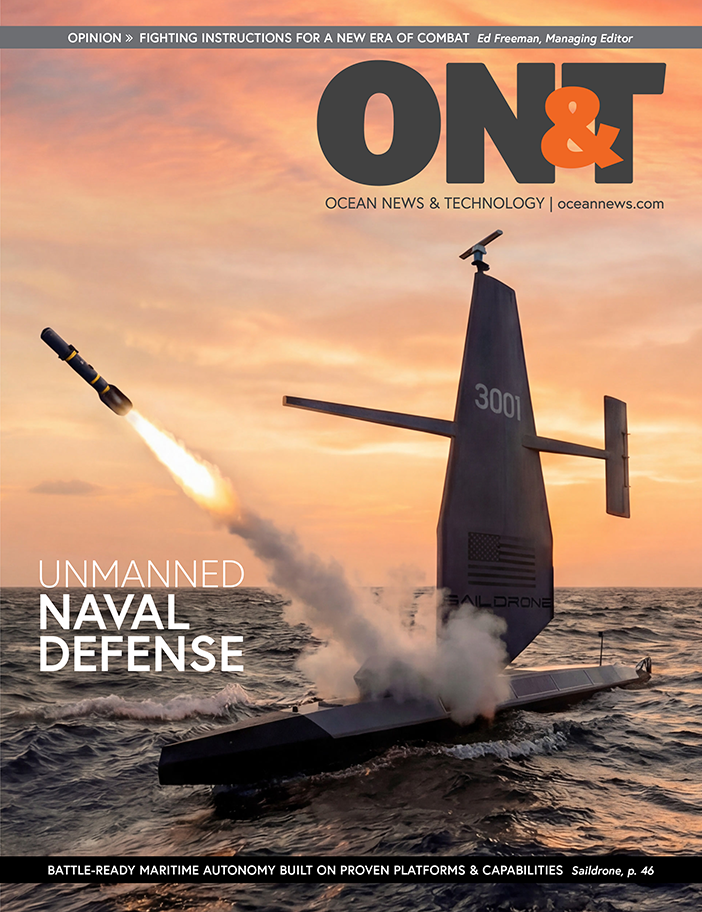
This spotlight appeared in ON&T Magazine’s 2026 March Edition, Unmanned Naval Defense, to read more access the magazine here.