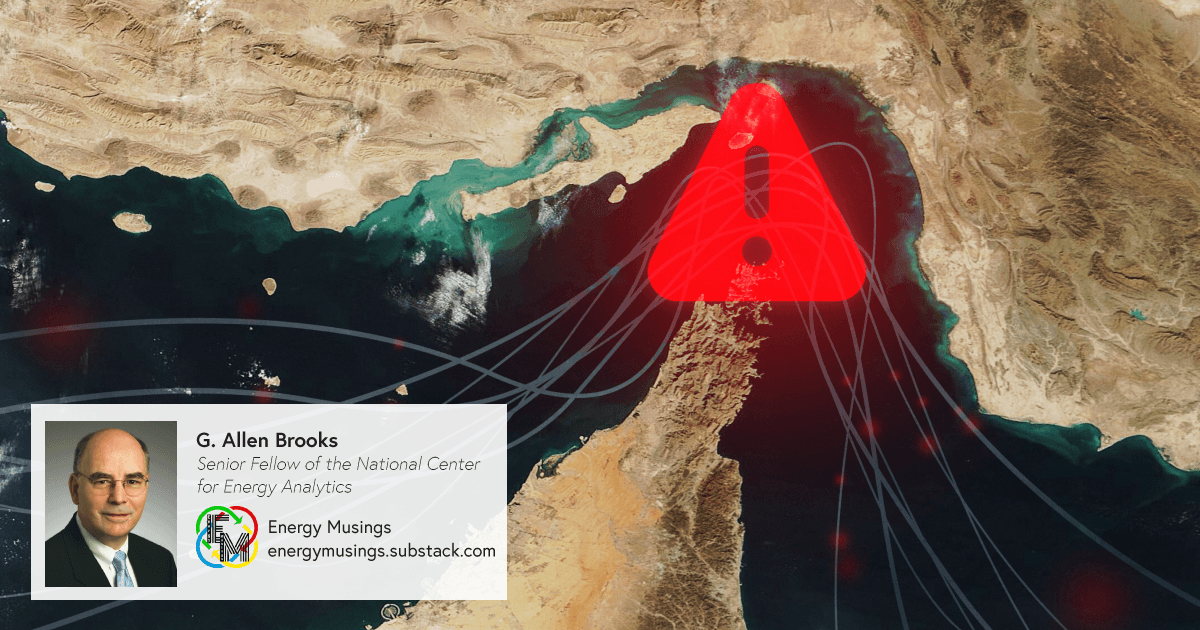
Iran’s retaliation strategy involved attacking the energy infrastructure of its neighbors, while closing vessel passage through the Strait of Hormuz to inflict pain on global customers. That narrow waterway is the world’s leading oil chokepoint, as 20 percent of global crude oil and natural gas supplies, along with significant amounts of naphtha, urea, sulfur, fertilizer, helium, and other raw materials necessary for the normal functioning of the global economy, flow through the Strait.
Asian countries are particularly vulnerable to the world’s largest energy disruption in history, as they are the primary market for Middle Eastern energy shipments. China buys 90 percent of Iran’s oil exports, as well as oil from other regional suppliers. Despite having built a significant strategic oil storage reserve in anticipation of such a disruption, China acted. It ordered refineries to stop exporting refined petroleum products, opting to keep that supply for domestic use. Reports are that lines of cars at gasoline stations have stretched for miles.
Other Asian countries are shifting to four-day workweeks for government offices, closing schools and universities, urging carpooling, rationing liquid petroleum gas for cooking while promoting electric stoves, wearing lighter clothes, and limiting air conditioning use. But reducing demand cannot overcome the magnitude of the oil supply lost.
We soon learned that Iran was conducting a selective closure of the Hormuz Strait. It allowed Iranian tankers hauling oil to China, along with Chinese tankers and other ships that claimed to be Chinese-owned, to pass. Some ships ventured through the Strait by turning off their Automatic Identification System transponder, essentially going dark.
Foreign governments began talks with Iranian officials to secure permission for their ships to pass.
The US has proposed backup insurance for ships trapped in the Persian Gulf that lack or cannot afford warrisk insurance. Transiting the Strait puts the vessel, the crew’s lives, its cargo, and the environment at risk if attacked. There are 65 desalination plants ringing the Persian Gulf, providing fresh water to an arid region.
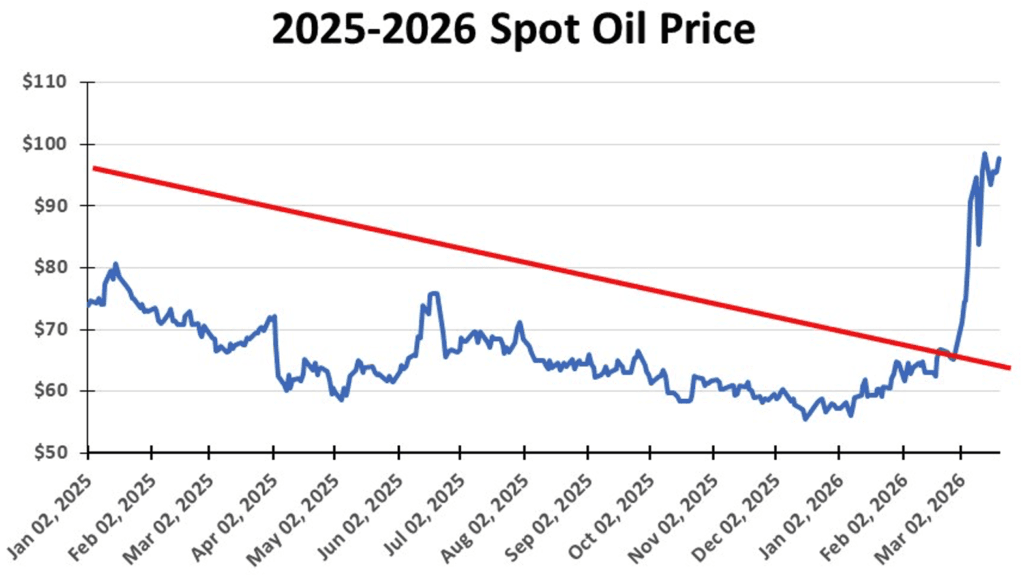
With the Hormuz Strait restricted, oil prices soared, even as some oil is exiting the Persian Gulf. You haven’t heard the word “glut” since January, when the Middle East military buildup began. We wrote numerous times last year that oil prices lacked a geopolitical risk premium. We warned that we were one military confrontation away from sharply higher oil prices. Boy, have we seen that!
While near-term oil prices are sharply higher, future oil prices have barely moved, as traders expect the disruption to end soon and the world’s energy market to return to normal. Oil experts claim oil prices could soar to $150, $180, or even $250 a barrel if the Strait is not reopened soon. We would caution that we don’t know what normal will look like once it is reopened. Everyone will have to rethink their future access to global oil supplies and the policy changes needed to protect their economies from a future disruption.
NATURAL GAS
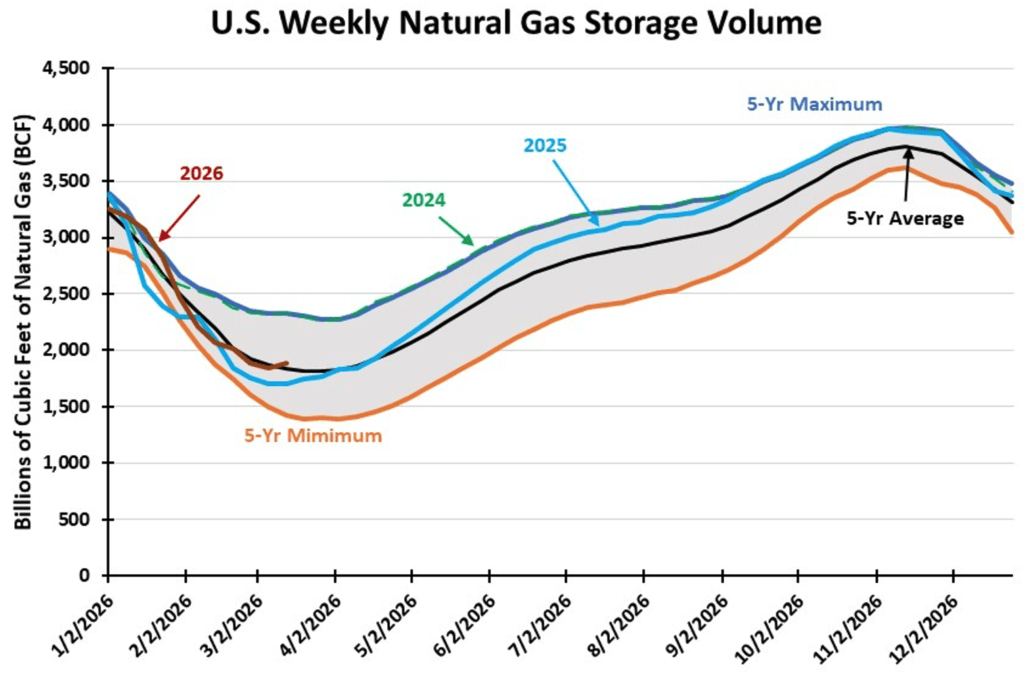
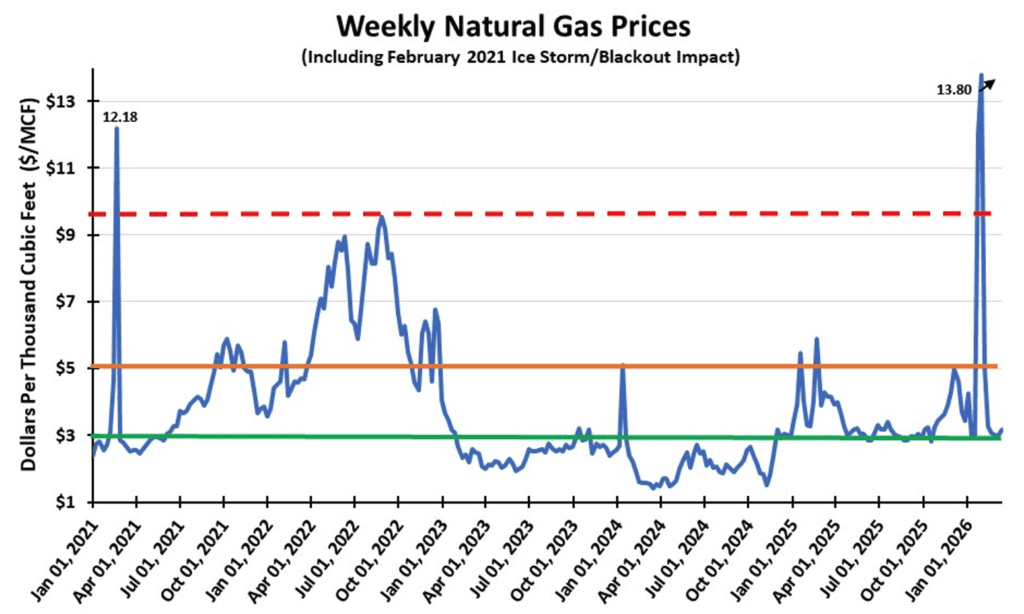
US natural gas prices returned to normal after January’s Winter Storm Fern, despite the disruption of the global LNG market. Shipments ended after Iran attacked Qatar’s Ras Laffan Industrial City, the world’s largest gas export complex. The initial attack caused minimal damage but forced the terminal to shut down its operations and the loading of LNG carriers. Officials explained that it would take four weeks to restart exports once hostilities ended, because it takes two weeks to bring the cooling tanks down to -260º F, and another two weeks to cool the gas flowing into the tanks.
Last week, Iran hit the complex again, this time damaging two of the export trains, eliminating 17 percent of its 77 million tons per annum output. The CEO of Qatar-Energy, the owner of the complex, said that repairing the damage will take 3–5 years. The duration of that supply loss has the global LNG market in turmoil. It came at a very bad time for Europe, which ended winter with gas storage volumes at extremely low levels and is facing soaring LNG prices. It will cost Europeans much more to refill their storage for next winter, which will impact electricity and home heating costs, and impair the continent’s industrial base.
US LNG tankers heading to European customers were suddenly rerouted to Asian customers willing to pay much more for the gas. There are few options for Europe. The situation reintroduces Russia into the global gas discussion. Sanctions on Russian crude oil sitting on shadow tankers at sea have been lifted to ease the oil shortage. Reversing Russian sanctions on pipeline and LNG purchases will likely be necessary to ease the European gas supply shortage.
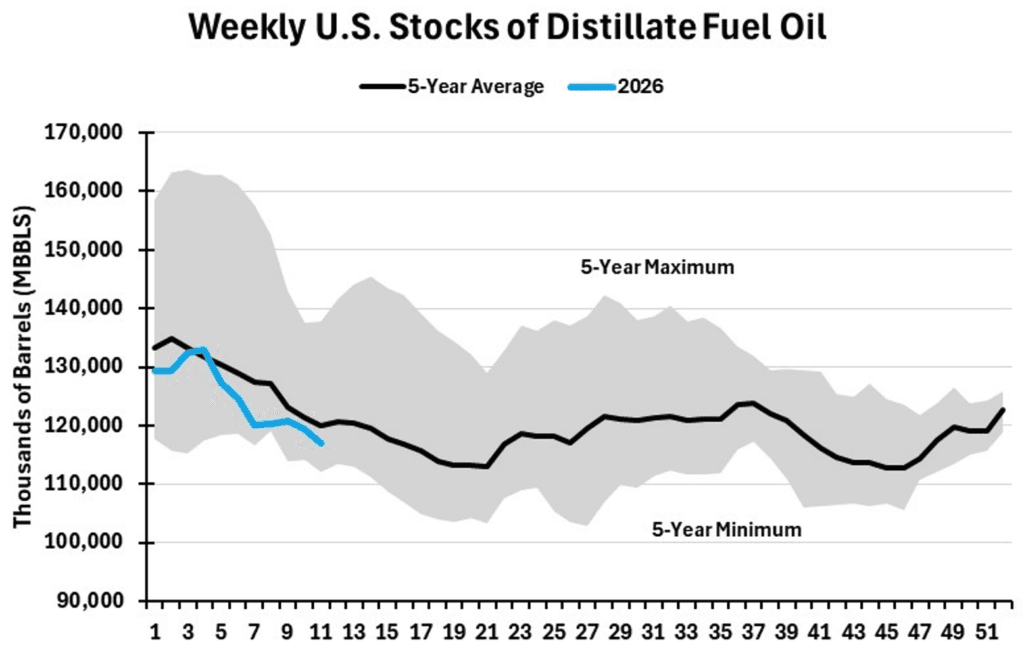
The US is fortunate to be a gas exporter, as it means we have sufficient domestic gas supplies to meet domestic needs. So, it is not surprising that domestic gas prices remain around $3 per thousand cubic feet despite turmoil in the global LNG market.
The pressure to build new US terminals will grow, but they are a long-term insurance policy for supply diversification. Expanding our domestic gas pipeline network is needed. Without more takeaway capacity from gas-producing basins, it will be difficult to increase our output and LNG exports. In the meantime, natural gas prices will remain tethered to weather and LNG export shipments. Right now, we are entering the weakest gas-demand period, so prices have little upward pressure, absent a geopolitical event, until the AC season begins.
WAR IN IRAN HAS UPENDED GLOBAL OIL MARKETS
US GAS MARKET INSULATED FROM GLOBAL TURMOIL
This feature appeared in ON&T Magazine’s 2026 February Edition, Exploring the Deep, to read more access the magazine here.