Tell us a little about Hefring Marine and the company’s current focus…
Hefring Marine is a maritime technology company focused on improving how vessels are operated, across both crewed and uncrewed fleets. Our primary work centers on the Intelligent Marine Assistance System (IMAS),an AI-driven platform that delivers real-time decision support for vessel operators, autonomy controllers, and fleet managers.
Our core focus is on: Enhancing AI-powered guidance and control to help vessels operate safely and efficiently in dynamic sea states; supporting fleets with stronger decision-making tools for marine domain awareness, mission execution, and operational oversight; and building a unified IMAS ecosystem that integrates onboard sensing, edge intelligence, and cloud analytics to improve situational awareness, reduce risk, and strengthen operational resilience.
Overall, we are developing an intelligence layer for the maritime domain, one that enhances safety, efficiency, and predictability across diverse missions and vessel types.
Tell us about Hefring Marine’s IMAS solution…
The Intelligent Marine Assistance System (IMAS) is an AI-driven decision-support and control platform designed to help vessels operate more safely, efficiently, and predictably. It combines onboard sensor data, vessel-specific behavior models, and real-time analytics to guide how a craft should move through changing sea conditions.
IMAS delivers five core capabilities:
- Real-time speed and motion guidance to reduce hull stress, shocks, and excessive fuel burn.
- Adaptive vessel behavior modeling, learning how each craft handles in different environments.
- Enhanced situational awareness through continuous monitoring of vessel motions, system status, and mission context.
- Remote fleet oversight, allowing operators and commanders to track vessel health, performance, and mission progress.
- Post-mission analytics that support maintenance planning, performance assessment, and operational refinement.
The system is used today across manned and unmanned fleets to improve survivability, extend endurance, and reduce operational risk in demanding maritime environments.
 The Hefring Marine IMAS Helm, Console and App. (Credit: Hefring Marine)
How can IMAS help enhance the role and relevance of unmanned naval defense?
IMAS strengthens unmanned capabilities by giving USVs the real-time intelligence they need to operate safely and reliably in challenging environments. It reduces hull stress, prevents control-loss events, improves endurance, and helps ensure mission completion without human intervention.
For defense operators, this means uncrewed assets can take on more com-plex roles with greater confidence. IMAS provides continuous vessel-health, motion, and performance awareness, enabling more predictable behavior, higher survivability, and reduced operator workload throughout the mission.
Overall, IMAS helps USVs become more capable, resilient, and operationally relevant, expanding the range of missions they can support in modern naval operations.
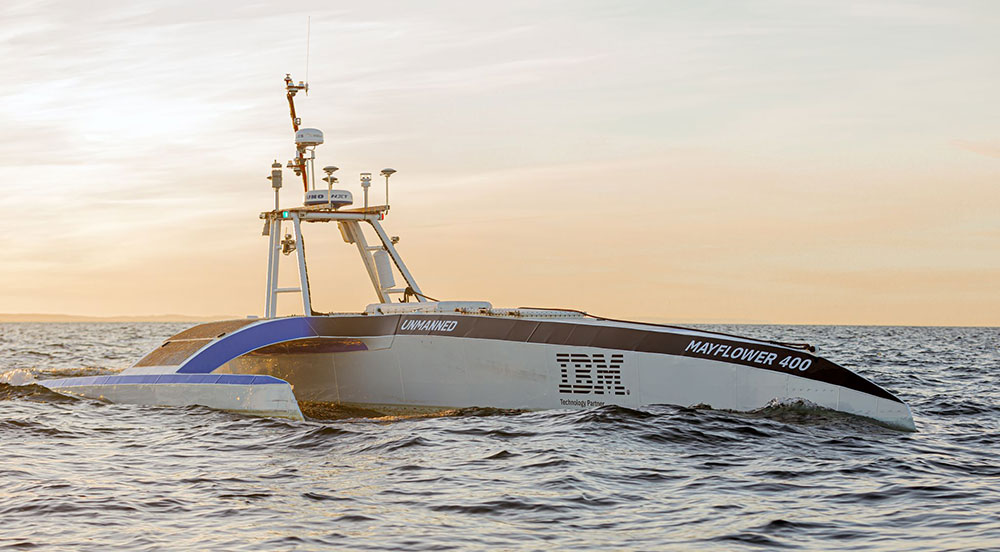 The Mayflower Autonomous Ship (MAS400), a Hefring Marine partner. (Credit: Hefring Marine)
What does next-level autonomy in this space look like?
Next-level autonomy for uncrewed maritime systems will be defined by higher levels of onboard decision-making, including capabilities aligned with International Maritime Organization (IMO) Level 4+, where vessels can assess conditions, execute missions, and respond to change with minimal human oversight.
It will rely on far more accurate real-time sea-state understanding and safety intelligence, giving craft the ability to anticipate wave impacts, manage energy usage, protect sensors and payloads, and maintain stability in high-risk environments.
Greater autonomy also means higher operational efficiency, with vessels dynamically adjusting speed, motion, and routing to extend endurance and ensure mission completion.
To remain reliable in contested environments, autonomous systems must integrate GPS-denied navigation solutions, such as radar-based positioning, inertial navigation, and multi-sensor fusion techniques.
Finally, next-level autonomy will depend on strong partnerships and collaborative development across operators, research institutions, and technology providers, ensuring that emerging capabilities are operationally validated, interoperable, and robust enough for real deployments.
Can you elaborate on how you see these key collaborations developing?
Collaborations with partners such as Marine AI and MSRS Navigation will increasingly focus on integrating complementary technologies to strengthen reliability, safety, and autonomy in uncrewed operations.
We see these partnerships evolving through: Deep technical integration, combining IMAS guidance and motion-intelligence with advanced autonomy cores, multi-sensor navigation engines, and GPS-denied positioning solutions; joint validation and testing, ensuring new capabilities are proven in real operational environments across diverse platforms and mission profiles; and aligned capability development, where each partner contributes its strengths, whether in perception, navigation, decision-support, or autonomy, to build interoperable systems that meet defense requirements.
Over time, these collaborations will contribute to a more robust, modular, and mission-ready ecosystem for uncrewed maritime operations.
This feature appeared in ON&T Magazine’s 2026 March Edition, Unmanned Naval Defense, to read more access the magazine here.