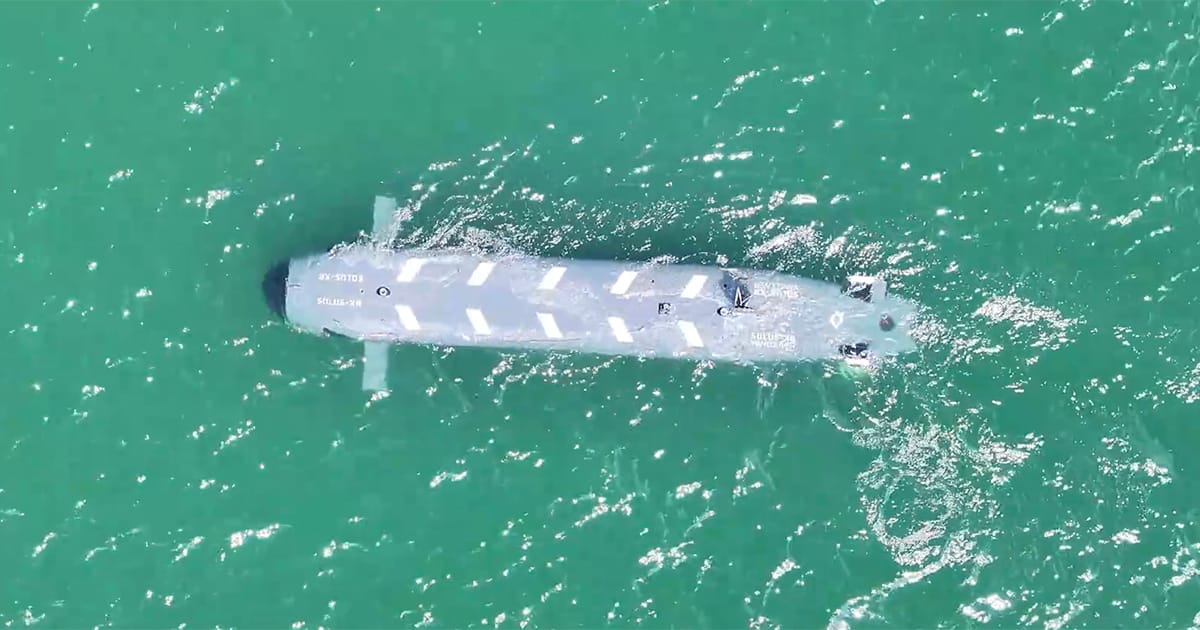
Now under development for the Defense Innovation Unit’s Combat Autonomous Maritime Platform (CAMP) project, Lancet™ brings together Metron’s mission-tested autonomy, Cellula Robotics’ long-endurance hydrogen fuel cell Uncrewed Underwater Vehicle (UUV) technology, modular payload capacity, and open interfaces for integration with existing and future Navy systems.
Lancet is being developed as an undersea mission effector prototype: a persistent, long-reach autonomous system designed to provide flexible payload delivery options while helping reduce operational risk and increase efficiency in contested environments.
Autonomy for Communications Denied Operations
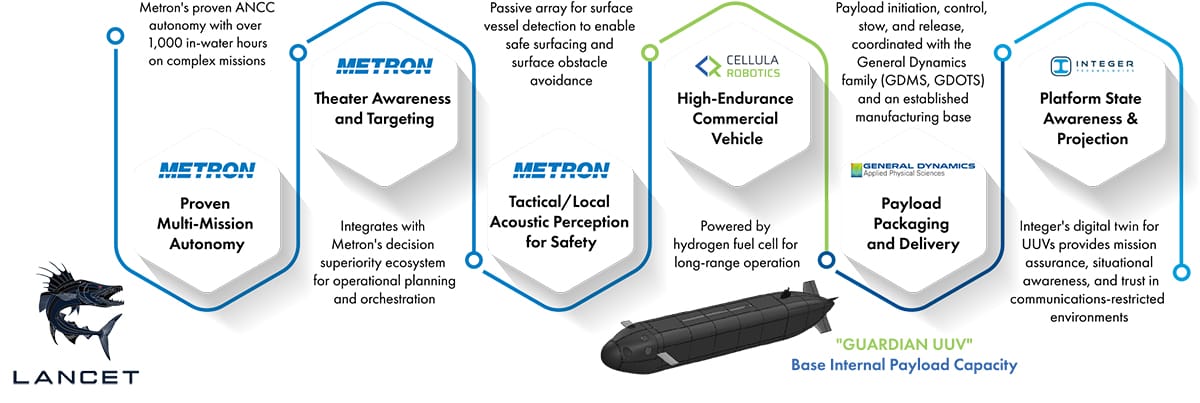
Lancet uses Metron’s Autonomy Navigation Command and Control (ANCC) software, a fielded autonomy stack with over 1,000 in-water hours on communications-limited and communications-denied missions. ANCC provides scalable, adaptive autonomy through a modular, open-architecture design that can seamlessly integrate across multiple UUV classes and mission systems. (Since 2012, the software has been successfully fielded across DOD programs and integrated into 15+ OEM platforms, ranging from small to XL-sized UUVs). ANCC reflects more than a decade of refinement from operator feedback, real deployments, and practical mission needs providing Lancet with a highly mature, mission-tested autonomy capability that reduces integration risk while accelerating operational effectiveness across complex maritime environments.
Undersea missions cannot depend on a constant link to an operator. Once deployed, the vehicle must be able to execute the mission, respond to changing conditions and replan without human intervention. That is the role of ANCC: giving the system the ability to continue operating when communications are limited, the environment is uncertain and the mission still has to be completed.
Endurance by Design
Lancet’s endurance comes from Cellula Robotics’ hydrogen fuel cell UUV technology, developed for long-range missions where battery-powered systems face practical limits in endurance, recovery cycles, and logistics.
Cellula has already demonstrated this capability in the water, completing a continuous 2,000-kilometer mission with a vehicle originally built in 2018. That proven endurance gives Lancet a credible undersea platform for long-range autonomous operations, with the range and persistence needed to support missions in contested and communications-limited environments.
Modular Payloads, Open Interfaces
Lancet includes a modular payload section designed to accommodate a range of mission packages, including payload delivery systems from General Dynamics Applied Physical Sciences.
The modularity is central to the system’s value. It allows end users to configure the vehicle around payload type, mission requirement and operational need, while creating a prototype foundation that can support future integrations and mission demands.
Lancet is also being developed to integrate with Navy command and control and undersea warfare mission planning systems through interfaces that meet Government Purpose Rights requirements. The aim is not to create a closed, one-off solution. It is to deliver a mission-ready prototype that can work within the Navy’s architecture and provide a practical path for future capability growth.
A Team with History in the Water
Led by Metron, the Lancet team includes Cellula Robotics, Integer Technologies, and General Dynamics Applied Physical Sciences. Together, the team brings proven experience across the critical elements of undersea autonomy: mission planning and control, long-endurance UUV design, mission assurance, payload integration and at-sea operations.
The CAMP demonstration, scheduled for March 2027, will validate a fully autonomous 1,400-nautical- mile transit at more than 200 meters depth.
The ocean will test every claim. Lancet is being built so that the hardest questions are answered before the mission depends on it.