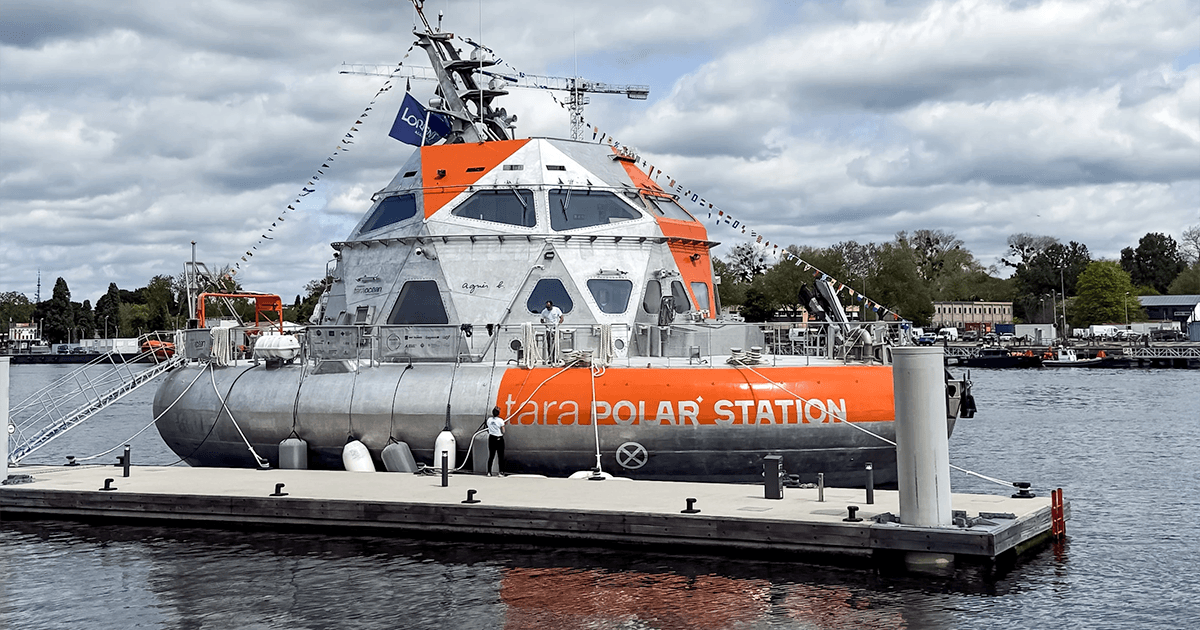
The Tara Polar Station was developed from a preliminary design conceived by Olivier Petit. At the request of the TARA Foundation, MAURIC worked on the entire concept to improve the station’s performance and capabilities, as well as to integrate new regulatory frameworks such as the Bureau Veritas ice markings for the structure. Thus, was born this atypical concept based on an oblong, self-propelled form, synthesizing Olivier Petit’s experience in polar vessel design and MAURIC’s expertise in special vessels and scientific exploration.
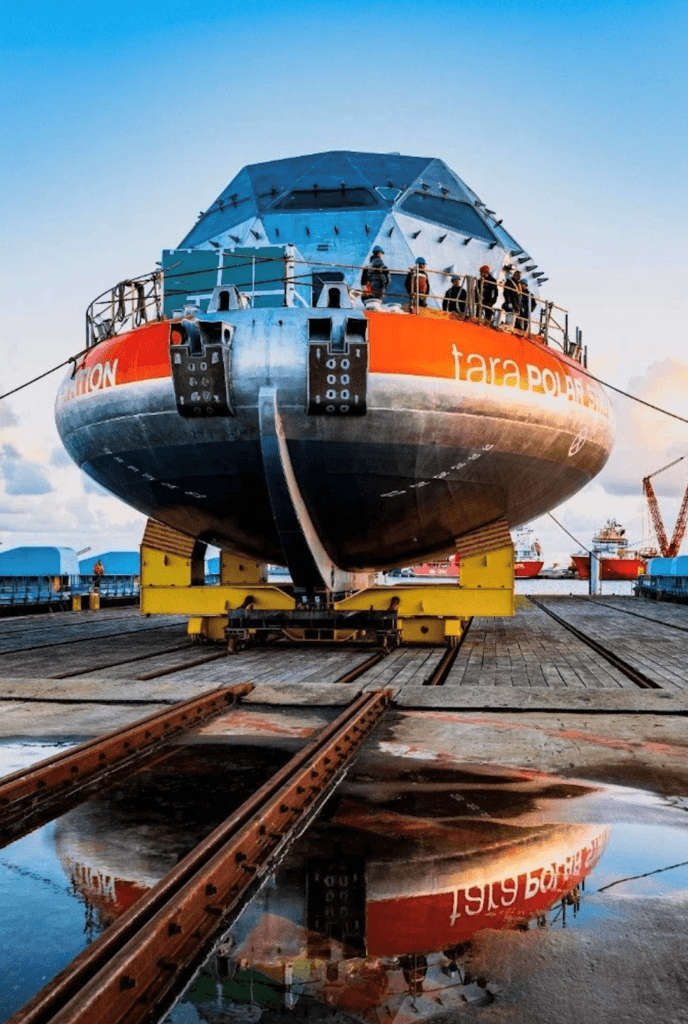
MAURIC, an Exail Group Company, subsequently conducted all the naval architecture studies and detailed engineering for this platform, on behalf of the Constructions Mécaniques de Normandie (CMN) shipyard in Cherbourg, in close collaboration with the shipyard’s teams and its subcontractors. Construction began in May 2023 and the station was inaugurated in Lorient on April 24, 2025. The TPS is designed to undertake consecutive missions of approximately 14 months, drifting with the Arctic ice pack to collect crucial scientific data.
Design and Engineering
MAURIC’s teams have worked to develop a station adapted to polar environments, withstanding temperatures ranging from -20°C to -52°C and extreme ice pressures. Therefore, the vessel is equipped with a 20 mm aluminum hull reinforced to withstand the pressure and abrasion of ice. Key design elements include:
Ice-specific structure: A reinforced, ice-resistant aluminum hull, supporting low temperatures without altering its strength and meeting the demanding ICE CLASS 1A SUPER ice marking from Bureau Veritas. The shape of the hull, resulting from Olivier Petit’s experience and the TARA Foundation’s work with the schooner TARA, limits the pressure exerted on the hull when the vessel becomes locked in ice.
Moonpool: A central well with a diameter of 1.6 meters, connected to a wet laboratory, allowing direct access to the ocean beneath the ice, enabling the deployment of divers and scientific equipment.
Sustainable Systems: The vessel is designed to limit all her discharges and reduce her environmental impact. Working in one of the most preserved places on Earth requires zero pollution, which is why the vessel is equipped with solar panels, a wind turbine, and biodiesel-powered generators. These systems are associated with a heat recovery network for heating and hot water production, as well as fluid treatment systems to ensure no discharges into the marine environment throughout her mission duration. A lithium battery pack also enables the storage of energy from decarbonized electrical production sources.
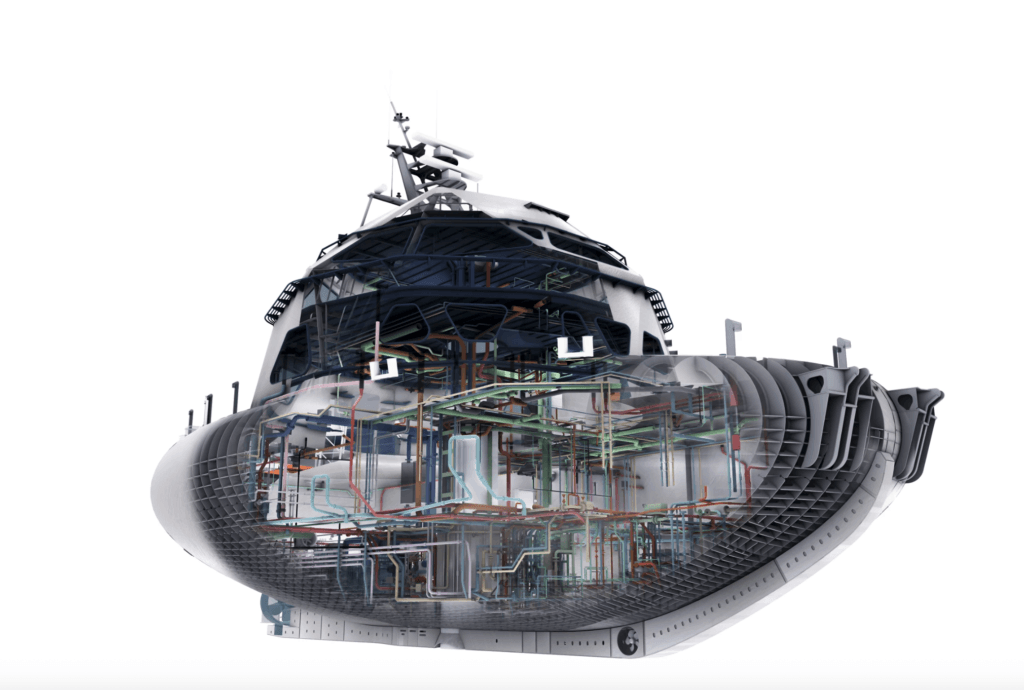
Compact Layout: The vessel’s design maximizes accommodation and carrying capacities thanks to advanced space optimization. The entire vessel is organized around the central well. “The interior space is very restricted, and arranging all elements around the central well was comparable to solving a three-dimensional puzzle where every centimeter counts,” explains Project Manager Paul Regnacq.
Consideration of polar environment constraints: The vessel is beached on ice, with limited access to seawater, and potential icing of all external components or those opening to the outside. Numerous studies have been conducted by MAURIC’s technical teams to ensure the proper functioning and redundancy of the station’s systems in all conditions encountered during polar winters.
Vessel safety and resilience: The Tara Polar Station operates autonomously far from any inhabited areas. Her resilience to extreme conditions and any damage that may occur in icy zones has therefore been studied with particular care. Despite her reduced size for a polar vessel, flag authority regulations, and classification society (Bureau Veritas) requirements have been applied without compromise. The vessel is also equipped with a polar jet fuel tank, allowing for helicopter refueling for crew evacuation in case of a serious incident.
When developing detailed plans, mass estimates, structural designs, and specifications for specialized components, MAURIC consistently ensured the quality, safety, and environmental footprint of the vessel.
Scientific and Environmental Objectives
The TPS will address critical gaps in Arctic research, where warming occurs three times faster than globally. By drifting with the ice pack during 14-month missions, she will enable:
- Collect data on biodiversity, atmospheric interactions, and ecosystem resilience.
- Refinement of climate models projecting impacts to 2050.
- Support global climate change mitigation through in-depth scientific knowledge.