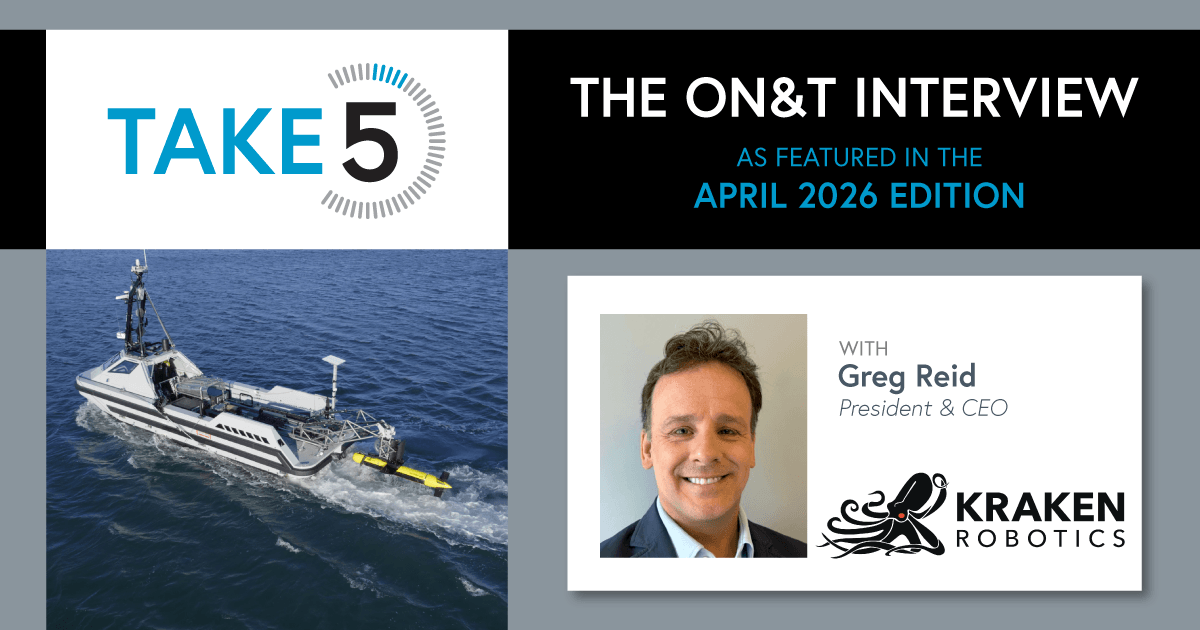
Kraken Robotics recently announced the strategic acquisition of the Covelya Group. Could you tell us more about how the deal came to be?
At Kraken, we’ve always taken a systematic approach to both organic and inorganic growth, looking for opportunities that expand our capabilities in a meaningful way aligned with our long-term strategy. Over the past several years, we’ve expanded beyond synthetic aperture sonar (SAS) into subsea batteries, subsea LiDAR, and commercial services, strengthening our ability to deliver more complete solutions to our customers.
Our discussions with the Covelya Group began last summer, as I reached out to Simon (Partridge, Executive Director) to express how I felt our businesses shared some common customers and together we would be able to accelerate our growth opportunities. The Covelya Group is made up of six operating companies: Sonardyne, EIVA, Forcys, Voyis, Wavefront, and Chelsea Technologies.
From the outset, it was clear there was strong alignment across technologies, markets, and culture. There is very little overlap between our offerings, making this combination highly complementary.
Covelya brings globally recognized strengths in navigation, positioning, communication, and detection technologies, while Kraken provides advanced 3D imaging, power solutions, and established commercial services offerings. Together, we can deliver more integrated solutions to complex subsea challenges.
Just as importantly, we’re bringing together some of the brightest engineering talent and domain expertise in the subsea sector. That combination of technical depth, global reach, and complementary capabilities positions us to accelerate innovation and deliver greater value to our customers.
How do you see the integration of the Covelya Group brands as strengthening Kraken’s offering to the offshore energy sector and beyond?
This acquisition is transformative for Kraken, enabling us to offer a much more complete and integrated set of solutions to customers across offshore energy, defense, and other marine sectors.
Historically, Covelya has been very strong in the offshore oil and gas and science markets, with global operations and deep expertise in subsea navigation, positioning and monitoring. Kraken has built a strong presence in offshore wind and inspection markets through our SAS, sub-bottom imaging, and subsea LiDAR technologies. When you combine these strengths, you create a portfolio that spans the full lifecycle of subsea operations and technologies, from positioning and communication to high-resolution imaging, inspection and analysis.
For customers, that means access to best-in-class technologies that can be delivered as integrated solutions. Rather than managing multiple vendors, they can work with a single partner capable of tailoring solutions to specific mission requirements.
Together, we will have a significantly expanded international presence, enabling stronger local support and faster response times globally.
Looking ahead, this combination also strengthens our ability to invest in next-generation technologies. By leveraging shared technology building blocks, we can accelerate development and bring new capabilities to market more quickly, particularly autonomous operations and advanced subsea sensing for critical underwater infrastructure inspection.
We have seen a steady drip-feed of announcements in recent years regarding Kraken’s Sea-Power subsea battery systems—what is driving growth in this segment?
The growth we’re seeing in our Sea- Power subsea battery business is being driven by a fundamental shift toward unmanned and autonomous systems across both defense and commercial markets.
In today’s operating environment with increasingly contested oceans, there is a growing reliance on uncrewed underwater vehicles (UUVs). We’re seeing strong adoption as these systems move from trial and evaluation into operational deployment. These systems are being tasked with more complex missions in challenging environments, requiring greater endurance and higher energy density.
At the same time, space within these platforms is limited. Operators are looking for compact, high-performance energy solutions to support longer missions without increasing size or weight.
We’ve developed some of the most energy- dense rechargeable subsea battery systems available, enabling longer deployments and more capable payloads. Sea- Power’s proprietary polymer matrix provides pressure tolerance to 6,000 meters without the need for pressure vessels or oil compensation, optimizing space and weight within UUVs.
To support the growing demand, we’re bringing a new subsea battery manufacturing facility online in Nova Scotia. This will significantly increase our production capacity while maintaining the quality and reliability standards our customers expect.
Last year Kraken participated in the demo of the KATFISH USV LARS for the Royal Navy; what is the commercial sector learning from naval defense exercises?
One of the key advantages of Kraken’s technology portfolio is that it is inherently dual-use. The same systems we deploy for defense applications, such as mine countermeasures or maritime security, are equally applicable to commercial use cases like offshore energy inspection and infrastructure monitoring.
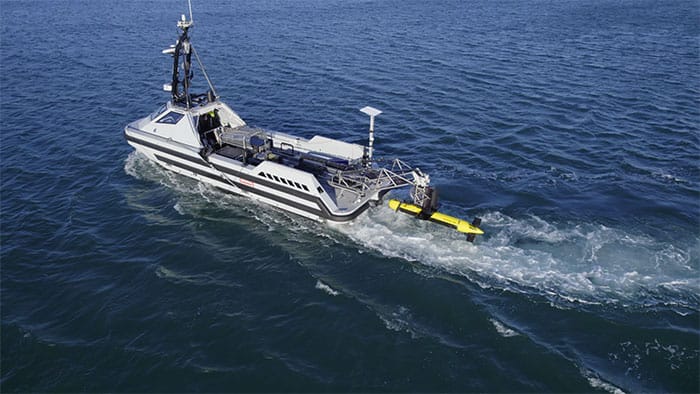
The demonstration of our KATFISH USV LARS provides valuable insights into how these systems perform in real-world operational scenarios, particularly in terms of autonomy, launch and recovery, and operating in harsh environments. These are the kinds of challenges that also exist in offshore energy, especially as operations move into deeper water and more remote locations.
Research and development investment on the defense side accelerates advancements in areas like autonomous operations, sensor performance, and data processing. Those advancements translate directly into improved capabilities for commercial applications.
For example, higher-resolution sonar imaging developed for defense missions enables more detailed inspection of subsea infrastructure. That can reduce the need for repeat surveys, improve anomaly detection, and lower the cost of inspection and maintenance for offshore energy operators.
We’re seeing a convergence where technologies developed for defense are helping to modernize how offshore assets are monitored and maintained, improving efficiency and reliability.
What are the most immediate focuses for Kraken Robotics for the remainder of 2026?
Our primary focus in 2026 is delivering on the strong growth opportunities we’ve created across the business.
A key milestone will be the opening and ramp-up of our new subsea battery manufacturing facility in Nova Scotia, which will play an important role in supporting increased demand from defense customers.
We’re also focused on completing the acquisition of the Covelya Group in Q2 and beginning a thoughtful integration process. Our approach will be measured and strategic, ensuring we preserve the strengths of each organization while aligning around a common vision and delivering a seamless experience for our customers.
Beyond that, we will continue to invest in innovation across our core technology areas, including advanced sonar, subsea LiDAR, subsea power, and autonomous systems. As the subsea environment becomes more complex and mission requirements evolve, our goal is to remain at the forefront of providing high-performance, integrated solutions that help our customers operate more safely, efficiently, and effectively.
This feature appeared in ON&T Magazine’s 2026 April Edition, Unmanned Naval Defense, to read more access the magazine here.