Mapping Coral Reefs to Investigate Genetic Diversity
Researchers from NTNU, the University of Sydney, and CalAcademy are working together to investigate how mesophotic reefs (low-light coral reefs in middle-depth waters) support the genetic diversity of corals, which are increasingly threatened by climate change.

“Shallow reefs are more susceptible to climate change,” explained Dr. Jackson Shields, Research Fellow at the University of Sydney’s Australian Centre for Robotics (ACFR). “There are theories that deeper reefs can act as refuges for these corals. When shallow reefs die out, they can be reseeded with corals from deeper ecosystems.”
As part of the Inkfish Coastal Seas expedition, the research team traveled to Tonga in the fall of 2024 to conduct a photogrammetry assessment of reefs in the Hapai area: essentially, create a 3-dimensional map of the reefs, which will be used to geo-reference their collected coral samples.
“The genomic sequencing from the samples is combined with the 3D model to study how different coral species breed in mesophotic reefs,” explained Shields.
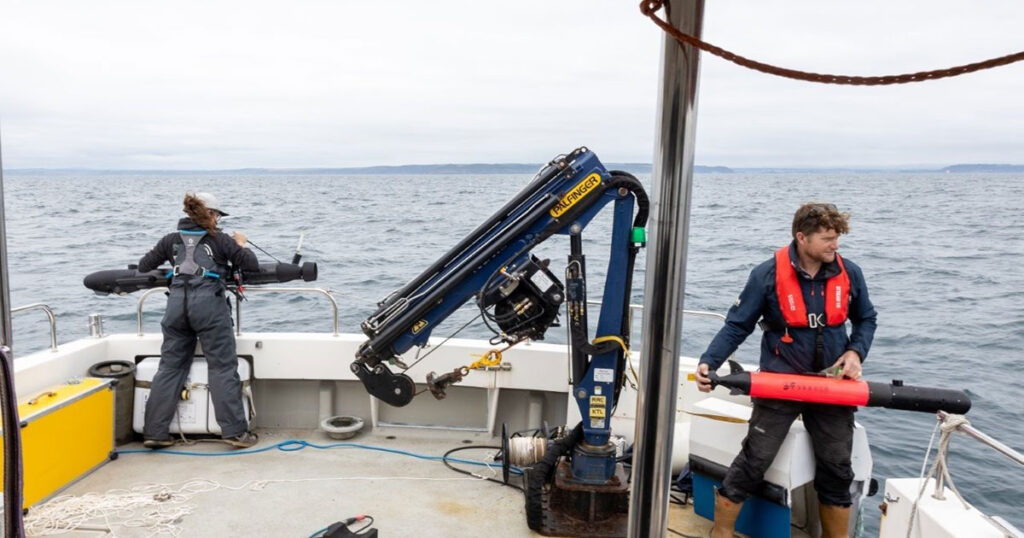
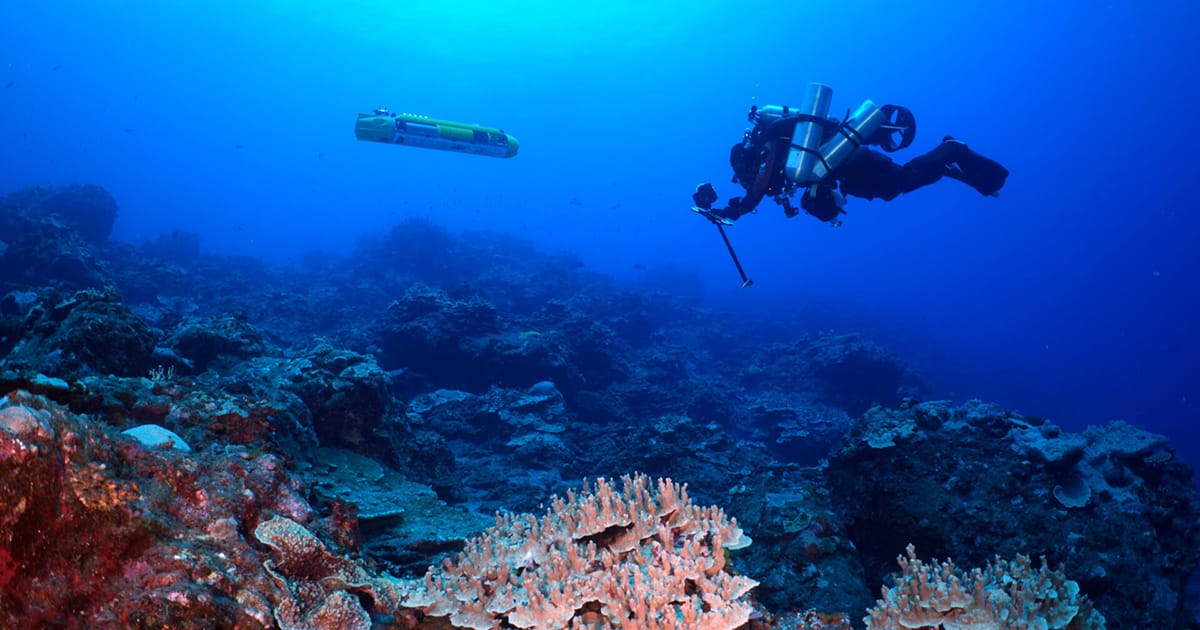
However, mesophotic reefs are historically under-studied, in part because they are difficult to access by divers due to their deeper depths. Additionally, divers could only cover so much ground during a dive. The team therefore chose to use two Seeker AUVs developed by the ACFR, equipped with Nortek Nucleus 1000 navigation sensors, to aid with the collection of photogrammetry data.
Using AUVs and Divers to Collect Coral Reef Photogrammetry Data
The ACFR’s Seeker AUV is a lightweight AUV designed to be cost-efficient and easily deployable. It is equipped with an 8MP stereo camera, which it uses to collect image surveys of reef slopes at depths of 5–75 m.

“The vehicle can sustain operations over an entire day, with eight hours of battery life and hot-swappable batteries,” explained Shields.
The team used two of these Seeker AUVs, collecting data in a total area covering 8,000 square meters over one to two days at each site, about 20 times what a diver could cover. The vehicles traveled at a consistent altitude of 2m above the reef while traveling along their tightly spaced “lawnmower” path, traversing over 8 km with precise navigation.
While the AUVs gathered large-scale photogrammetry data, divers from CalAcademy took close-range photogrammetry plots and gathered coral samples from each area.
Navigating the AUV with a Nucleus 1000
The Seeker AUVs used a combination of USBL and the Nucleus 1000 sensor for navigation. The Nucleus is designed for use on small AUVs like this one, and provides DVL information, has a designated altimeter beam, a pressure sensor, and a pre-synchronized AHRS.
In this case, the ACFR team fuses the data streams from the Nucleus into their Kalman filter for vehicle navigation. This data, combined with data from the USBL, kept the vehicle on track while mapping the area.

“We fuse the sensor data collected from the Nucleus into our Extended Kalman Filter navigation solution, which also fuses USBL and other sensor data,” explained Shields. “The Nucleus is convenient as it provides the DVL, a depth sensor, and an IMU in a compact package.”
Shields also says the Nucleus’ compact size and easy integration have been beneficial to the AUVs. Having a reliable navigation solution, even on such a compact vehicle, is crucial to the success of projects like these.
“Having accurate navigation while the AUV is conducting its lawnmower path is critical to avoid holes in the model,” said Shields.
Using AUVs for Future Coral Research
Mesophotic reefs support an abundance of species and are crucial ecosystems for reef resilience. According to Shields, the Inkfish Coastal Seas expedition aimed to characterize the physical environment, biodiversity, and ecology of these mesophotic reefs and their influence on shallow reef systems.
Shields also says there is an opportunity in the future for vehicles like these to continue researching ecosystems like these.

“Our long-term research goals are to use robotic systems to automate the sampling too, to extend this science beyond diver depths,” said Shields.
Continuing to explore and better understand important underwater ecosystems like these will rely on modern subsea technology, including easily deployable AUVs with reliable navigation sensors.