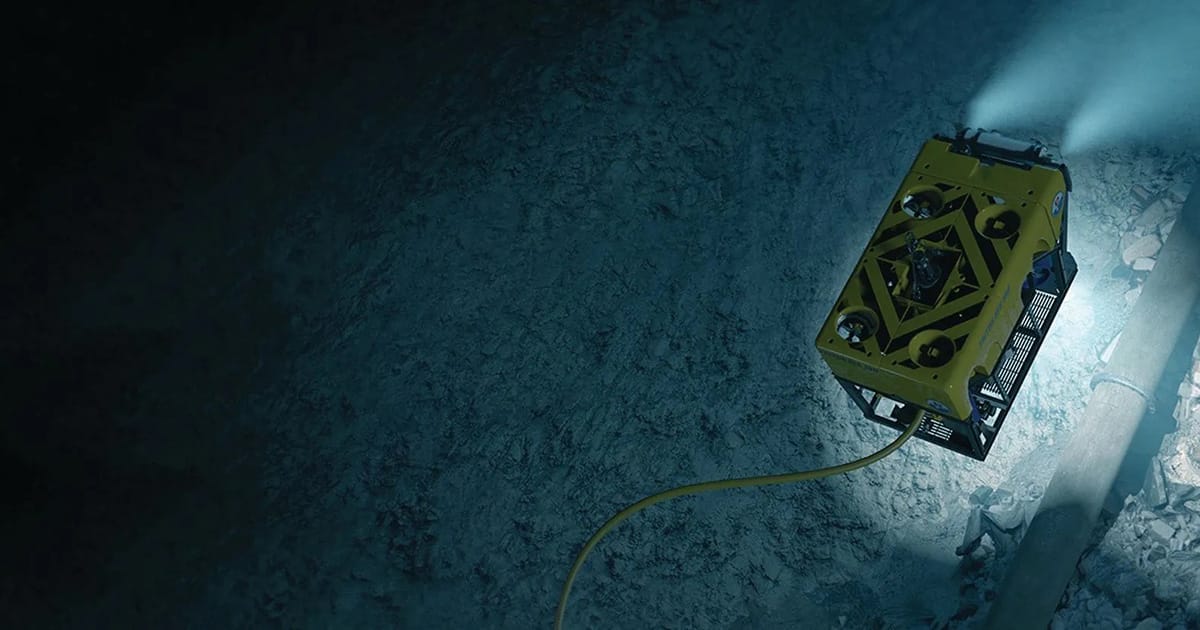
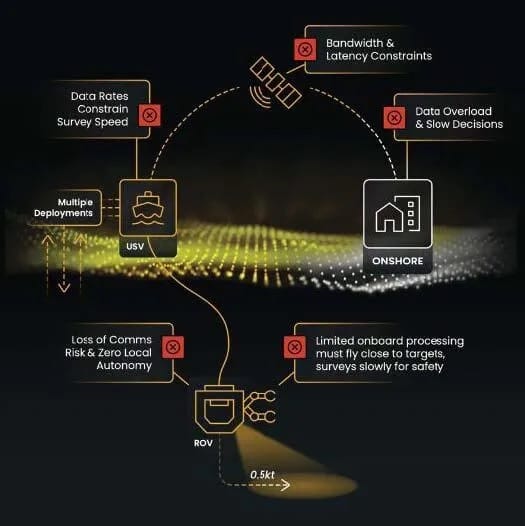
ROVs have come a long way. Ten years ago, pipeline surveys crawled at half a knot, hugging the seabed to ensure nothing was missed. Cathx’s Fast Digital Inspection (FDI®) changed that, helping crews track pipelines precisely at four or five knots. But even with
FDI®, most data processing still only starts after the acquisition phase is finished, and the faster we go, the more that data piles up.
Edge processing is often pitched as the solution. Modern processors can handle huge volumes of data while the vehicle is still underwater. But hardware alone can’t decide what matters during a survey. To scale uncrewed and remote ROVs in particular, the challenge isn’t just moving data, it’s transforming it into insights while still offshore.
WORKFLOW, NOT JUST PROCESSING
Many surveys today collect excessive amounts of data as a form of insurance, gathering everything possible just in case it’s needed later. QC checks for lighting, focus, overlap, and coverage don’t happen until the ROV resurfaces and analysts examine the data. When gaps or poor-quality areas are discovered, revisiting the site is often the only fix.
And this problem isn’t unique to pipelines. Defense operations like mine countermeasures and critical infrastructure surveillance, as well as environmental monitoring, face the same pressure: cover more ground, deliver faster results, and know the job’s done without waiting weeks for post-mission analysis.
The true bottleneck isn’t better sensors or bigger bandwidth. It’s the gap between gathering raw data and turning it into real information, decisions, and actions while the vehicle is still underwater. And when communication links drop, vehicles often fall back to basic failsafe modes instead of continuing the mission intelligently.
INTRODUCING DATA AGENTS
Edge hardware processes data quickly, but it needs guidance. That’s where autonomous subsea data agents step in.
Think of data agents like specialized software tasks running on the vehicle. Each one has a focused job: checking lighting or focus, spotting poor quality or gaps in data, building data products, or reporting events of importance. Instead of just recording raw data, these agents identify what data to focus on and start transforming it immediately into useful insights while the mission’s happening.
They don’t work alone. Data agents can be orchestrated into workflow sequences that become application specific modules. Take pipeline inspection again: that’s not a single agent but a bundle working together:
- QC agents constantly check lighting, focus, coverage, and other key parameters as data is captured.
- Eventing agents detect objects, changes, or defects along a pipeline.
- Data product agents generate outputs like color laser point clouds or mosaics.
- Reporting agents format findings and trigger alerts for faster communication to other vehicles, or to shore.
Instead of treating uncrewed and remote ROVs as just a recorder, data agents help it become an intelligent partner. Even if topside communication drops, the ROV can keep operating safely or continue missions autonomously, rather than simply stopping in its tracks.
WHY MODULARITY MATTERS
The real power of data agents lies in how they’re built and combined. Instead of writing new software for every mission, teams can assemble application modules from reusable agents. No two missions are identical, but core tasks like QC or data pre-processing are common across projects, while specialized agents are refined for unique goals or client needs.
This modularity avoids everyone reinventing solutions to the same problems. Teams can focus on refining the agents that matter most, deploying them through an intuitive UI, and even running their own or third-party AI models right on the vehicle. Data agents also make it easier to blend different sensor types for reliable outcomes as missions become more complex.
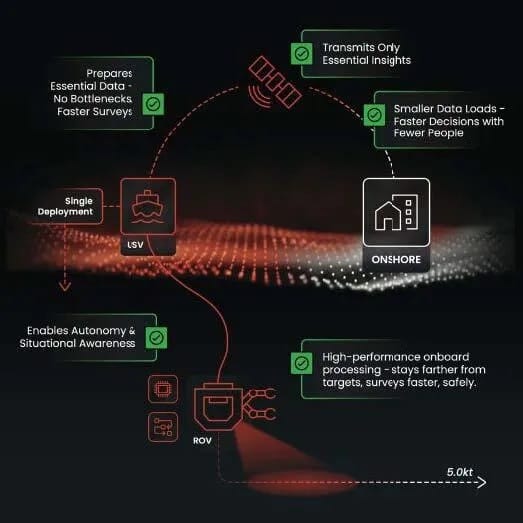
In pipeline surveys, operations can operate at higher speeds without sacrificing quality. Defense and environmental missions can scale more easily. Across all sectors, it saves onshore teams from drowning in raw data and imagery.
The real difference comes from combining edge hardware with specialized software that coordinates data agents, manages resources, and keeps workflows running smoothly.
A PRACTICAL PATH FORWARD
Building data agents isn’t just writing software. It requires deep knowledge of how subsea sensors behave, how physics affects underwater data collection, and how to integrate hardware, edge processing, and mission workflows into a single reliable system. Equally important is having experience across diverse missions to design reusable solutions that work offshore. That’s why this isn’t something any software company can simply bolt on, and why it’s tough for internal teams to deliver end-to-end on their own.
Cathx knows this firsthand. FDI® proved that combining advanced imaging hardware with tailored software and application-specific workflows transforms how pipeline operations work. It wasn’t just about sharper images; it was about collecting better data faster to reduce vessel time. Data agents build on that same principle, blending sensor expertise with workflows to turn raw data into immediate information, decisions, and actions at the edge.
Here’s the upside: while designing this kind of system is complex, adopting it doesn’t have to be. Because Cathx designs both sensors and edge software, its data agent
infrastructure fits seamlessly into existing vehicles. Instead of tearing out systems, vehicle manufacturers and service providers can adopt edge workflows simply by swapping in a new sensor, like the compact INKA Iris, which integrates processing hardware and Clarity software for running modular data agents.
Cathx already has a solid data agent foundation in applications like pipeline inspection. Work is ongoing for other application modules, and new data agents are being added for onboard machine learning, enabling clients to take their own ML models out of the lab and onto the vehicle, where they can have the biggest impact.
It’s a smarter way to cut delays, reduce the burden on data processing teams, and get closer to real-time information, decisions, and actions.
Modular data agents aren’t some distant vision. They’re the crucial next step for subsea operations, and they’re ready now.
This feature appeared in ON&T Magazine’s 2025 August Edition, Lights, Camera, Action!, to read more access the magazine here.