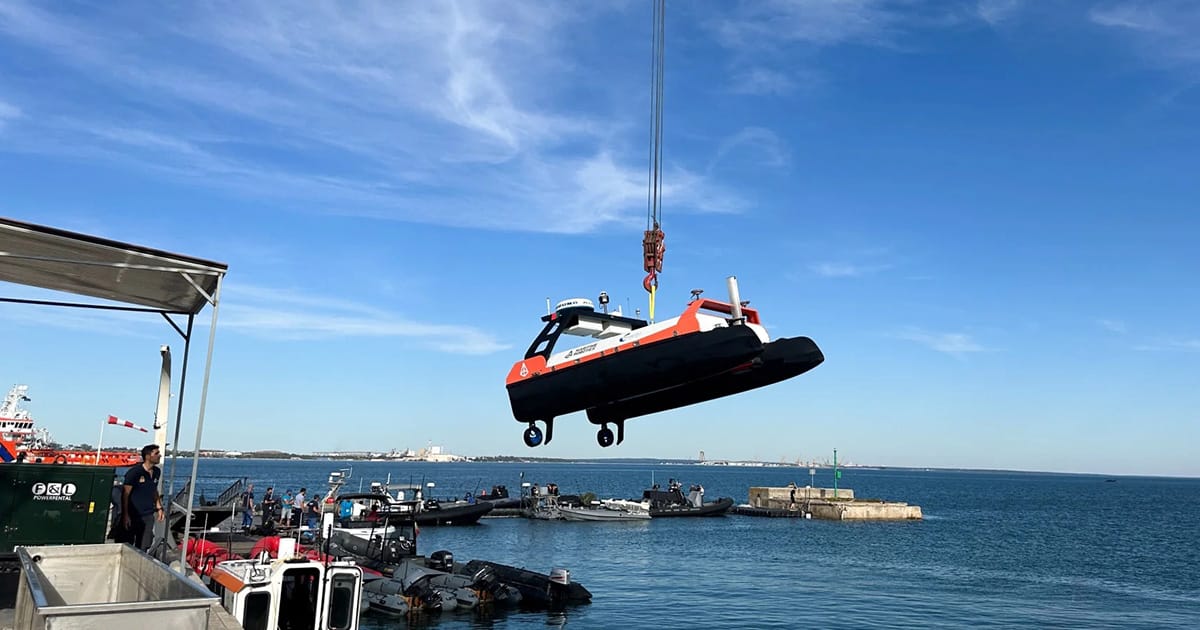
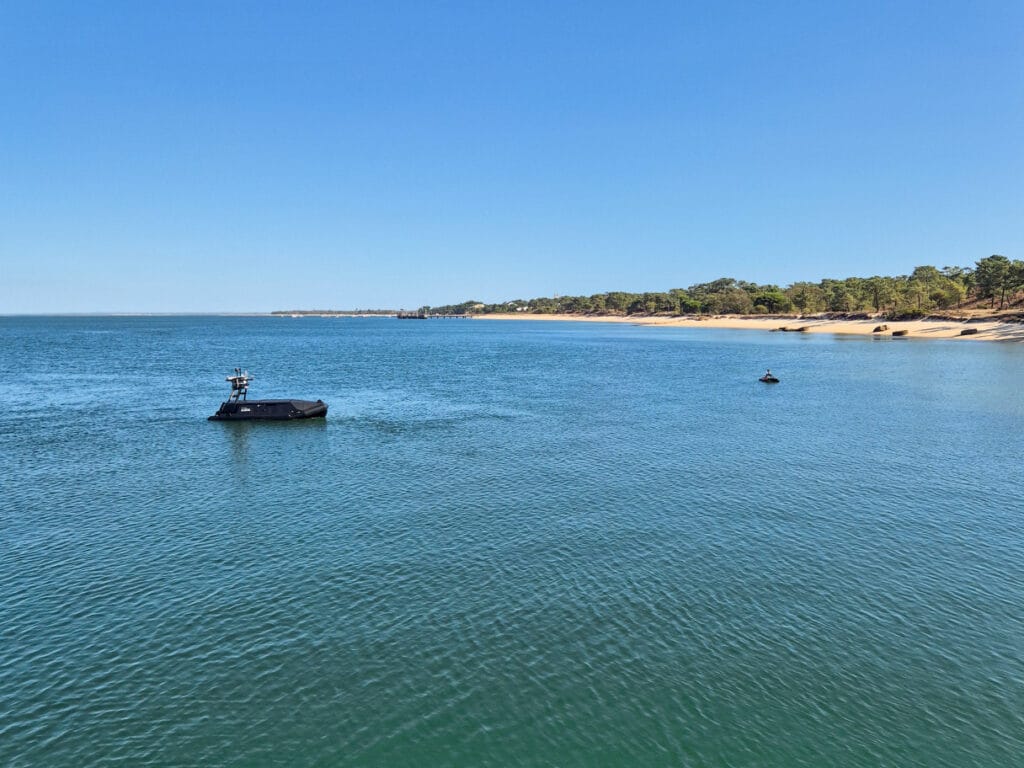
Hosted by the Portuguese Navy, REPMUS brought together allied forces, industry, and academia to advance the integration of autonomous technologies into naval operations. For Maritime Robotics, the exercise was an opportunity to demonstrate how its sea drones (USVs) enhance safety, efficiency, and situational awareness across a wide range of missions.
Real-World Missions for Sea Drones
During the two-week exercise, Maritime Robotics’ platforms were deployed in a range of scenarios where sea drones can outperform crewed vessels in efficiency and risk reduction:
- Seabed mapping (Rapid Environmental Assessment – REA): Delivering high-resolution hydrographic data in complex waters, enabling faster navigation and mission planning while minimizing crew exposure.
- Critical infrastructure monitoring: Providing persistent surveillance of subsea cables, pipelines, and offshore installations to detect anomalies and protect vital assets.
- Mine countermeasures (MCM): Reducing human risk by using sea drones for mine detection and clearance support while maintaining operational tempo.
- Anti-submarine warfare (CUxV/ASW): Towing acoustic arrays to track underwater threats, extending naval reach and safeguarding larger allied vessels.
- ROVEX (Towed ROV test): Deploying and supporting a remotely operated vehicle (ROV) with the Otter sea drone, showcasing cost-efficient subsea inspection and intervention without large manned vessels.
During REPMUS 2025, the Otter Seadrone (USV) by Maritime Robotics deployed and supported a remotely operated vehicle (ROV).
Strengthening Allied Capabilities
“Uncrewed systems are no longer experimental—they are essential”, said Håvar Øie, Senior Sales Director Defense & Security at Maritime Robotics.
“Exercises like REPMUS prove how sea drones can deliver persistent surveillance, rapid response, and long-endurance missions that traditional vessels alone cannot achieve,” added Håvar Øie, Senior Sales Director Defense & Security at Maritime Robotics
During REPMUS 2025, the Otter Seadrone (USV) by Maritime Robotics deployed and supported a remotely operated vehicle (ROV). (Video credit: Maritime Robotics)
For Norway and NATO, the exercise highlighted a step toward more resilient and scalable defense capabilities. For Maritime Robotics, it reinforced the company’s position as a trusted supplier of maritime autonomy, delivering technology that supports today’s missions while shaping the naval operations of tomorrow.