A quiet revolution is now underway. Advances in software-defined vessel control are bringing dynamic positioning-level precision to smaller, more agile workboats without the cost or crew burden of traditional DP systems. At the center of this change is Hybrid Autonomy—technology that takes over the demanding, repetitive elements of vessel control so crews can focus on higher-level decisions, safety, and project success.
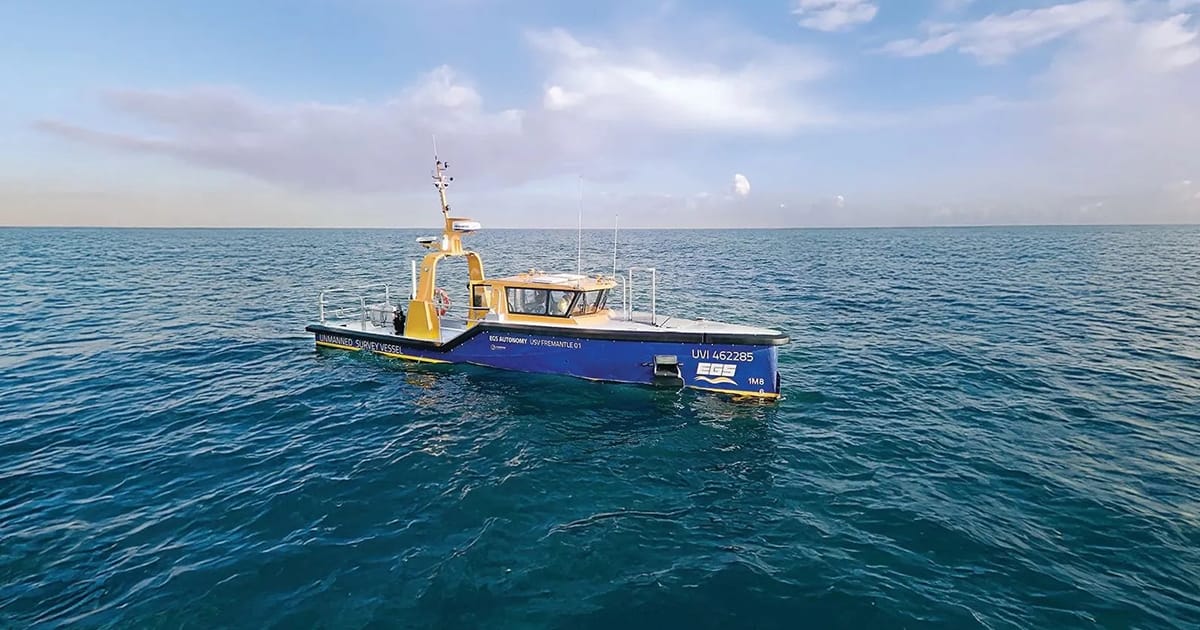
This is not theory. It is happening today. In Australia, the 33-meter Tenggara Explorer has been retrofitted with GAMA—Greenroom Robotics’ autonomy software—and now performs complex offshore operations with precision that rivals DP ships many times its size and cost. The result is a safer, leaner, and far more economical way to operate at sea.
DEFINING MARITIME AUTONOMY
Autonomy in maritime systems is not a single technology but a layered progression of capability. Each level builds on the one before it, reducing manual workload and increasing operational independence.
- Platform Control provides low-level actuation and precision maneuvering, automating helm, propulsion, and thruster control.
- Platform Autonomy ensures the vessel can sustain itself with minimal human input, maintaining power and propulsion safely and efficiently.
- Navigational Autonomy adds intelligent decision-making to move safely and efficiently, following routes, avoiding hazards, and adapting to sea and traffic conditions.
- Collaborative Autonomy enables multiple assets, surface and subsea, to work together seamlessly, sharing data and coordinating movement.
- Mission Autonomy ties it all together, ensuring that collective operations achieve higher strategic objectives.
Between these layers sits Hybrid Autonomy, the human-machine partnership where automation handles fine vessel control while operators supervise and direct project priorities. Retrofitting Hybrid Autonomy allows vessel owners to advance along the autonomy roadmap confidently, gaining the benefits of automation today without needing to go fully uncrewed.
HYBRID AUTONOMY FOR WORKBOATS
Modern offshore operations rely on precise vessel control, particularly in ROV and AUV deployment, pipeline inspection, and nearshore survey. Traditionally, this precision came from skilled helmsmen performing constant micro-adjustments to propulsion and thrusters. Repetitive and fatiguing tasks that require intense concentration.
The conventional solution has been to use a Dynamic Positioning (DP) vessel. These large, complex ships require specialist operators and extensive crews. While effective, they are expensive to run, burn large amounts of fuel, and often cost far more than the task demands.
Dynamic Predictive Control (DPC) enables control systems such as GAMA to provide a smarter, more efficient alternative. By automating the coordination between helm and thrusters i.e. the “split-stick steering” once done by hand, GAMA achieves DP-like precision without the DP price tag. It maintains station or follows a moving subsea target automatically, freeing the crew from constant manual corrections.
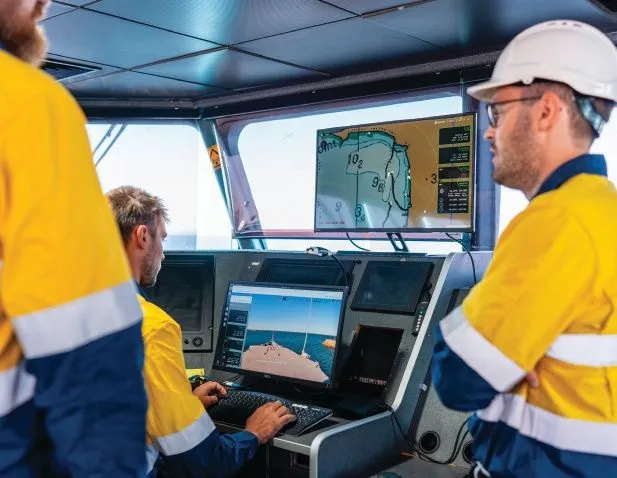
Rather than replacing people, this hybrid model enhances them. With GAMA managing fine vessel motion, bridge teams can maintain higher vigilance and focus on project oversight, data quality, and safety. The result is reduced fatigue, improved situational awareness, and leaner crewing. Fewer personnel are needed offshore performing repetitive control tasks, lowering risk and improving both efficiency and safety.
A COMPLETE AUTONOMY STACK
At the heart of this transformation is Greenroom Robotics’ GAMA, a software-defined autonomy system that can be installed on new or existing vessels. GAMA connects with the vessel’s control systems, sensors, and communications to deliver precise actuation, dynamic station-keeping, waypoint navigation, target following, and collision avoidance. Its hardware-agnostic design allows retrofits to existing workboats, improving capability without costly new builds.
For situational awareness, GAMA pairs with Lookout+, Greenroom’s AI-driven perception software. Lookout+ processes visual and thermal camera feeds to detect, classify, and geo-locate nearby objects such as vessels, buoys, debris, or marine life. It complements radar and AIS, filling gaps traditional sensors miss and giving both crew and autonomy systems a complete understanding of their surroundings.
Together, GAMA and Lookout+ form a complete autonomy stack. GAMA provides control intelligence, while Lookout+ delivers perception intelligence. The result is a system that supports fully uncrewed operation when required but is equally effective in hybrid mode, assisting onboard crews or enabling remote supervision from shore.
CASE STUDY: THE TENGGARA EXPLORER
A prime example of Hybrid Autonomy in practice is the Tenggara Explorer, a 110-foot multipurpose survey vessel operating in Australian waters. Recently retrofitted with GAMA, the vessel now performs advanced autonomous functions, including dynamic predictive control for ROV and AUV following.
Integrated with an industry-standard USBL acoustic positioning system from Unique Group and Sonardyne, GAMA enables the Tenggara Explorer to hold heading and maintain position relative to subsea assets with DP-like precision, but without the cost or complexity of a DP vessel. The autonomy core continuously predicts vessel motion under wind, wave, and current, adjusting thrusters proactively to stay stable.
For the crew onboard, this means less time fighting the helm and more time focusing on project success and safety. As Greenroom Robotics CTO Zac Pullen explained,
“Experienced captains don’t just react to the sea, they anticipate it. GAMA now does the same, embedding seamanship into software.”
The result is a safer, more efficient vessel capable of complex offshore operations with a leaner crew profile. It proves that autonomy can multiply capability without requiring fully uncrewed operations.
THE ROAD AHEAD
Hybrid Autonomy represents the next logical step in the evolution of maritime operations. It aligns with current regulatory frameworks that still require human oversight, while demonstrating the real-world value of autonomy in commercial service. As classification societies, regulators, and operators gain experience, these systems will pave the way for higher levels of autonomy across global fleets.
With software-defined systems like GAMA and Lookout+, operators can enhance existing vessels, streamline offshore projects, and step confidently into the future of maritime autonomy.
This feature appeared in ON&T Magazine’s 2025 November Edition, Remote Operations & Force Multiplication, to read more access the magazine here.