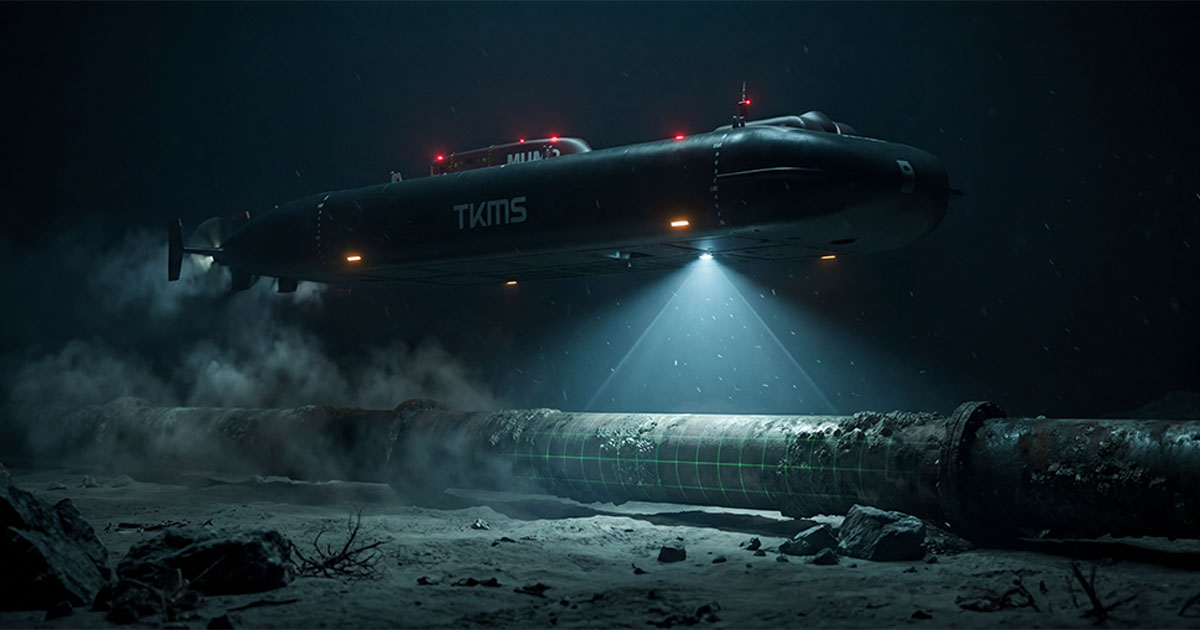
TKMS is thus the first German company to have the design and development of an autonomous unmanned watercraft based on the class rules confirmed by an AiP. The scalable demonstrator, measuring 25 meters in length and 7 meters in width, is scheduled to set sail for the first time in 2026 and will be tested in specially developed scenarios.
“Among experts, compliance with class rules is considered one of the most challenging hurdles in the development of autonomous maritime systems. The AiP thus marks an important milestone that confirms the expertise of our teams across engineering, production, and project management, and lays the foundation for an entire generation of autonomous unmanned watercrafts from TKMS,” said Christian Rogge, Head of the Submarines Operating Unit at TKMS.
TKMS established structured communication with all relevant authorities at an early stage, thereby contributing significantly to the development of a cross-agency approval process for autonomous unmanned watercrafts. Central to the process was the involvement of DNV as a recognized classification society, to which extensive design documentation was submitted for review. The granted AiP extends far beyond the MUM2 project and forms an important foundation for further projects involving autonomous unmanned watercrafts.
TKMS is responsible for coordinating the MUM2 project consortium, which also includes EvoLogics GmbH, the University of Rostock, the Technical University of Berlin, the German Aerospace Center (DLR), and the Fraunhofer Institute for Communication, Information Processing and Ergonomics (FKIE).
With the demonstration test scheduled for late 2026, the project is entering its decisive phase. TKMS aims to consistently translate the insights gained into concrete customer programs, thereby advancing the readiness of next-generation autonomous unmanned watercrafts for series production.