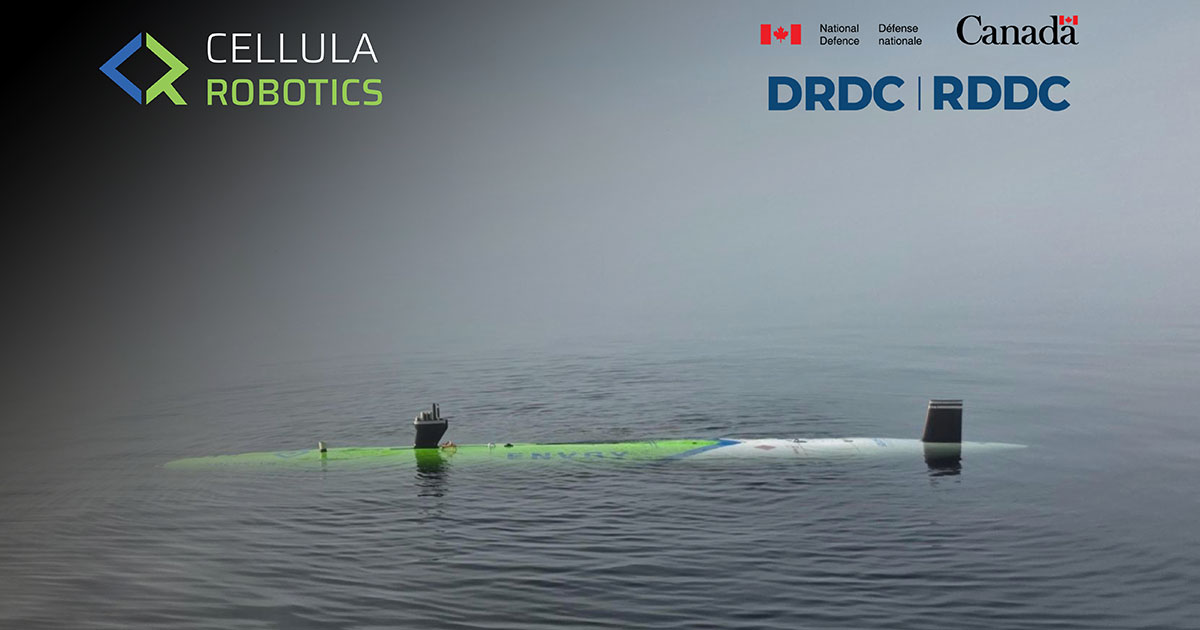
DRDC/RDDC has maintained a long-term interest in accelerating the development of long-endurance AUVs, and Cellula has been supported through a development contract that has helped mature the underlying capability. The Envoy AUV used in recent endurance testing is owned by DRDC/RDDC.
That progress was recently reflected in a fully submerged endurance demonstration by Cellula’s Envoy AUV, powered by a hydrogen fuel cell. In a representative underwater mission profile, the vehicle remained on mission for 385 hours and covered 2,023 km submerged, exceeding the platform’s published performance specification.
Importantly, the demonstration was not a simple straight-line endurance run. The mission included more than 4,000 turns and maneuvers, each of which increased energy demand compared with steady, linear travel. As a result, it provided a meaningful indication of usable underwater endurance in practical subsea operating conditions.
“Capability of this kind is advanced through sustained collaboration, rigorous testing, and a shared commitment to what is operationally useful,” said Eric Jackson, President & Founder of Cellula Robotics. “We are very pleased to announce such progress, reflected in a representative mission demonstration that exceeded a key performance objective, and we are very appreciative of the important role DRDC/RDDC has played in helping mature this capability over time.”
The demonstration was achieved using hydrogen fuel cell technology developed with Infinity Fuel Cell and Hydrogen, Inc., and reflects part of a broader effort to mature autonomous subsea systems capable of delivering greater persistence, stronger mission continuity, and more practical offshore performance.
For operators, these improvements matter because endurance is not simply a technical metric. It affects how long a vehicle can remain productive below the surface, how often intervention is required, and how effectively offshore time can be used. Continued progress in this area helps expand what is practical for autonomous subsea systems across defense, survey, scientific, and other mission-driven applications.
More broadly, the collaboration highlights the role sustained development partnerships can play in advancing complex underwater technologies. In areas such as long-endurance autonomy, meaningful progress depends not only on technical innovation, but on the continuity, shared focus, and practical support needed to mature capability over time.