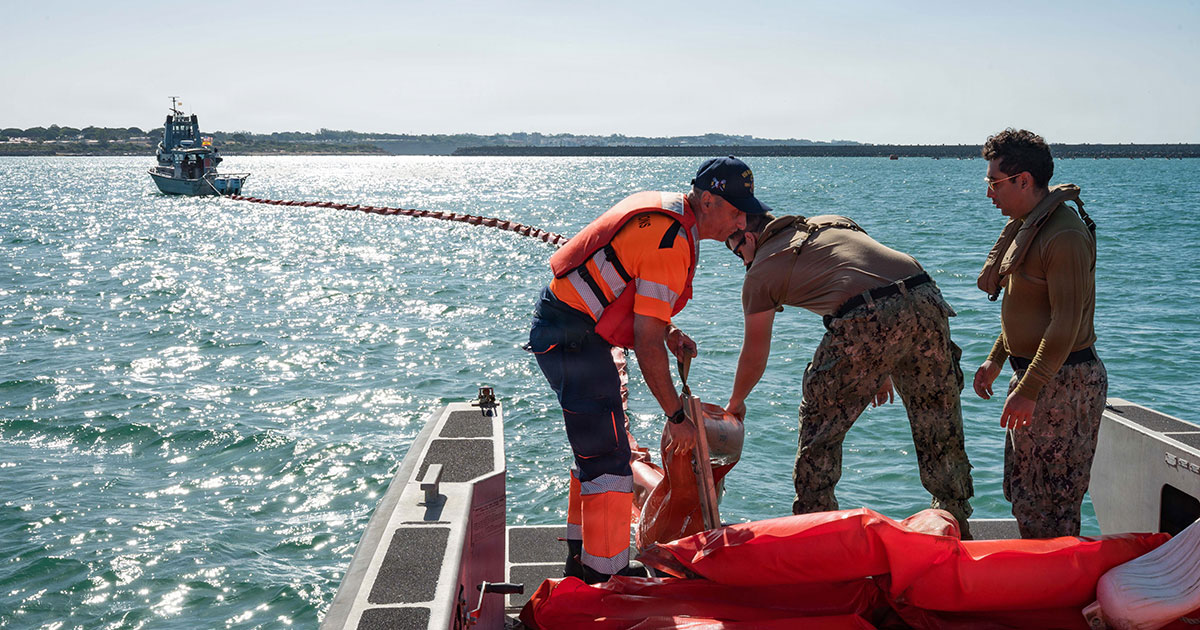
Sailors assigned to Naval Station (NAVSTA) Rota port operations department adjust a mobile oil skimmer during a bilateral oil spill response exercise between US Navy and Spanish Armada service members and Spanish civil authorities onboard Naval Station (NAVSTA) Rota, Spain, June 4, 2026. The United States and Spain work closely together on a range of global challenges, including promoting international peace, security, and economic prosperity, and our strong and enduring relationship has directly contributed to mutual and regional security and prosperity. (US Navy photo by Mass Communication Specialist 2nd Class Jett Morgan)
Sailors and local nationals assigned to the Naval Station (NAVSTA) Rota port operations department retrieve oil containment buoys during a bilateral oil spill response exercise with the Spanish Armada onboard the installation, June 4, 2026. The United States and Spain work closely together on a range of global challenges, including promoting international peace, security, and economic prosperity, and our strong and enduring relationship has directly contributed to mutual regional security and prosperity. (US Navy photo by Mass Communication Specialist 1st Class Drace Wilson)
Sailors and local nationals assigned to the Naval Station (NAVSTA) Rota port operations department retrieve oil containment buoys during a bilateral oil spill response exercise with the Spanish Armada onboard the installation, June 4, 2026. The United States and Spain work closely together on a range of global challenges, including promoting international peace, security, and economic prosperity, and our strong and enduring relationship has directly contributed to mutual regional security and prosperity. (US Navy photo by Mass Communication Specialist 1st Class Drace Wilson)
Bay of Cadiz Port Authority, Cadiz Port Captain’s Office, and Spanish Maritime Rescue Services participated in the event, in accordance with the Spanish national response system to maritime contamination. Furthermore, the Director General of Spanish Merchant Marine and Commander of US Naval Activities Spain Capt. Charles Chmielak were present during the exercise.
“Executing joint exercises alongside civilian authorities allows us to improve the coordination between entities during emergencies, natural disasters, or threats to our national security. These exercises foster a mutual understanding in the processes, capabilities, and limitations of each entity, which is essential for a quick and efficient response,” explained Spanish Armada Capt. Antonio Benitez Delgado, chief of base general services at Base Naval de Rota and director of the exercise.
Commander of US Naval Activities Spain Capt. Charles Chmielak oversaw the initial response procedures from the US Emergency Operations Center, as well as the initial coordination and turnover of incident response command to Spanish authorities.
“As guests on a foreign military base, our partnership with our Spanish allies is central to everything we do,” said Chmielak. “For over 70 years, we have worked and trained together to solve challenges, prepare for emergencies, and strengthen the safety and security of our shared community while enhancing our collective capabilities.” Every year, the importance of this exercise increases, motivated by the Base Naval de Rota Internal Maritime Plan, which became official two years ago.
The Exercise: Minute by Minute
“Exercise, exercise, exercise,” announced the giant voice at Base Naval at the beginning of the drill, which was used for the first time for this exercise.
The simulation started with a small spill of 50 gallons of oil from one of the piers at Base Naval de Rota, initially contained by the US Navy and Spanish Armada resources on the base, which constitutes level I of response. At that moment, the Base Naval de Rota Internal Maritime Plan is activated to use all resources available to contain the spill, and the Armada deploys the Environmental section, whose objective is to evaluate the reach of the spill to inform at all times about its dangerousness in order to activate the appropriate resources to contain it.
The spill was not controlled and increased to 5,000 gallons, which forced the activation of level two of the Spanish national response system to maritime contamination. Once the spill was carried outside of the base perimeter, coordination with the Bay of Cadiz Port Authority started, and the Spanish Maritime Rescue Services resources were used to avoid further expansion of the oil throughout the sea and the coastline of the Bay of Cadiz.
“During maritime emergencies, coordination is crucial. It allows the mobilization of available resources, it facilitates the decision-making process, and it prevents duplications and delays in the intervention,” stated Ana Núñez, director general of Merchant Marine. “Therefore, the Directorate General of the Merchant Marine supports this type of exercise, which strengthens the coordination and helps us detect minor mistakes.”
The United States and Spain work closely together on a range of global challenges, including promoting international peace, security, and economic prosperity, and our strong and enduring relationship has directly contributed to mutual and regional security and prosperity.