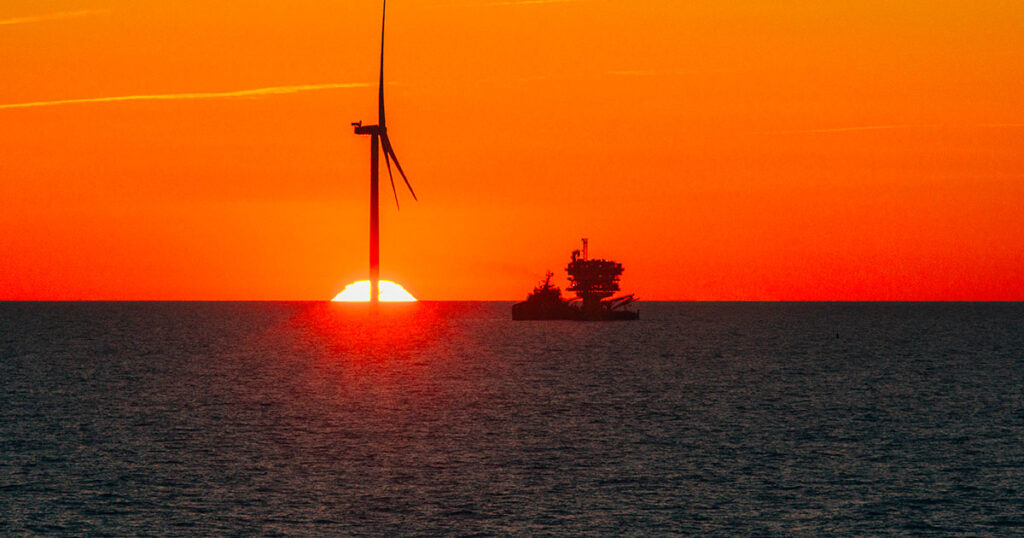
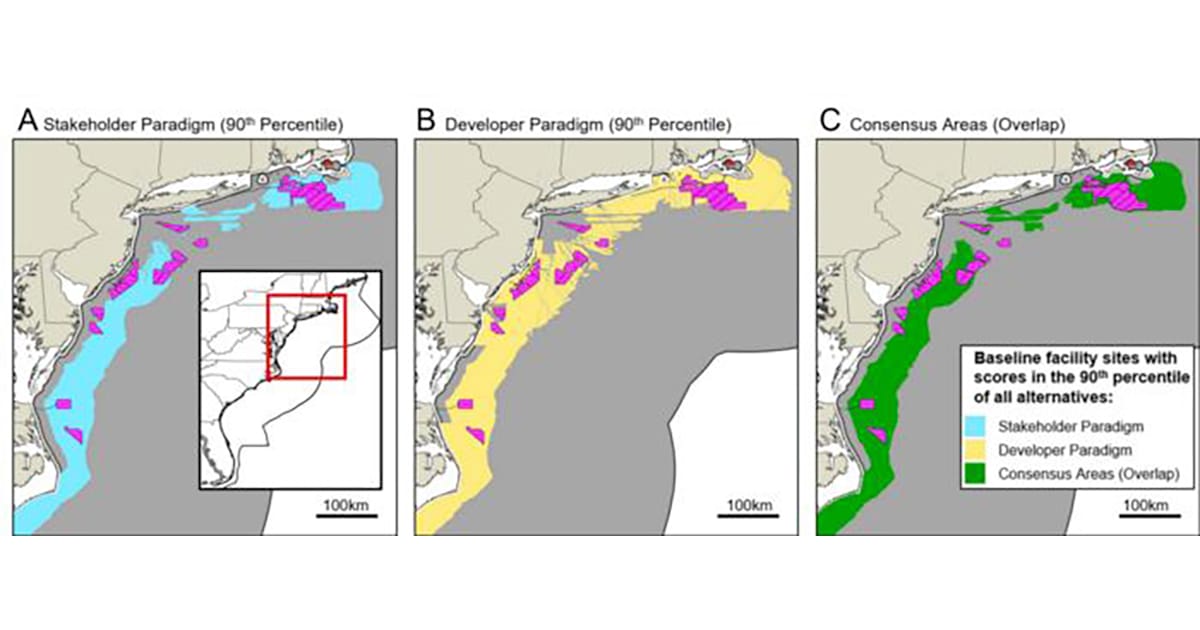
Fifty-eight percent of plant location alternatives are suitable from the perspective of developers (techno-economic perspective), but just eighteen percent of sites are suitable from the perspective of a broad range of external stakeholders (socio-environmental perspective). Nearly all the past and current offshore wind project proposals are in suitable areas for developers, but many—including the cancelled Cape Wind project in Nantucket Sound off the coast of Massachusetts—are in unsuitable areas for stakeholders, according to the analysis.
The authors mapped areas that both developers and external stakeholders would likely consider suitable, which, on the East Coast, has the potential for 600 GW of power. On the West Coast, consensus areas are scarce, with only potential for 5 GW of power owing to greater depths nearshore that limit the possible development area. Using unmoored floating turbines and power-to-hydrogen—which does not require transmission cables—might increase the consensus areas on the West Coast, albeit at greater investment costs. Investment tax credits currently in place may help develop plants that are more socio-environmentally suitable.
Finally, the authors find that while the industry is moving toward larger projects, smaller projects afford less uncertainty in their impacts and are potentially more robust and flexible for development in various sites. According to the authors, developers should focus on consensus areas and consider smaller projects when proposing offshore wind installations.