Therefore, as our collective ambitions to explore unchartered regions expand, whether for commercial, scientific, or naval security reasons, the tactical reliance on multibeam sonars to cover these vast expanses is all but guaranteed. While marine engineers work to perfect the next generation of vessels and vehicles (both manned and unmanned) to access remote waters with efficiency and safety as default design principles, the ongoing development of sonar technology is equally important.
ADVANCING SONAR APPLICATIONS
Tritech knows this well, having been in the business of providing the most reliable imaging and ancillary equipment for more than 30 years. A lot has happened over the last three decades in terms of ocean tech development, but the company’s goal is as true today as it was when we first set up shop as a two-man outfit operating out of a converted house in Kingswells, Aberdeenshire: to provide customers with robust products and reliable support to execute best-in-class underwater imaging campaigns in the harshest of subsea environments.
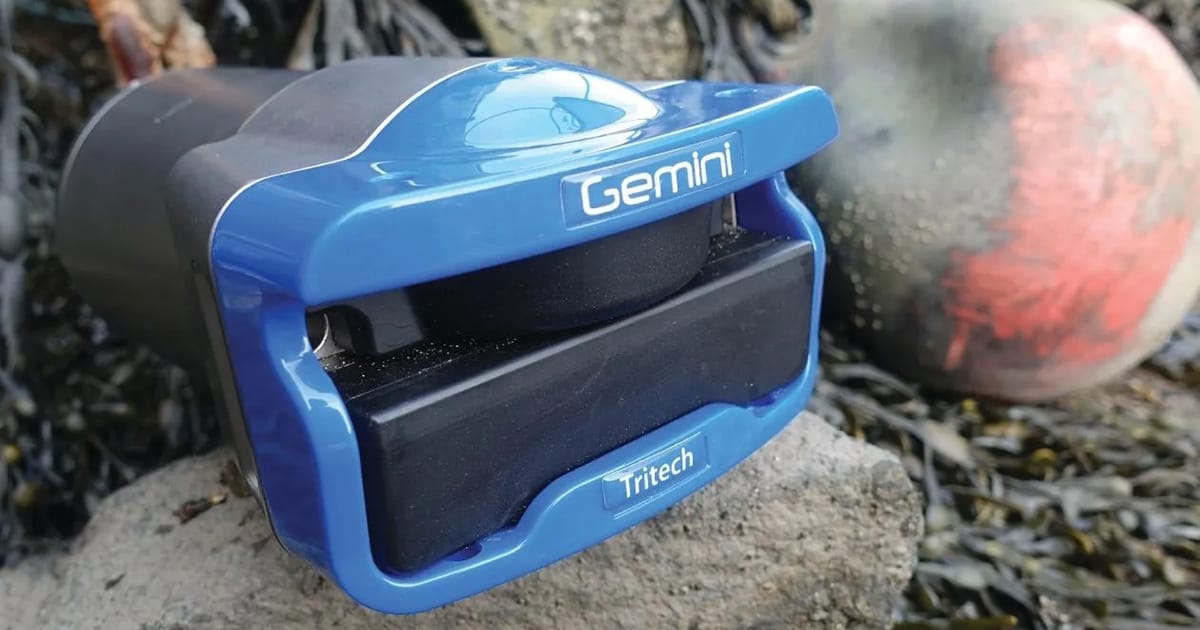
Naturally, Tritech’s portfolio has expanded over the years, but one of our key focuses has always been the research and development of navigation and imaging solutions for subsea survey and intervention vehicles. One of Tritech’s latest innovations is the Gemini 1200id, a multibeam imaging sonar specifically designed to be integrated into work-class ROVs, to aid missions that hinge on pinpoint accuracy and failsafe reliability.
UPGRADED IMAGING RESOLUTION
The 1200id was developed in response to direct requests from our existing customers familiar with operating our Gemini 720is sonar to depths of up to 4,000 m. In addition to the 720 kHz acoustic frequency offered by the Gemini 720is model, the Gemini 1200id introduces dual frequency operation with the addition of a new 1.2 MHz acoustic operating frequency, which improves angular resolution from 1° to 0.6° and range resolution from 4 mm to 2.4 mm.
This upgrade in resolution necessitated a redesign of the analogue front-end electronics to enable the system to handle the higher sampling rate requirements of the new higherfrequency mode of operation. Rather than opting for the somewhat easier (and frankly cheaper) approach of transitioning over to single-ended analogue front-end integrated circuits developed for ultrasound applications, as typically used by the majority of other multibeam sonars, the Gemini 1200id continues to employ a proprietary analogue frontend solution developed by Tritech that incorporates fully differential receiver channels consisting of discrete low-noise amplifiers, discrete variable gain amplifiers, second-order bandpass filters, and discrete high-speed, high-resolution serial ADCs.
This custom analogue front-end solution allows the receiver to be optimized for longerrange sonar applications rather than shorter-range medical ultrasound applications, which primarily drive the development of ultrasound analogue front-end integrated circuits. What does this mean in terms of performance in the field? The Gemini 1200id has a dynamic range twice as wide as its nearest competitor.
TUNING OUT THE NOISE
The electronic circuits within the Gemini 1200id have also been optimized and where necessary additional filtering exclusively employed to minimize self-generated noise around the two acoustic operating frequencies, resulting in significant reductions in unwanted artefacts that can appear in the sonar image.
The Gemini 1200id also actively attenuates external waterborne noise stemming from other subsea equipment in operation close to the sonar, including from ROV components such as thrusters that can often generate electromagnetic interference. By directing self-generated electrical noise away from the acoustic operating frequencies, and by actively attenuating external waterborne electromagnetic interference, the Gemini 1200id offers significant improvements in Signal-to-Noise Ratio (SNR).
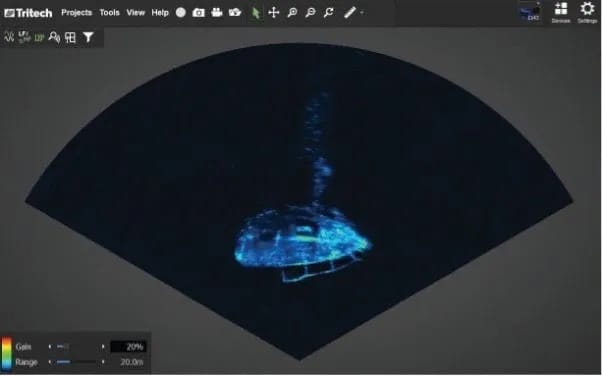
The wide dynamic range and enhanced SNR of the Gemini 1200id enable the Gemini 1200id to generate sonar images of excellent clarity, displaying sharp and bright acoustic returns on a noise reduced dark background.
A flight-time sensor operating at 1 MHz and integrated into the side of the Gemini 1200id measures the speed of sound in the water immediately around the sonar at the time of acoustic reception to ensure that observed targets are displayed accurately for position and size.
All auxiliary port features supported on the Gemini 720is are also supported by the Gemini 1200id, so, with the depth rating of 4,000 meters maintained, the Gemini 1200id represents a logical upgrade for customers familiar with their trusted Gemini 720is sonars for mission-critical dives.
COMPREHENSIVE PRODUCT SUPPORT
The Gemini 1200id can be controlled using either Genesis or software development kits that support integration into third party applications. Genesis is Tritech’s latest all-in-one, dynamic, and easy-to-use software package for controlling, displaying, and recording data. The data bandwidth consumed by the Gemini 1200id can also be limited by capping the ping rate, reducing resolution, or enabling data compression, therefore allowing other equipment and sensors to operate on an existing or shared network connection.
All Gemini 1200id sonar units undergo the strictest factory acceptance testing regime to ensure quality and performance in the field. During factory acceptance testing, every function of the sonar is stress tested, with the system subjected to a series of simulations at varying pressure limits to confirm operational reliability under extreme subsea conditions. The sonar is designed and built to withstand shock and vibration, corrosion, and is fully compliant with relevant EMC regulations.
Tritech offers a 2-year warranty covering defects in materials and workmanship. The warranty can be extended by 12 months if the product is returned to the seller for a full service and repair within 2 years of purchase. Tritech stands by its portfolio of products and offers 24/7 technical support to all of its customers.
This feature appeared in ON&T Magazine’s 2026 February Edition, Exploring the Deep, to read more access the magazine here.