Understanding the sources of these jamming signals, the geographic footprint of their effects, and the technical vulnerabilities of standard GNSS antennas is essential for developing resilient navigation solutions. This article explores the operational realities of Baltic Sea GNSS jamming and highlights how controlled reception pattern antennas (CRPAs) and low elevation angle nulling antennas mitigate these threats.
GNSS Jamming in the Baltic Sea
GNSS jamming in the Baltic Sea is not random. It is closely tied to regional military activity, electronic warfare (EW) posturing, and geopolitical tensions. Aviation incident reports and signal strength mapping point toward high-power, directional jammers operating from Kaliningrad and occasionally from naval vessels. These systems create uncertainty for maritime traffic, with persistent GNSS degraded zones extending hundreds of kilometers across the Baltic Sea.

The combination of advanced antennas, new constellations, and multi-sensor fusion will define the next generation of navigation resilience.
The Impact on GNSS Receiver & Antenna
In the presence of jamming, it is more challenging for GNSS receivers to correlate known satellite codes with received signals. Jamming introduces noise that disrupts correlation peaks, causing the receiver to lose lock. Strong jamming power can also cause the front-end amplifiers and the analog to digital convertor (ADC) to saturate. These factors can result in distortions in the tracking loops, reduction in carrier-to-noise ratio (C/N0), reduction in accuracy of position, velocity, and time (PVT) solutions, and in severe cases a complete loss of PVT.
A standard GNSS antenna is optimized for maximum gain at zenith, with a gradual roll-off toward horizon, providing coverage across the entire upper hemisphere, including low elevation angles needed to track satellites near horizon. GNSS signals arrive at the Earth’s surface at power levels as low as -130 dBm, whereas a jammer power can be millions of times stronger. Given the radiation pattern omnidirectionality of a standard antenna, GNSS and jamming signals will be received with comparable gain. This makes a standard GNSS antenna highly susceptible to performance degradation from even relatively low-power jamming sources.
In modern GNSS systems, significant performance degradation can occur with jammer-to-signal ratios above 40 dB (i.e., J/S > 40 dB). For example, a 100 Watt jammer can disrupt GNSS for a standard antenna up to 200 km away as shown in the Figure 2 map of the Baltic region. Replacing the standard antenna with an anti-jamming antenna allows GNSS operation closer to the jammer.
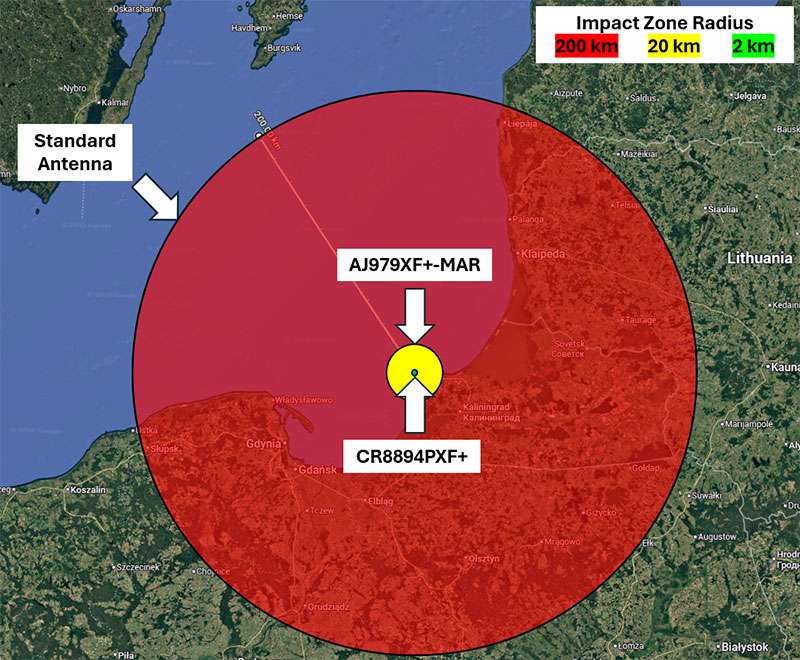
Calian’s low-elevation-angle nulling antenna, AJ979XF+-MAR, provides 20 dB of mitigation of near-horizon jammers, which allows operation as close as 20 km, whereas Calian’s four-element CRPA, the CR8894PXF+, provides up to 40 dB of mitigation, which allows GNSS operation down to 2 km.
How CRPAS Mitigate Jamming
CRPAs represent the most effective defense against jamming. Instead of a single antenna element, a CRPA uses multiple elements to steer nulls toward interference sources, thus reducing power arriving from their direction while maintaining high gain in other directions to maximize reception of satellite signals.
The CR8894PXF+ is Calian’s four-element pole mount CRPA (Figure 3(a)). It covers the GNSS bands of L1/E1/B1 and L2/E5b/B2/G3/ G2. It provides 20 to 40 dB of jamming mitigation in a compact, lightweight (435 g), and low power IP69 package. With its low current draw (max. 150 mA at 5 V), the CR8894PXF+ is compatible with, and can be powered from, commercial-off-the-shelf (COTS) receivers. The CR8894PXF+ also incorporates marine filtering with strong rejection of Iridium and Inmarsat signals. The CR8894PXF+ can create up to 3 nulls per band, as shown in Figure 3(b). The CR8894PXF+ enhances GNSS resilience by maintaining receiver lock during jamming events, reducing positioning degradation, and providing rapid recovery from interference.
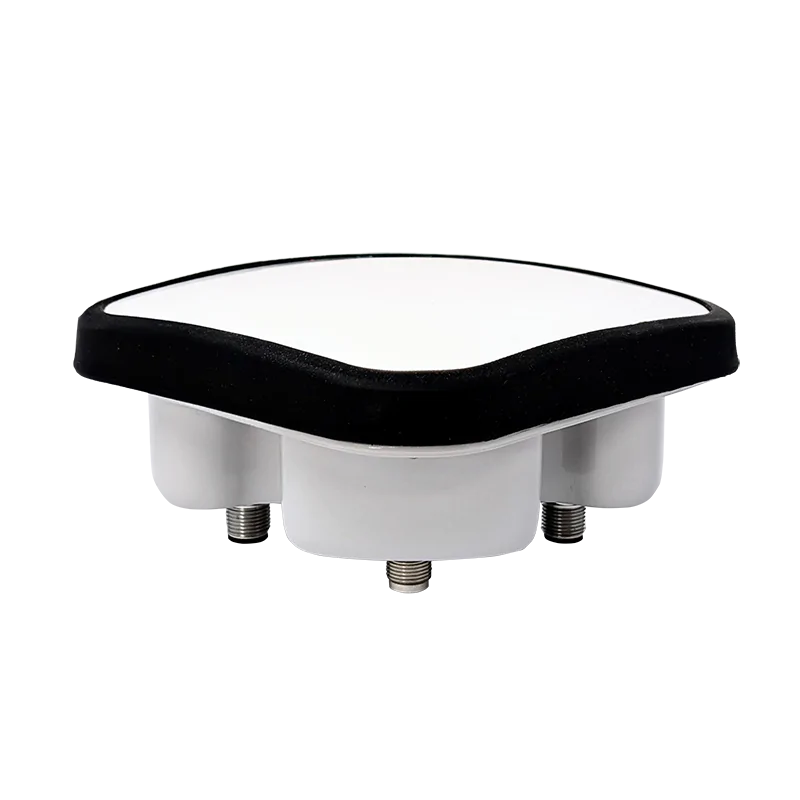
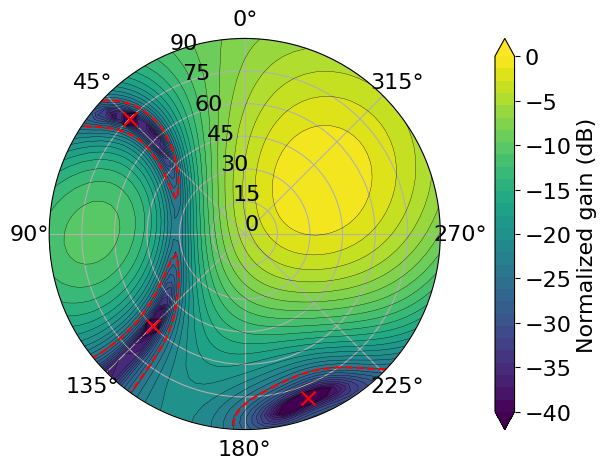
Figure 3: (a) Calian’s CR8894PXF+ CRPA. (b) Demonstration of the CR8894PXF+ null forming capability (denoted by “X”). (Credit: Calian)
Low Elevation Angle Nulling Antennas
While CRPAs offer the highest performance, a simpler alternative is a low elevation angle nulling antenna designed to suppress jamming from near horizon. Calian’s AJ979XF+-MAR, shown in Figure 4(a), is a full-band multi-constellation low-elevation-angle nulling antenna providing a fixed elevation null at low elevation angles as shown in Figure 4(b). The AJ979XF+-MAR provides 20 dB attenuation of low-elevation jammers (between 0 and 15 degrees), deep rejection of Iridium and Inmarsat signals, and a stable phase center supporting precise positioning. The AJ979XF+-MAR is compatible all COTS receivers.
The AJ979XF+-MAR is less effective against airborne jammers and may experience reduced GNSS signal strength for low-elevation satellites. Despite these constraints, the AJ979XF+-MAR provides valuable protection in regions such as the Baltic Sea, where much of the GNSS interference originates from Kaliningrad or maritime-based jamming sources.


Figure 4: (a) Calian’s AJ979XF+-MAR. (b) Typical radiation pattern of the AJ979XF+-MAR. (Credit: Calian)
The Future of GNSS Resilience in the Baltics
The Baltic Sea is likely to remain a hotspot for GNSS jamming due to ongoing geopolitical tensions. As reliance on satellite navigation grows, especially for autonomous systems, the need for resilient position, navigation and timing (PNT) is increasingly important. Other emerging solutions include LEO-based satellites offering higher signal power and jamming resistance, and hybrid PNT systems combining GNSS, inertial sensors, and vision based navigation. The combination of advanced antennas, new constellations, and multi sensor fusion will define the next generation of navigation resilience.
GNSS jamming in the Baltic Sea is a persistent threat affecting aviation, maritime operations, and critical infrastructure. Standard GNSS antennas are highly vulnerable to interference, but modern solutions such as controlled reception pattern antennas and low elevation angle nulling antennas provide effective mitigation. As the region continues to experience EW activity, resilient navigation technologies will play a central role in ensuring safety, reliability, and operational continuity.