
The start to the year has been frenetic—ON&T has already published several hundred stories citing product news, contract wins, partnership announcements, etc.—with collaboration, a recurring theme throughout this month’s magazine, setting the tone. In times of unfolding geopolitical volatility, there is seemingly strength in numbers.
Amid such uncertainty, the most promising commercial opportunities for ocean tech developers lie in the naval defense and offshore energy markets, with many applications set to benefit both industries here in the US and abroad. Most notably, the ongoing integration of uncrewed platforms continues to dominate the headlines, and this will be a consistent theme over the coming months.
PROOF OF PROGRESS
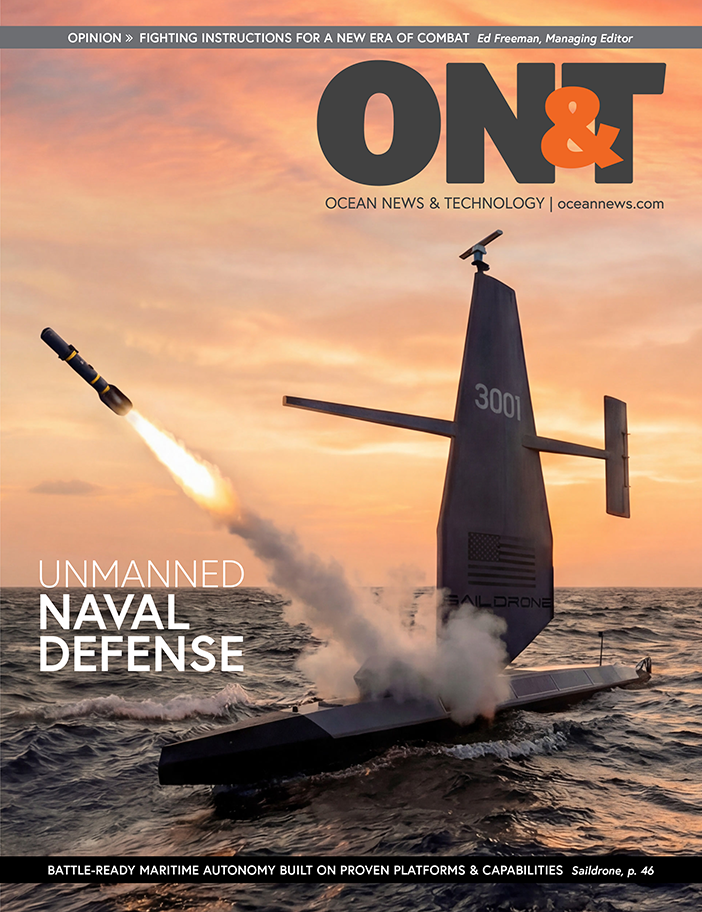
The growing prevalence of—and preference for—uncrewed vehicles in the field is indicative. The discipline of marine robotics continues to dictate a new operating reality in which fit-for-purpose platforms supporting mission-specific payloads allow operators to scale back personnel in the field in favor of AI-led intelligent systems. In this edition alone, there are 4 editorial features and 17 news items that center around the real-world deployment or development of USVs, AUVs, or ROVs. The appetite for this paradigm shift is undeniable, and so is the technology engineered to achieve it.
This year will not only be defined by cooperation between organizations but also by robotic systems. HII’s announcement in mid-January that their ROMULUS 7 USV operated in concert with a HII REMUS UUV serves as a timely bellwether. We can expect a steady drip-feed of announcements throughout the year from naval demonstrations and exercises arranged to validate the coordinated operations between surface and subsurface autonomous systems. And that includes aerial drones. Ambitions extend beyond the functional parameters of one platform running in isolation and towards the optimization of autonomy control software directed to synchronize multiple uncrewed systems operating in tandem on, above, and below the water. All at scale, of course, with a diminishing need for human intervention.
SCALING AMBITION
Scalability depends, among other variables, on production costs and timing. In our defense pages, we report on the testing of a 3D-printed USV. The implications for active naval defense tactics in the age of kamikaze drones and swarm formation surveillance are exciting to say the least.
The challenges of operational endurance will persist. The ongoing development of practical energy storage systems that support dynamic mission profiles, paired with hybrid power systems able to efficiently harvest renewable energy sources while at sea, will unlock further potential. As reported in these pages, company commitments to build 200-ft USVs designed to deploy and retrieve ancillary assets could become a regular feature of 2026.
RENEWED ENERGY
With defense spending a priority, the outlook for the energy sector is a little more unclear. With the current US federal administration pivoting away from renewables in favor of oil and gas development, companies that have diversified their interests will surely fare best. Outside of the US, however, increased emphasis on offshore wind generation has proven fertile ground for both service providers and tech developers across the supply chain. This month, we report on several breakthroughs from the Asian offshore wind market, including SMD’s successful sale and acceptance testing of its electric work-class ROV, the Quantum EV. The increased capacity of electrification is one to watch across the offshore energy sector.
Punctuating the many MoUs and strategic alliances already announced in Q1, some cooperation will be more immediate and permanent in nature, with 2026 kicking off with a series of company acquisition announcements. Nothing particularly new in the land of M&A, but we are seeing clear clusters of specialisms beginning to coalesce in certain corners of the ocean tech spectrum, with the resulting conglomerates setting out their stalls for the next phase of marine exploration.
February also signals the beginning of conference season, where products, people, and policy align to ensure that technical progress keeps pace with operational opportunities. Other than here, of course, there is no better place to Check the Tech. See our events listings on page 56 or visit oceannews.com/events for the latest updates to the calendar.
This spotlight appeared in ON&T Magazine’s 2026 February Edition, Exploring the Deep, to read more access the magazine here.