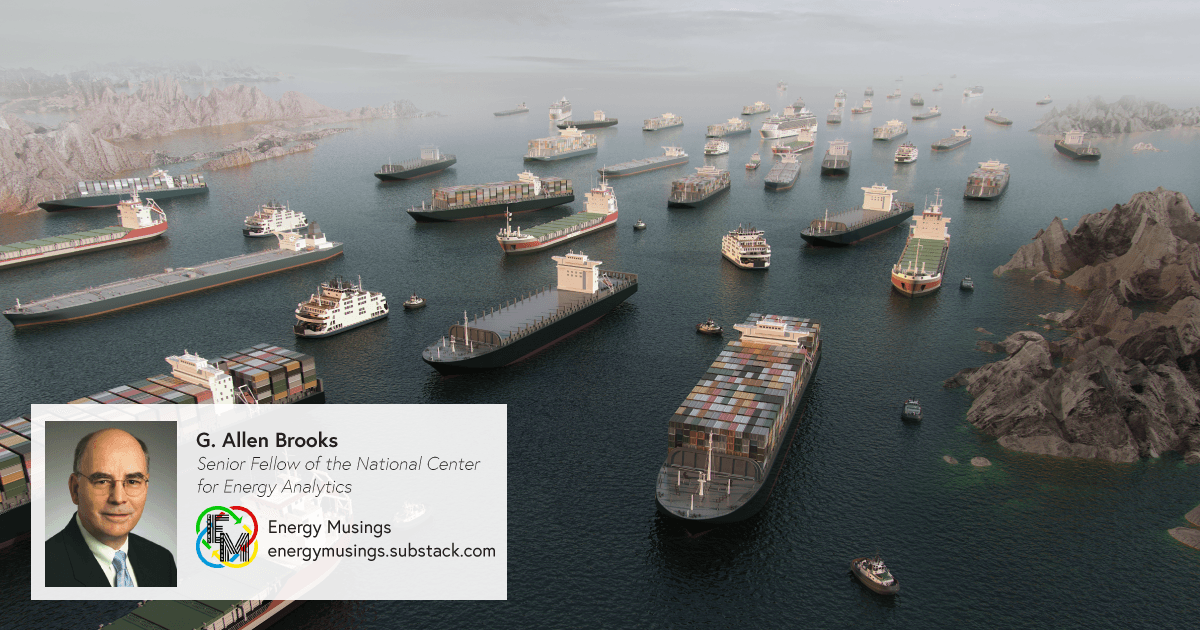

We learned that the US had organized nighttime escorts of oil tankers and cargo ships trapped in the Persian Gulf by the Strait closure. Coupled with the increased shipments of Saudi Arabian and United Arab Emirates (UAE) crude oil via their overland pipelines, the world suddenly relaxed over the lost output. Yes, oil prices remained elevated, but they never soared to the levels predicted when the war began.
The global oil market was further helped by the International Energy Agency’s (IEA) organizing a massive drawdown of global strategic oil reserves. Reduced oil buying by China further helped ease the fear of a worldwide oil shortage. China drew on its huge oil inventory to meet reduced domestic demand.
Events appeared to be on the road to a permanent reopening of the Strait. However, Iran’s IRGC began attacking ships passing through the Strait, and even fired missiles at US military bases in the Middle East. These attacks killed American warriors and spurred the US to declare the ceasefire over and recommence bombing. When this happened, ships feared attempting to traverse the Strait. Oil prices began climbing back to earlier war levels. Then the war spread, as Iran’s proxy, the Houthis in Yemen, attacked Saudi Arabian tankers and closed the Bab al-Mandab exit from the Red Sea. This restricted Saudi oil exports to the Suez Canal, which cannot handle super-large tankers, sharply reducing volumes.
The war then spread to the Black Sea when Ukraine struck tankers loading at the CPC terminal for oil flowing from Kazakhstan. These actions sent Brent oil prices briefly above $100 a barrel. With reports of recent diplomatic progress, oil prices have fallen in anticipation of the Strait reopening soon.
Near-term, the oil market will reflect the status of these battles and diplomacy. Prices will move on prospects of oil shortages and high refining margins due to the lack of sufficient global refining capacity with the loss of 50 percent of Russia’s due to Ukraine attacks. US fuel stocks are down sharply and will remain low until the war is resolved.
Natural Gas
The natural gas industry has overcome multiple challenges this year. In the US, various regions of the country have experienced heat domes sending daily temperatures into the high 90s or over 100 degrees, often accompanied by high humidity. Additionally, the North Central, New England, and Mid-Atlantic states have suffered from smoke from Canadian wildfires, which forced health officials to warn people to remain indoors due to possible lung problems from inhaling smoke particulates.
The heat domes reached western Europe and boosted power demand. This has driven increased LNG purchases from US exporters. Meeting increased electricity demand, as well as rebuilding European winter gas storage, has been challenged by the Iranian war, which has shut down LNG exports from Qatar and the UAE.
When the ceasefire was negotiated between Iran and the US, reopening the Strait of Hormuz, Qatar and the UAE were able to begin exporting small volumes of LNG. Major LNG exports were delayed because of the time required to restart liquefaction plants that must be cooled to -162º C (-260º F). This process can take as long as two months, depending on how warm the tanks are when the cooling begins.
The global LNG market is further challenged by the loss of 17 percent of Qatar’s capacity due to the Iranian attack on the facilities early in the war. The CEO of QatarEnergy, the operator of the LNG facility, has said repairing the damage may take up to five years. Losing this amount of global LNG capacity will strain the industry to meet rising demand for natural gas worldwide. Fear of permanent supply shortages drove some Asian countries to build new coal-fired electricity generating plants rather than wait for additional LNG export capacity to come online.
With additional US LNG export capacity coming online this spring, it has been able to deliver nearly 25 percent more gas year-over-year during the first five months of 2026. Still, Europe struggles to refill its storage because of its unwillingness to pay high gas prices. During the early days of the Iranian war, Europe’s gas price soared to over €60 per megawatt-hour, a doubling of the price. After the initial market shock, prices declined to €40-€50/MWh. Prices were at the low point when the ceasefire fell apart, sending them back above €60/MWh.
Due to the high price and Asian buyers’ willingness to pay higher prices for LNG cargoes, Europe is well short of filling its storage capacity. European Union officials have waived the mandate to refill to 90 percent of capacity, hoping for 80 percent. Forecast models, however, suggest Europe may only reach the low 70 percent level. Such a low storage level puts Europeans at risk of an early cold wave sending electricity prices soaring and jeopardizing adequate power generation.
Strong US gas production has enabled our industry to rebuild storage on par with 2025’s rebuilding pace, while supplying more LNG to the global gas market. Also, domestic gas prices remain at or below $3 per thousand cubic feet, a reasonable price. Remaining summer heat and increased LNG exports will determine how US gas prices trade for the next several months.
IRAN WAR IS CHALLENGING THE GLOBAL AND US OIL MARKETS


HEAT AND LNG EXPORTS HAVE NOT KEPT STORAGE FROM MATCHING 2025 LEVELS


This feature appeared in ON&T Magazine’s 2026 August Edition, Defending Critical Underwater Infrastructure, to read more access the magazine here.