
These are two words close to the hearts and minds of the team at RAD Propulsion, an outfit established in 2018 by a pair of marine engineering experts with proven experience of building and developing some of the world’s pioneering marine robotic vessels and control systems.
The company quickly formed a high-caliber team of product designers, engineers, app developers, and commercial experts to scale the use of modern electronics, power control, software and connectivity technologies in defining a next-gen suite of propulsion solutions.
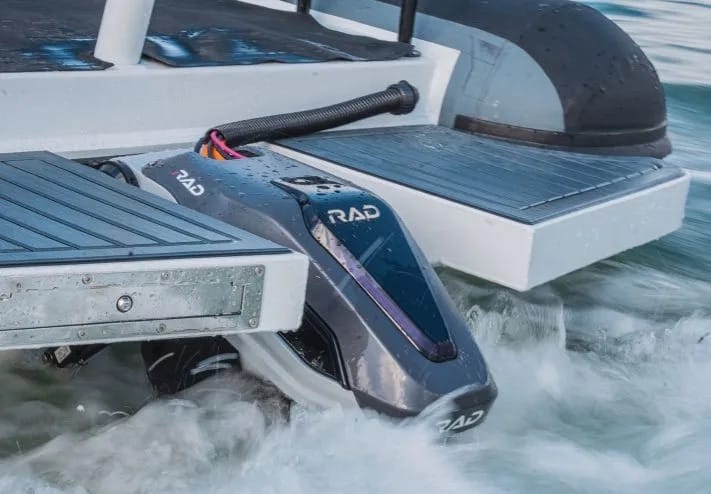
Fast forward to mid-2023, and the company launched its RAD 40 electric outboard, boasting a 40 kW of electric power, the equivalent thrust to a conventional 60 hp gasoline outboard. Supported by the RADBus control system and fast-charging RAD battery backs, RAD Propulsion now offers a fully integrated end-to-end electric propulsion package.
With mounting pressures to meaningfully drive down CO2 emissions, a diversifying market for cost-effective and powerful electric outboards will be seen as a boon for marine operators. We met up with Co-Founder and CEO Dan Hook to find out more about RAD Propulsion’s current offering and his vision for how his company can help shape the future of electric propulsion for both crewed and uncrewed vessels.
1. Give us the background story on RAD Propulsion and what the company is focused on right now…
RAD is hard at work developing and supplying products to help boat builders supply state-of-the-art electric craft and uncrewed systems. RAD was founded by a team with proven backgrounds in designing, developing,
and delivering uncrewed systems and marine robotics. Even back then, we could see a clearly pronounced trend in demand for both electric craft and also vessels that could be supported by more advanced control systems and connectivity. We have arrived at a point in time when assets can operate at varying degrees of autonomy, including fully autonomously. To scale this development correctly, today, the market needs a steady supply of electric drives in the 2-120kW range, batteries, autonomy and control interfaces, and hardware.
2. Tell us about the RAD 40 outboard and the unique selling point that this system offers prospective customers…
The RAD 40 is our first electric drive product to market, and we set out to do something special. It is a fully ‘fly-by-wire’ system. This means that it is electrically steered with digital inputs for rpm/ direction/steering angle, with an easy-to-use interface and API—it is a dream package for those developing autopilots and control software.
We use axial flux motors which make the entire system incredibly quiet and capable of turning larger propellers with relatively little noise disturbance. We also developed a novel method of steering just the lower leg (±90 degrees) and fully sealed with unit with closed circuit cooling to ensure that no corrosive salt or dirty water is needed to cool the unit from inside.
3. What is the ZENOW project and how did this collaborative opportunity come about?
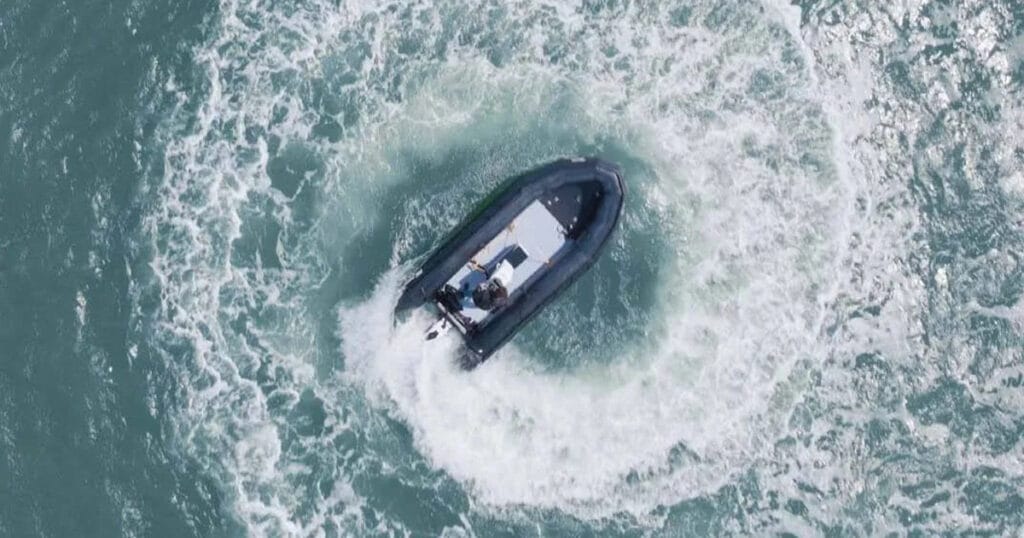
The ZENOW project, with support from the UK Government ZEVI scheme, has been an excellent way to get electric workboats in the hands of users. It was headed up by the boat builder RS Electric Boats and we supplied our RAD 40 systems to power workboats delivered to small harbors and marinas. The vessels will run and collect data for a minimum of three years within the project to gather both engineering data (speed, power, charging rates, volt/current/temp/flow rates, etc.) but also provide adoption case studies and economic data to optimize electric boat operation.
4. Given your previous experience with developing USVs, what degree of R&D work is being focused on engineering electric propulsion systems specifically for integration with uncrewed assets?
At RAD we are convinced that more and more craft of all types will use electric propulsion to drive and maneuver the vessel. The energy may come from batteries, fuel cells, solar or generators running alternative fuels, but we saw the trend for electric propulsion and the neat fit this has with ease of control, monitoring, predictability, and repeatability.
So, whether the boat is crewed (conventional), uses advanced driver assistance systems (ADAS) for certain roles, or is fully uncrewed (autonomous/remote or working in a hybrid fleet), we have always placed a premium on ensuring that our electric drives are designed to capitalize on this advanced control functionality. As a result, the team at RAD have channeled much of our ongoing efforts into achieving this outcome, and I think we have timed it well.
5. RAD Propulsion recently closed a significant funding round. What does this mean for the next chapter of growth at your company?
Developing hardware, software, sales, and support is an expensive business, and we decided early on that we wanted to move fast and do things to the highest standards—inevitably, this takes investment funding. We closed a round back in March 2024 that saw us take the RAD 40 to market and develop our RAD 120 (launching soon—watch this space!) and control systems.
We are actually in the process of closing a pre-series A round now to open a support facility in the USA and add further investment to our supply chain and tooling. We have a great team, a collective of brilliant minds who are united in our mission and our potential to shape the industry, so RAD Propulsion is definitely a fast-paced place to work and offers exciting opportunities to talented professionals looking for their next challenge.
This feature appeared in ON&T Magazine’s 2025 September Edition, Decarbonizing the Blue Economy, to read more access the magazine here.