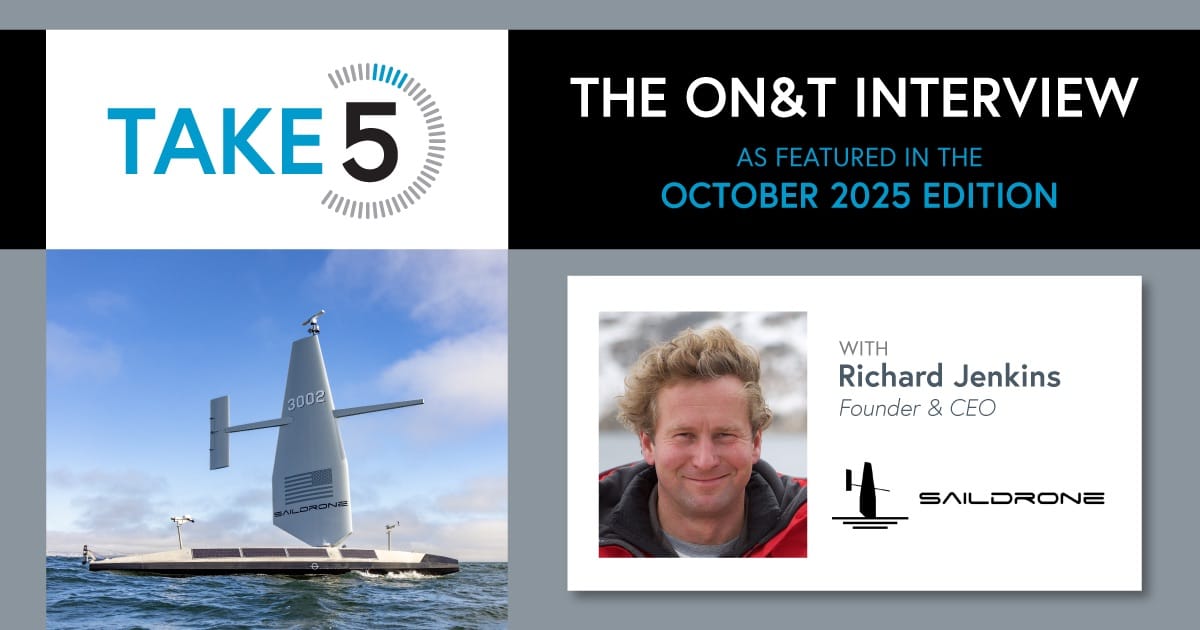
Jenkins, an accomplished sailor, decided to adapt Greenbird’s aerodynamic design for applications on water, founding Saildrone in 2012. Funding soon followed, as did a series of performance milestones, including circumnavigating Antarctica, setting a speed record across the Atlantic, and sailing into a Category 4 hurricane.
Fast forward to 2025, and Saildrone continues to make industry headlines in a year stacked with company announcements, including a partnership with Palantir to scale USV production, a new company president, an expansion to Europe, and achieving class for the Surveyor USV. This month, we caught up with Richard Jenkins to find out more.
1. What does achieving full ABS classification for the Surveyor mean for Saildrone, and the ocean tech sector?
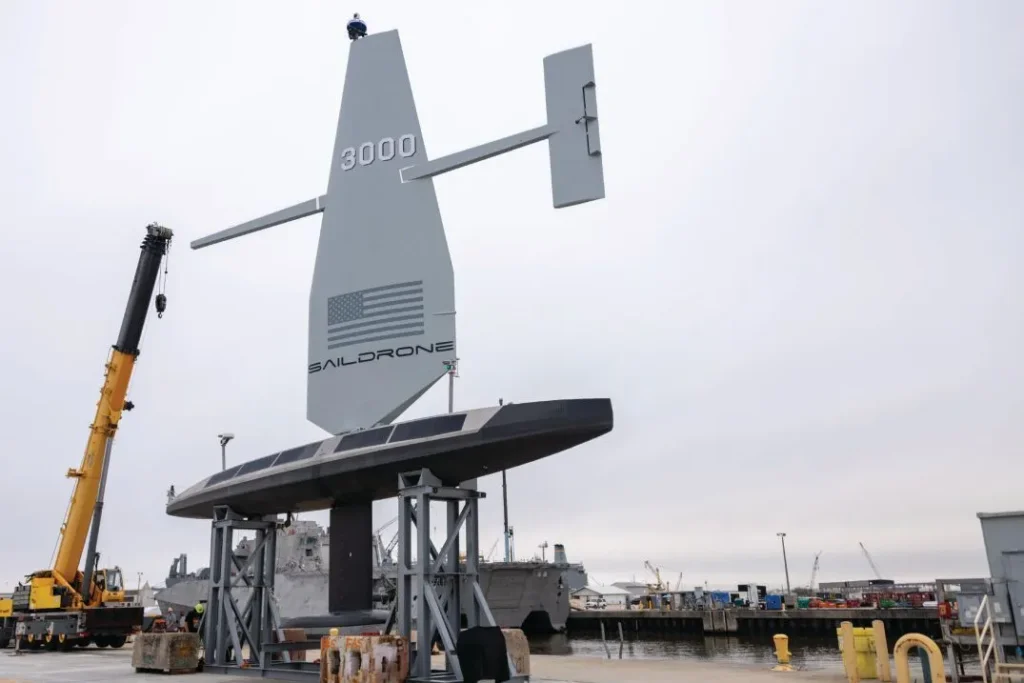
Achieving full classification from the American Bureau of Shipping (ABS) for the Saildrone Surveyor is a landmark moment, not just for us, but for the USV sector as a whole. It means the Surveyor has been validated against the same stringent standards that govern crewed ships: structural integrity, safety systems, autonomy architecture, and cyber-resilient communications. For the first time, a USV of this size and complexity has been granted the same level of trust and regulatory acceptance as traditional vessels.
For Saildrone, it validates more than a decade of R&D and operational testing. We’ve proven that USVs can safely and reliably operate in the open ocean for long durations without a crew on board. That opens the door for large-scale adoption by governments, navies, and commercial operators who previously needed that assurance. For the wider industry, it sets a precedent. To compete in high-stakes missions—from national defense to subsea infrastructure protection—meeting this standard is quickly becoming a baseline requirement.
2. We have seen others in the space receive certificates or MOUs, why is classification so significant for USVs?
Unlike certificates or MOUs, which are generally statements of intent or preliminary validations under evolving unmanned vessel frameworks, classification is the gold standard. It means ABS has formally recognized the vessel as meeting the same rigorous design, safety, and operational standards as a crewed ship and entered it into their official register.
But achieving classification is extremely difficult and requires design, production, and operational maturity. Most USV developers are still at the prototype or demonstration stage, where certificates or MOUs are more achievable and appropriate.
By contrast, Saildrone’s fleet has accumulated millions of miles and years of continuous operations at sea, proving a level of maturity and reliability necessary to satisfy ABS’s full review. Saildrone now has two vehicles—the Voyager and the Surveyor—fully classed by ABS. It’s the difference between signaling ambition and being recognized as a true seagoing vessel, underscoring the extreme reliability and proven maturity of the Saildrone design.
In many ways, classification sets the bar that all USVs must ultimately reach if they are to be trusted for real-world operations.
3. Saildrone USVs have been supporting US 4th Fleet operations. What can you share about those missions and the successes to date?
Working with the US Navy’s 4th Fleet is focused on strengthening maritime domain awareness in the Caribbean and Eastern Pacific. These are regions with dense commercial shipping, narcotics trafficking routes, and vast stretches of ocean that are difficult to monitor with crewed assets alone. Saildrone Voyagers have been deployed to provide persistent maritime domain awareness in support of counter-narcotics, interdiction, and broader security missions.
The key advantage is endurance. Operating for months without refueling or resupply, powered primarily by wind and solar, the Saildrone Voyager is a force multiplier. We have been able to monitor chokepoints, track suspicious vessel activity, and provide real-time data to commanders, all at a fraction of the cost of crewed patrols. While we can’t comment on mission specifics, it was widely reported that Saildrone was one of the tools the US Navy used to spot the Russian ships approaching Cuba in 2024. And, we’re providing this value at a fraction of the cost—the Center for Naval Analyses has calculated that Saildrone operates at $4.24 per nm2 per day, compared to a DDG that costs $88.77 per nm2 per day.
In testimony before the Senate Armed Services Committee, Adm. Caudle called Saildrone, “part of the fabric of how we improve our maritime domain awareness.” We’re not replacing ships or aircraft, but augmenting them—filling gaps in coverage, extending reach, and providing an unblinking eye in regions where it’s simply not feasible to keep a manned asset on station.
4. How are you calibrating your strategy for European expansion amid escalating security concerns in the region?
Europe is at the center of a seismic shift in maritime security. Events in the Baltic, the sabotage of undersea pipelines, and heightened tensions in the High North have underscored the vulnerability of subsea infrastructure and the importance of persistent surveillance. As geopolitical tensions increase, our NATO allies need cost-effective and scalable solutions to maintain situational awareness across vast areas and monitor critical underwater infrastructure (CUI).
By establishing Saildrone Denmark, we’ve created a regional hub to support operations close to where they’re needed most. Our recent $60 million funding round, led by EIFO, is dedicated to scaling our presence in Europe, tailoring payloads and mission profiles for regional needs, and ensuring we can support our customers locally. We already have four Voyagers operational with the Danish Armed Forces for surveillance and infrastructure monitoring missions, and participated in a NATO demonstration earlier in the summer to resounding success.
I see Europe as a growth region for us—not just for defense, but also for ocean mapping in the Arctic and North Atlantic. We want to become a trusted partner to European allies, with Saildrone USVs integrated into the day-to-day fabric of maritime security.
5. You have been scaling the vehicles over the years. Are there any plans to scale to a platform larger than Surveyor?
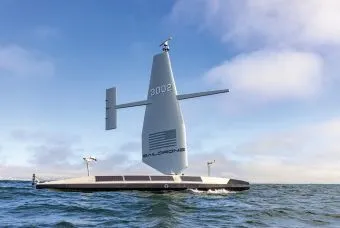
For Saildrone, one of the most interesting things we’ve learned along the way is that the bigger our USV platform gets, the better it performs. The intuition to scale, both in terms of USV dimensions and fleet numbers, is ingrained into our DNA. So, these are exciting times at Saildrone. We are busy ramping up production across USV classes and have announced a series of strategic investments to ensure that Saildrone is best equipped to respond to market forces, bringing continual improvement to our company’s products, processes, and personnel. Stay tuned.
This feature appeared in ON&T Magazine’s 2025 October Edition, Subsea Infrastructure: Integrity & Security, to read more access the magazine here.