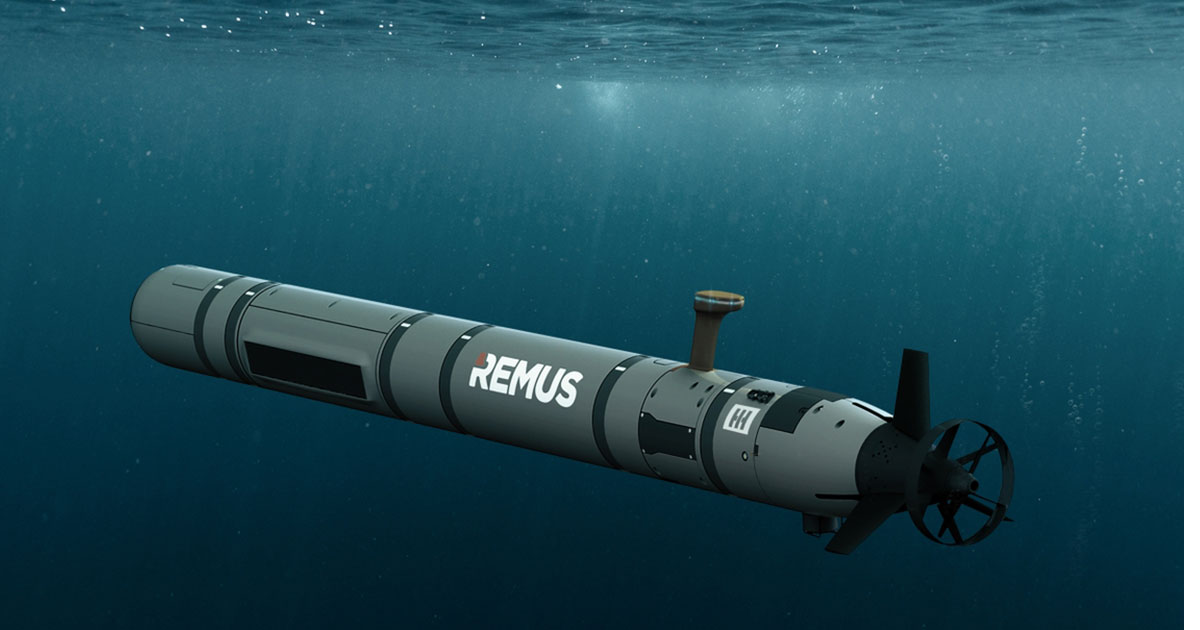
Originally funded by the Office of Naval Research (ONR) and developed by the Woods Hole Oceanographic Institution (WHOI) in Woods Hole, Massachusetts, REMUS began as a research vehicle designed to advance ocean science and undersea exploration. Over the past 25 years, HII has expanded that pioneering technology into the most widely produced and adopted autonomous unmanned underwater systems in the world, supporting defense, commercial and scientific missions.
“REMUS has endured for 25 years because it was designed to evolve,” said Duane Fotheringham, President of the Unmanned Systems group in HII’s Mission Technologies division. “Its reliability, modularity, and open architecture allow operators to quickly adapt the platform to new missions while maintaining the performance and trust customers rely on.”
Today, more than 750 REMUS vehicles have been delivered to over 30 nations. They are currently used by 14 NATO navies, including the U.S., United Kingdom, Norway and Germany, as well as allied partners across the Indo-Pacific. REMUS vehicles support mine countermeasures, intelligence, surveillance and reconnaissance (ISR), and seabed mapping missions. More than 90% of all REMUS systems deployed in the past 25 years remain in active service, a testament to their durability, reliability and lifecycle value.
Among REMUS’s notable capabilities and recognition:
- The REMUS family supports modern naval operations with unmatched reliability. Its autonomous systems enable independent and teamed operations. In a recent breakthrough, REMUS 600 vehicles were successfully launched and recovered from the torpedo tubes of an HII-built U.S. Navy Virginia-class submarine, extending mission reach while reducing exposure risk and enhancing stealth for submarine forces.
- REMUS’ open-architecture design enables rapid integration of new payloads as missions evolve, maximizing platform modularity while controlling lifecycle costs. The REMUS product line includes multiple variants designed for specific mission profiles and operating depths. Vehicle designations reflect operational depth capability and generational improvements, from the compact REMUS 130 optimized for shallow-water operations, to the REMUS 6000 designed for deep-sea exploration and recovery operations. REMUS 620, a medium unmanned underwater vehicle (MUUV), features modernized electronics, modular upgrades, and endurance of up to 110 hours with a range of approximately 275 nautical miles.
- REMUS vehicles have played critical roles in high-profile global search operations, including the deep-ocean search for Air France Flight 447, post-tsunami maritime surveys in Japan, and the historic discovery of the USS Indianapolis (CA 35) in the Philippine Sea.
- Research institutions and environmental organizations continue to rely on REMUS vehicles for oceanographic research, marine archaeology, and ecosystem monitoring. The National Oceanic and Atmospheric Administration (NOAA) is currently deploying REMUS 620 vehicles to map seafloor habitats impacted by the Deepwater Horizon oil spill, while universities and marine laboratories use the systems to conduct long-duration environmental surveys.