
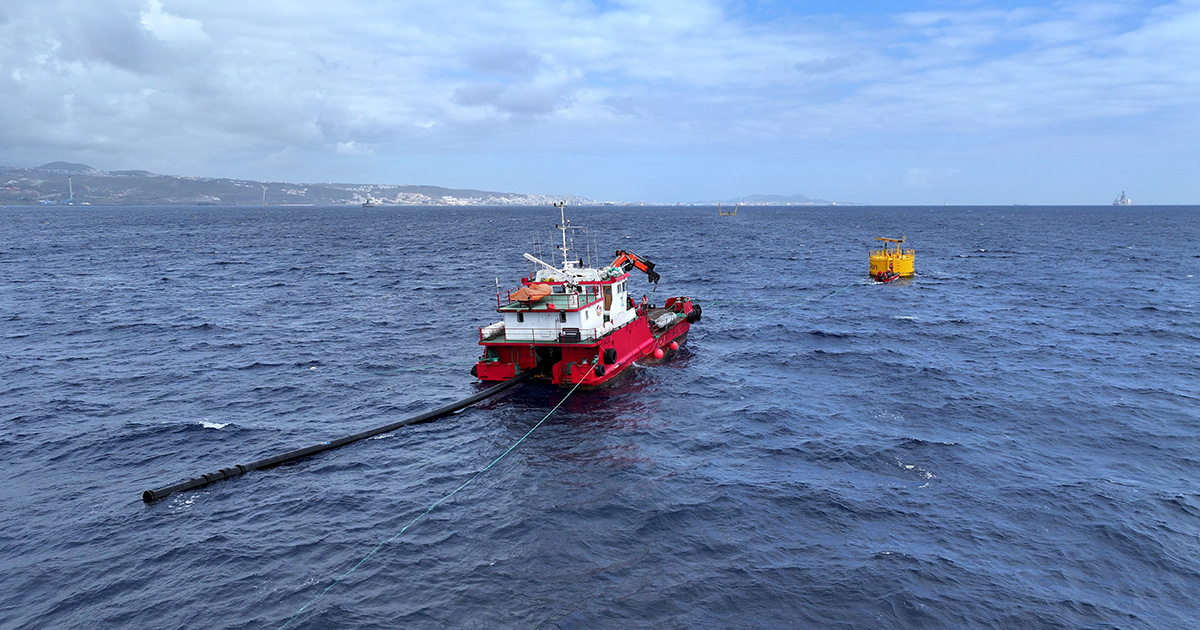
The company has completed the offshore installation of a floating platform prototype in the Canary Islands, potentially removing one of the longest-standing barriers to scaling OTEC for islands and coastal communities in the tropics and sub-tropics.
OTEC generates electricity by harnessing the temperature difference between warm surface water and cold deep ocean water. OTEC has been successfully demonstrated onshore at a small scale, where existing deep ocean water intake facilities are available, but the size and length of required pipes to provide seawater have limited the size of previous efforts.
Offshore OTEC enables the scale required for meaningful power generation in island markets by reducing the length of the pipe needed compared to onshore operations by 80%.
Today, the majority of electricity in tropical island nations is generated from diesel and heavy fuel oil, exposing these economies to volatile fuel prices and high energy costs.
While wind and solar have been deployed, their expansion is often constrained by limited land availability and challenging seabed conditions close to shore. As a result, many islands face structural barriers to achieving reliable, large-scale renewable power.
OTEC offers a fundamentally new solution that utilizes a tropical island’s largest natural resource, the ocean. By operating offshore and drawing on the ocean’s natural temperature gradient, it provides continuous, baseload electricity without competing for land or relying on intermittency. Global OTEC has identified over 25 GW of existing fossil fuel capacity across tropical islands that could be replaced by OTEC systems over time.
Until now, however, scaling OTEC offshore has been constrained by engineering challenges. This installation represents a critical step toward overcoming those barriers.
The PLOTEC project culminated this week with the successful deployment and connection of the vertical seawater intake riser, the installation of which is widely considered the most complex step in establishing an offshore OTEC system.
“This is the moment where OTEC moves away from controlled environments into the real world,” said Dan Grech, Founder and CEO of Global OTEC. “Conventional onshore intake systems, while great resources for aquaculture and testing equipment, are low-capacity and expensive. Offshore, OTEC can scale in a modular approach that transitions OTEC from being a niche technology to a powerful resource. We now have a new class of standardized and replicable baseload power on a learning curve akin to wind, solar, and batteries.”
The prototype floating platform has been installed at Oceanic Platform of the Canary Islands (PLOCAN), a pre-consented marine technology test site off the coast of Spain. The location provides access to deep ocean water close to shore, allowing engineers to validate system performance and environmental impact under realistic operating conditions.
The prototype forms part of a €3.5 million project funded by the European Union’s Horizon Europe initiative, awarded to a pan-European consortium led by Global OTEC in 2022. The full program has advanced offshore OTEC platforms through desktop simulations, tank testing, and now full-scale ocean deployment.
With offshore validation now underway, Global OTEC will next bring the first OTEC Power Module to Hawai’i, an important step in positioning OTEC as a new category of clean, renewable energy capable of delivering continuous, 24/7 power for islands and coastal communities.