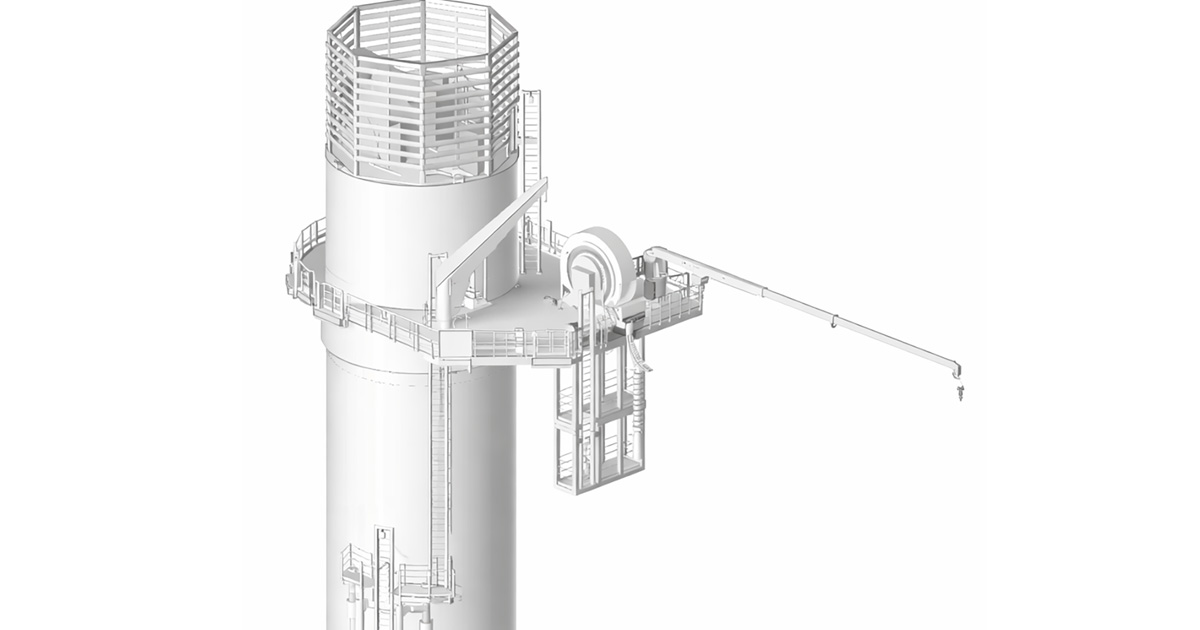
The Power Hub and Power Tower introduce standalone options that can be deployed independently of turbine infrastructure, enabling flexible charging across both operational and future offshore wind developments. They mark the next stage in Stillstrom’s offshore charging strategy, broadening its portfolio and increasing flexibility in how and where infrastructure can be deployed, alongside solutions already integrated within wind farm assets.
As wind farms move further offshore and increase in scale, service vessels are becoming increasingly central to installation, maintenance, and long-term operations. Reliable offshore power is therefore a key enabler for vessel electrification, supporting reduced reliance on maritime fuels, enhanced efficiencies, and lower greenhouse gas emissions across offshore campaigns.
The launch builds on the work of Stillstrom’s R&D team, with engineers Koen Legrand and Raymond Bergmann recently recognized as Inventors of the Year 2025 by A.P. Moller – Maersk, reflecting the strength of the company’s innovation. This includes multiple patents across its offshore charging technologies, as well as pending protection for both the Power Hub and Power Tower.
Stillstrom’s Detailed Engineering Manager, Koen Legrand, and co-recipient of the award, said: “Our two new monopile systems help to address the sector’s long-standing ‘chicken and egg’ challenge, where vessel electrification and infrastructure deployment must progress in step. The Power Hub is a compact, monopile-mounted structure designed for installation within operational wind farms, enabling charging capability to be added to existing infrastructure. The Power Tower is designed for new-build offshore wind projects, with a form that mirrors a turbine foundation and allows installation using standard construction vessels, tools, and processes, enabling charging to be integrated from the outset.”
Kristian Borum Jørgensen, CEO of Stillstrom, said: “Our mission is to eliminate vessel emissions, the largest source of CO2 in offshore wind farm operations. Electrification of SOVs is therefore essential if the wind industry is to meet its full decarbonization potential. What has been missing is the infrastructure to support it at sea. These new solutions give developers and operators practical, scalable options, enabling offshore charging either fully integrated within wind farm structures or through standalone offshore installations.”
Stillstrom is exhibiting at Stand 9-F80 WindEurope in Madrid from April 21–23, 2023.