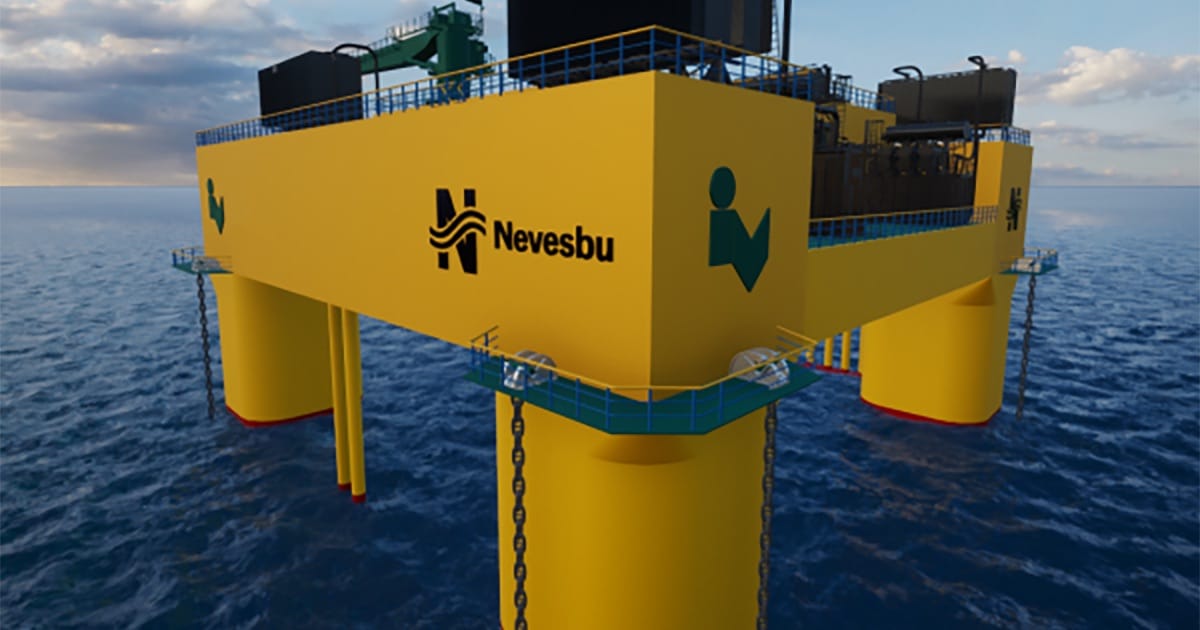
Designed for Challenging Conditions
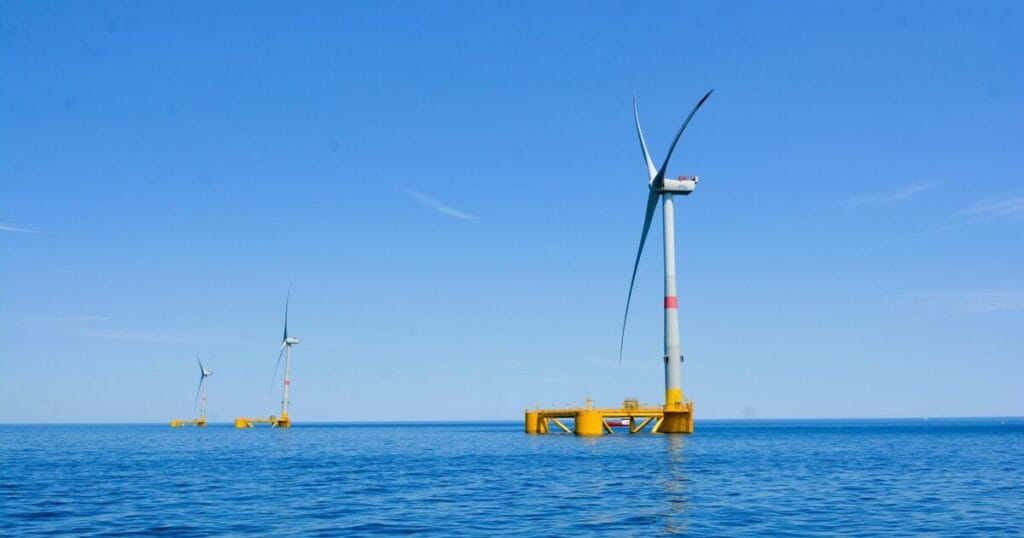
The floating HVAC substation is designed for demanding offshore conditions and is suitable for water depths ranging from 400 to 1,500 meters. The substation has a capacity of 500 to 1,000 MW and can float effortlessly for years on rough seas. This technology enables wind farms at great depths to be connected to the electricity grid. As such, it forms a crucial link in ensuring reliable delivery of renewable energy and accelerating the energy transition—not by 2050, but in the near term. Iv and Nevesbu expect to see the first floating HVAC substation operational before 2035. But how do we ensure the reliability and feasibility of this concept?
From Fixed to Floating Substations
In developing this floating substation concept, Iv and Nevesbu draw on decades of experience in the offshore industry. As a result, Iv and Nevesbu have a thorough understanding of the offshore conditions, requirements, and technical challenges that exist. Iv has an extensive track record in designing fixed HVAC and HVDC substations in collaboration with construction yards. Recent examples include the 2 GW platforms for TenneT, which Iv is designing for the GE-Seatrium consortium, and the HVAC substations for HSM and Smulders. This expertise is essential for making the transition to floating offshore substations.
Nevesbu has been designing floating structures such as FPSOs and naval vessels for 90 years—vessels that must operate in highly challenging offshore environments. Nevesbu has specialist knowledge of the motion behavior of floating offshore structures, floaters subjected to long-term dynamic loads, and the design and mooring of complex floating units. Combining this knowledge and experience results in a reliable, integrated solution that meets stringent operational requirements. This enables us to move towards floating substations and provide what the market and offshore wind developers require.
About the Floating Substation
The floating HVAC substation measures 50 by 50 meters, rises 40 meters above sea level, and weighs less than 10,000 tonnes. It houses two transformer units, each with a capacity of 500 MW, stepping up the voltage from the offshore wind turbines from
66 kV to 220 kV, transmitting it via cables to the onshore electricity grid. The switchgear on either side of the transformers protects components such as the cables and the transformers themselves, thereby ensuring maximum energy transfer to the shore. The substation is built on a semi-submersible base, which minimizes motions even during stormy conditions at sea. Iv has been refining this proven principle over the past thirty years.
Are There Alternatives?
Everything that floats experiences motions, especially further offshore, where depths exceed 400 meters, winds are consistently strong, and waves can reach up to ten meters. One could question whether a floating concept is viable, given that substation equipment is not typically designed to cope with this kind of motion. However, alternatives are not straightforward, and running cables from each wind turbine to shore is highly inefficient, causes excessive energy loss, and there simply isn’t enough space. Installing an Alternating Current substation on the seabed may seem like an ideal solution in terms of stability; however, underwater conditions necessitate technical specifications that require further research. This is aside from the complexity involved in underwater installation and maintenance. Thus, a floating HVAC substation offers a realistic and cost-effective solution for scaling up offshore wind energy supply in the near term.
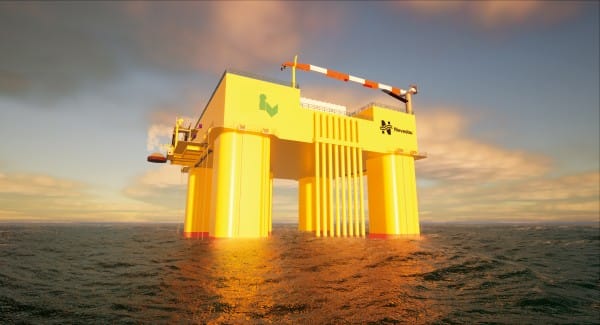
Technical Challenges
Managing continuous motion is a challenge Iv and Nevesbu have been working on for over eight years. The key question is: what are the platform’s motions under high wind and wave conditions, and how do we address them?
Cables and Equipment
The challenge posed by platform motions lies in two key elements: the cables and the equipment. The cables, which consist of multiple layers of insulation and shielding around a copper core, must not suffer fatigue from the constant motion caused by the sea’s swell. It is also essential to prevent the cables from suffering from water ingress over time. Cables rated up to 245 kV are now certified for long-term dynamic loading. Equipment must also be able to withstand continuous motion. The mass on the platform accelerates and shifts. Equipment suppliers set strict requirements: ideally, a transformer should be stationary and firmly anchored to the ground or seabed. The heavy motion calls for new specifications and smart structural solutions to minimize the impact of motion and acceleration on the equipment.
Ready for Introduction
The current floating HVAC substation concept is designed for conditions found in the Mediterranean Sea. The design is based on a well-known and proven concept from the oil and gas industry, where semi-submersibles have been used as drilling platforms for over 40 years. Several have also been in use for around 20 years as production platforms that, like the HVAC platform, remain in place without returning to shore for maintenance. Nevesbu’s experience with semi-submersibles dates back to 1990. The electrical system is based on Iv’s twenty-plus years of experience with fixed HVAC and HVDC substations. Utilizing such a proven concept provides confidence that the design will perform as intended. Tailored to the specific requirements of HVAC equipment, it is ready to be adapted for other offshore environments.
Suitable Locations
What are the ideal conditions for the floating HVAC substation? From a water depth of 400 meters, the floating substation becomes an attractive solution for offshore wind farms. The Mediterranean Sea, for instance, off the coast of Italy, is highly suitable for this concept. So is the area west of Scotland, where wind speeds routinely exceed Beaufort force five. The sea off the Californian coast also offers a suitable climate, although current political conditions are less favorable.
HVAC and HVDC
Iv and Nevesbu previously worked on a similar substation using High Voltage Direct Current (HVDC). Theoretically, HVDC is more efficient for long distances due to less energy loss during transport. This HVDC concept, which is larger and more complex than the HVAC substation, has been tested for feasibility. Yet it remains a step too far for now in terms of both technology and financial viability. Two patented innovations have brought technical feasibility closer: one limits the motion of the export cable, and another enhances equipment stability on the floating platform. HVAC is more feasible in the near term. Iv and Nevesbu are eager to push the energy transition forward. Offshore wind development cannot wait. The floating HVDC substation will continue to be developed, as its potential remains strong.
Taking the Next Step Together
Despite setbacks from geopolitical developments, unclear policies, and rising costs, Europe’s climate ambitions remain high. By 2030, 60 GW of offshore wind capacity must be installed, and 300 GW by 2050. By the end of 2025, capacity is expected to reach 40 GW. The challenge is to enable the energy transition for a growing population. Renewable energy sources require space, and that space is available in deeper seas with consistent wind. For Iv and Nevesbu, this is a unique opportunity to take the next big step in offshore wind development together with operators.