An extraordinary signal corresponding to a neutrino with an energy of about 220 PeV (220 times 1015 electron volts or 220 million billion electron volts). This was detected by the ARCA detector of the cubic kilometer neutrino telescope (KM3NeT) on February 13, 2023, in the deep sea. This measurement, named KM3-230213A, is the most energetic neutrino ever observed. This provides the first proof that neutrinos with such high energies are produced in the universe.
Detecting Neutrinos with KM3NeT
After photons, neutrinos are the most common particles in the universe. They are very difficult to detect due to their weak interaction with matter, which means they require enormous detectors. The KM3NeT neutrino telescope, which is currently being built, is a gigantic deep-sea infrastructure divided into two detectors, ARCA and ORCA. When the detector is completely finished, it will occupy a volume of more than one cubic kilometre. KM3NeT uses seawater as an interaction medium for neutrinos. When a neutrino particle moves through the water, it can ‘collide’ with water molecules. Under the right circumstances, these collisions can create so-called ultra-relativistic particles. These particles then spread Cherenkov light: a bluish glow that is detected by the high-tech optical modules in KM3NeT.
The neutrino telescope is still under construction, which gives the discovery extra luster. “We detected this neutrino with only a tenth of the final detector configuration. This shows the great potential of our experiment for studying neutrinos and for neutrino astronomy,” said Aart Heijboer, KM3NeT Physics & Software Manager at the time of the detection, Nikhef researcher and professor at the University of Amsterdam.
Dutch Scientists and Technicians Play an Important Role
Dutch scientists and technicians are closely involved in this special discovery. From the Netherlands, Nikhef, NWO-I, the University of Amsterdam, Leiden University, NIOZ, and TNO are members of the KM3NeT collaboration. They have various leadership positions within the collaboration and are involved in the design, construction, and placement of the detector, system engineering, software development, and the final analysis of the data. “What a beautiful observation. This is very promising for the future of this field of research. I look forward to the coming years in which KM3NeT will be expanded,” said Jorgen D’Hondt, director of Nikhef.

Development of Launch Vehicle by NIOZ
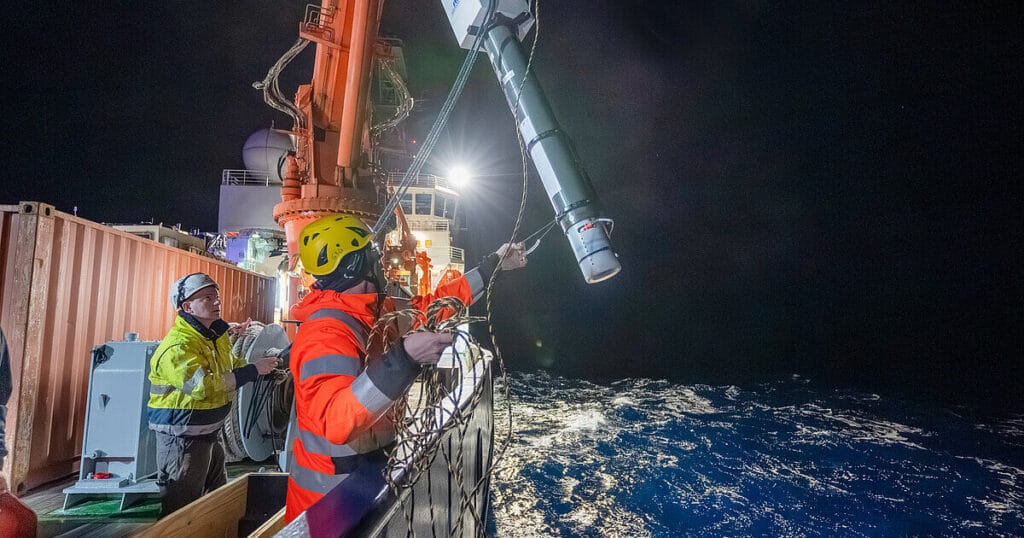
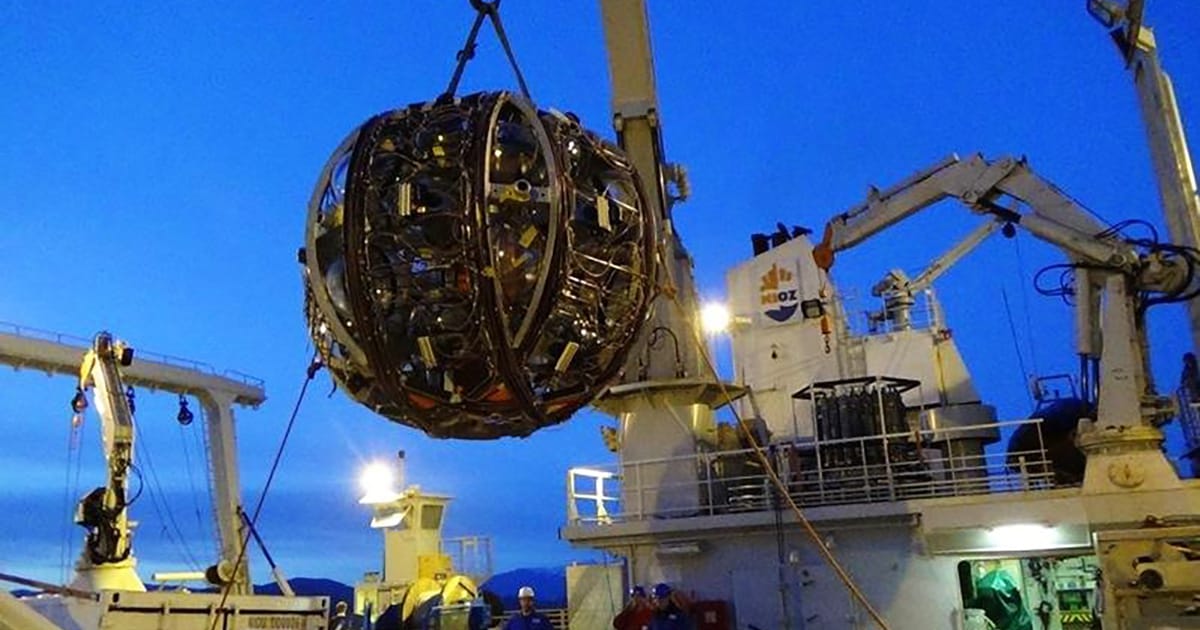
NIOZ researcher Hans van Haren has been involved in the project from the start. ‘Building a deep-sea neutrino detector, of course, requires oceanographic knowledge and expertise, and that is what we from NIOZ contribute,’ he explains. “For example, the influence of currents on the detector, or bioluminescent organisms in the deep sea that can almost ‘blind’ the detector. With the technicians from our NMF department, we developed a system to correctly lower the lines with the attached detectors into the water.” The detectors—a series of glass spheres on a ‘detection line’—are lowered in a launcher developed by NIOZ. Once at the bottom, the launcher rises, unwinding the line of detectors like a spool of thread.
Oceanographic Research as Part of KM3NeT
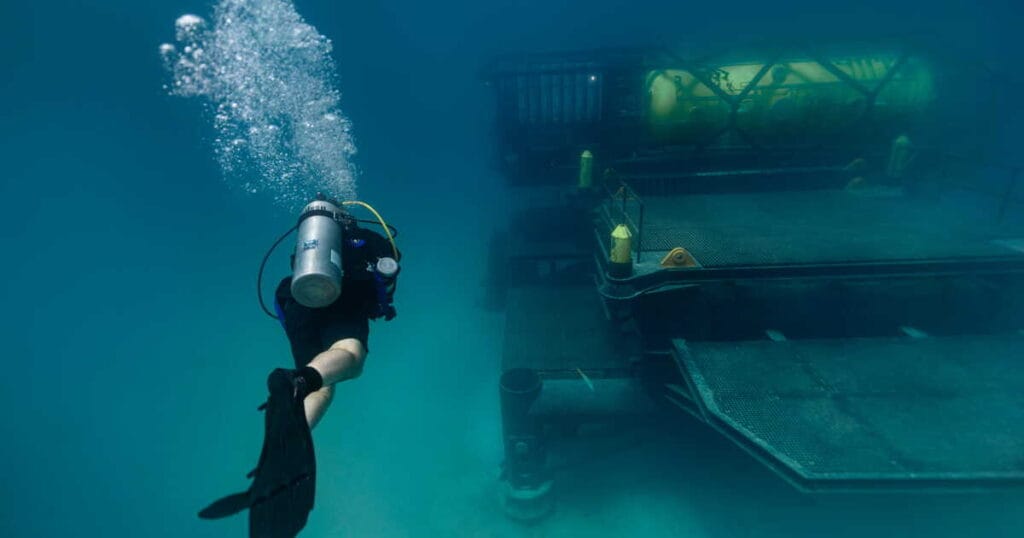
“The NIOZ worked with Nikhef to design and build the mechanical part, and all the prototype tests were carried out from the Pelagia,” said Van Haren. KM3NeT also offers opportunities for Van Haren’s own oceanographic research. “As part of KM3NeT, we were able to deploy a 3D network of 3,000 sensitive temperature sensors on the bottom of the Mediterranean Sea near the neutrino telescope. This allowed us to study three-dimensional processes of refracting internal waves and turbulent mixing in detail—something that, until now, was only measured in one direction.”
This measuring setup was raised again at the beginning of 2024, and Van Haren is now busy with the data analysis. “It is very nice to be able to collaborate with scientists from a completely different field of research and to be able to strengthen each other.”